Home · The Ordane Journal · Rules and mechanics · Prop Firm Copy Trading: Who May Copy Whom
Prop Firm Copy Trading: Who May Copy Whom
Prop firm copy trading is the mechanical replication of trading orders across simulated accounts. Ordane accounts operate on simulated capital. No live funds are traded and no deposits are accepted. Copying trades between accounts owned by the exact same verified person is usually permitted, while linking accounts of different individuals is strictly prohibited.
Proprietary trading firms operate complex risk models designed to evaluate individual trader performance rigorously. When a trader introduces a mechanical copier into this delicate ecosystem, it radically disrupts the baseline mathematical assumptions of that risk model. Firms must immediately determine if the copied trades represent a single trader efficiently managing their authorized allocation, or if the copied trades represent a distributed network transferring risk across multiple unconnected parties. This is exactly why the question of copy trading is never answered with a simple yes or no. The answer depends entirely on the flow of legal liability and account ownership.
The industry is saturated with promises of unlimited scaling and effortless portfolio management, but the reality is governed by strict, unforgiving contractual limits. Everyone promises. Ordane published the contract, the reserve, and the penalty. Traders search for a funded account every day, attempting to navigate a landscape filled with hidden clauses and subjective compliance decisions. When evaluating any prop firm copy trading rule, traders approach the terms with three profound fears.
- Do you actually pay? Traders worry that after meticulously following every rule, the firm will invent a reason to deny the withdrawal. At Ordane, every withdrawal request is approved, or denied in writing citing the exact rule breached by section number, within 24 clock hours. Past that deadline the request is treated as approved and the G-1 clock starts. A payout approved and not paid within 48 clock hours, not business hours, triggers automatic compensation: a 100 percent refund of the account fee, plus the payout owed in full. This mechanism is known as The Ordane Guarantee.
- What unwritten clause will take me down? Traders fear that a vague restriction on trading style will be weaponized against them. Ordane's prohibited-practice list is closed. Clause R-6 names six practices: latency, reverse or hedge arbitrage; high-frequency or bulk automated exploitation; copy trading between Ordane accounts; straddling news releases with paired opposing orders; platform or data-feed exploitation; and gap abuse. If a behavior is not listed in that section, it is not a violation. Discretion is not a rule.
- Will the firm still exist in twelve months? The industry is volatile, and firms close without warning. Ordane's payout reserve is published at a public TRON address on ordanemarkets.com and in Rulebook v1.0 clause PR-1. The page carries a dated observed balance and states that the reserve is not a promise, it is an address.
Ordane sells one product, the Ordane Instant Account: direct access, no evaluation phase and no challenge, on simulated capital. The fee is one-time: $59 for the $2,500 account, $139 for the $10,000 account, $299 for $25,000, $549 for $50,000 and $999 for $100,000. There are no recurring fees, no hidden tiers and no coupon games. The first withdrawal is available 7 calendar days after account activation, and the cycle thereafter is every 14 days. Ordane's profit split starts at 60 percent and rises 5 percentage points with every completed withdrawal, reaching 100 percent from the ninth withdrawal onward. Withdrawals #1 and #2 are each capped at 3 percent of initial balance. From withdrawal #3 onward there is no cap. Withdrawals reduce the account balance, and the R-1 drawdown floor stays anchored to the initial balance.
Is copy trading allowed on a prop firm account?
Copying trades between accounts you own yourself is usually allowed because the risk belongs to one person. Copying trades between accounts owned by different people is universally prohibited. Allowing a third party to log in and copy trades onto your account results in immediate termination.
Why the rulebook answers three questions, not one
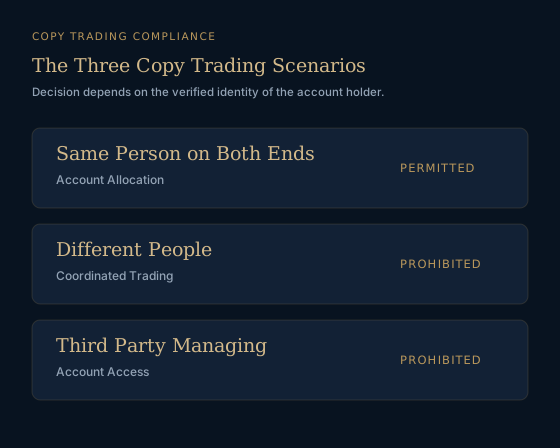
Proprietary trading firms do not evaluate the software executing the trade; they evaluate the risk profile generated by the trader. Therefore, a rulebook will never simply state that copy trading is allowed or banned globally. Instead, the legal framework divides the action into three distinct compliance tests that traders must pass.
- Account allocation and verifiable ownership: If you own both the source and the destination account, the total simulated capital remains under the direct control of a single verified individual. The firm can quantify exactly how much exposure you represent to their simulated liquidity.
- Coordinated market exposure: If you replicate trades with another individual, you are transferring risk and concentrating exposure across the firm's broader ecosystem, which directly violates the fundamental requirement for independent trading decisions.
- Unauthorized account access: The terms of service mandate unequivocally that the registered user must be the sole operator of the terminal at all times. If a third party connects a copier to your environment and manages the execution remotely, the account is compromised, regardless of the resulting trading profits or losses.
This article focuses specifically on how ownership and coordination dictate the rules for copying orders. Questions regarding expert advisors, automated bots, and algorithmic execution operate under entirely different frameworks. Those specific topics are explicitly out of scope for this analysis and are governed by separate automation and high-frequency trading policies, which traders must review independently before deployment.
Table 1: the three copy cases and the clause that governs each
The following table separates the three distinct scenarios that traders colloquially refer to as copy trading. It identifies the specific type of rulebook clause that governs each unique scenario and provides exact, verbatim language from active firm policies, complete with retrieval dates to ensure absolute accuracy. Reading a rulebook requires mapping your specific intended setup to the correct column in this matrix. If you misunderstand which clause applies to your software, you risk permanent account closure. The rules differentiate strictly by the verified identity of the account holders and the nature of the access, forming the absolute foundation of compliance enforcement across the industry.
| Account Holders | Clause Type | Firm Rule Wording | Retrieval Date |
|---|---|---|---|
| Same person on both ends | Account Allocation | Topstep (prop firm) documents a first-party trade copier that mirrors orders from one lead account to one or more follower accounts inside the same profile. (Topstep Help Center, retrieved 2026-08-10) | August 10, 2026 |
| Different people | Coordinated Trading | Universal prohibition on transferring risk across distinct users. | August 10, 2026 |
| Third party managing | Account Access | FTMO (prop firm) prohibits letting any third party access or use the account, and prohibits cooperating with a third party so that the third party trades for the account holder or in coordination with them. (FTMO, retrieved 2026-08-10) | August 10, 2026 |
Can you copy trades between two accounts you own yourself?
When a single trader manages a portfolio of multiple accounts, executing identical trades manually across each terminal is operationally inefficient and introduces severe execution risk. A delay of merely a few seconds between placing an order on the first account and the fourth account can result in drastically different entry prices during volatile market conditions. Recognizing this operational friction, many firms allow traders to use software to duplicate their own orders across their own accounts.
Why a firm may ship its own copier
The firm has already verified the identity of the trader comprehensively through the KYC process. The firm knows the absolute total simulated capital allocated to that specific trader. Because the ownership is strictly unified, the firm does not view this synchronization as a prohibited risk transfer. In fact, some operators facilitate this workflow directly to keep the execution inside their own controlled ecosystem. Topstep documents a first-party trade copier that mirrors orders from one lead account to one or more follower accounts inside the same profile. (Topstep Help Center, retrieved 2026-08-10)
Providing an internal tool ensures that the replication happens within the firm's secure infrastructure. It eliminates the need for external software that might introduce network latency, API errors, or unauthorized access vectors. The firm benefits from predictable, transparent order execution, and the trader benefits from seamless, instant synchronization. This internal solution serves as definitive proof that the mechanical act of copying orders is not inherently malicious or prohibited. The firm actively supports the practice when the boundaries of ownership are clear, verified, and contained strictly within a single user profile.
What the lead account drags down with it
Synchronizing accounts means synchronizing exposure, and traders often profoundly underestimate the cascading consequences of a single operational error. A trade copier does not isolate risk; it multiplies it aggressively across every connected balance. The convenience of executing a trade once and populating multiple accounts comes with a structural vulnerability known as shared fate.
If a sudden market movement, a miscalculated position size, or an unexpected macroeconomic news event triggers a daily loss limit on the master account, the replication software will have already transmitted those identical losing orders to every connected follower account. The execution is instantaneous, leaving absolutely no margin for human intervention or cancellation. In Topstep's copier, a loss-limit breach on the lead account flattens every follower account with it and stops further copying while the lead is locked out. (Topstep Help Center, retrieved 2026-08-10)
The sheer speed of the copier ensures that the breach is universally applied. Traders cannot rely on network delay to save the secondary accounts from the drawdown. The compliance mechanism treats the linked accounts as a single, unified risk entity during a severe drawdown event. This shared fate requires traders to adjust their risk parameters fundamentally before engaging a copier. A one percent risk on a master account becomes an aggregate one percent risk on every follower account simultaneously.
Ordane's maximum drawdown is 5 percent and static: account equity may never fall below 95 percent of the initial balance. The floor is fixed on day one, never trails upward, and a breach closes the account. The daily loss limit is 3 percent, measured against the balance at the start of the server day. A breach closes the account. When you copy trades, you duplicate the risk per trade across every balance. Maximum risk per trade is 1.5 percent of current balance and a stop-loss is mandatory at entry. Two maximum losses equal the daily limit, which is the design rather than an accident. If your copier duplicates a 1.5 percent risk trade onto three accounts, you are essentially committing 4.5 percent of your total simulated capital portfolio to a single market idea.
Furthermore, consistency rules apply to each account individually. Ordane's consistency rule is 20 percent: at the moment of a withdrawal request, no single trading day may account for more than 20 percent of the cycle's total profit. If a day exceeds 20 percent, the excess profit from that day is deferred to the next cycle. It is never confiscated, and the remainder of the cycle pays out normally. A massive, copied winning trade might trigger this 20 percent threshold on every connected account simultaneously, deferring the excess payout across your entire operation. The math of trading is unforgiving, and copying ensures that every mathematical consequence, both negative and positive, is applied globally to your capital.
Can you copy trades between two different people?
When orders move mechanically between accounts held by two different individuals, the compliance landscape changes entirely, shifting from an operational convenience to a severe regulatory violation. Firms design their risk models based on the strict statistical assumption of independent trading behavior across their client base.
Coordinated trading language
If hundreds of clients connect their accounts to a single signal provider or master account, the firm faces a massive, concentrated exposure to one specific strategy. To prevent this systemic risk, rulebooks include strict coordinated trading clauses. These clauses categorically prohibit acting in concert with others to execute identical trades. The prohibition applies universally, regardless of whether the coordination happens through an automated third-party copier, a private chat room, a discord server, or a paid signal service.
The rule targets the concentration of risk and the destruction of independent analysis, not the specific technology used to achieve the synchronization. When a firm detects identical entry times, instrument selections, lot sizing relative to account balance, and identical exit points across unrelated accounts, it immediately flags the behavior as coordinated trading. The detection algorithms are highly sensitive to these synchronized clusters and run continuously in the background. The burden of proof often falls on the traders to demonstrate absolute independence, which is mathematically impossible to defend if a copier is mechanically linking the accounts across different IP addresses and user profiles.
Opposite positions across connected accounts
Coordination between different people is not limited strictly to mirroring identical trades in the same direction. Some traders attempt to exploit firm rules by establishing networks of accounts taking opposing positions, hoping that one account will inevitably pass an evaluation phase or generate a payout while the other fails. Firms classify this as a severe, intentional violation of the simulated trading environment.
This distinction is critical for understanding the boundary of permitted behavior. Hedging within your own account is generally considered a standard risk management tool. However, hedging across accounts held by different people is an attempt to bypass market risk entirely and mathematically exploit the firm's payout structure. The compliance algorithms are designed specifically to detect these opposing structures by continuously analyzing trade times and execution patterns across the entire client base simultaneously. When a firm identifies a coordinated hedge between two distinct people, it terminates the accounts involved immediately because the behavior completely invalidates the premise of individual trading skill and risk management.
Letting a third party trade your account
Trading an account requires logging into a secure terminal, and logging in requires credentials that are strictly non-transferable under any circumstance. Firms issue these credentials to a specific individual only after a rigorous registration and identity verification process. Passing those credentials to someone else, or allowing software operated by someone else to execute trades on your behalf via an API connection, violates the foundational agreement of the service. You, and you alone, are the only person authorized to generate activity on your account.
FTMO prohibits letting any third party access or use the account, and prohibits cooperating with a third party so that the third party trades for the account holder or in coordination with them. (FTMO, retrieved 2026-08-10) This absolute rule exists because the firm evaluates your specific, individual trading data and risk management capabilities. If a third party is driving the performance, the data becomes entirely useless for the firm's risk modeling and performance tracking purposes.
The consequences for violating account access rules are absolute, immediate, and final. FTMO states that a breach of those rules may lead to removal of trades from the history, restricted platform access, disqualification, forfeiture of potential rewards, or termination of every agreement the trader holds with the firm. (FTMO, retrieved 2026-08-10) A managed account service, an account passing service, or a third-party copier fundamentally breaks the chain of verified identity. Even if the trades themselves are highly profitable, well-managed, and strictly within the established daily drawdown limits, the unauthorized access renders the entire account and all associated profits entirely invalid without any possibility of appeal.
What limit catches copiers without naming them?
Traders often fall into a false sense of security, assuming that if a rulebook does not explicitly mention the word copier in its prohibited list, they are entirely free to link an unlimited number of accounts. This assumption ignores the overarching structural limits that firms place on total aggregate exposure. Firms manage their maximum liability by rigidly capping the total simulated capital any one trader can control at any given time.
A cap on total capital across accounts
FTMO caps total capital allocation across all of a trader's accounts at 400,000 dollars per trader or per strategy, before any scaling. (FTMO, retrieved 2026-08-10) If you purchase four maximum-size accounts and successfully link them with a permitted trade copier, you might immediately hit or exceed this absolute ceiling. In this scenario, the software tool itself is not the violation; the aggregate capital allocation is the direct trigger for compliance action.
Firms enforce this limit strictly to prevent a single trader from generating disproportionate, concentrated risk within the ecosystem. Before configuring a multi-account setup and paying for external software, you must rigorously calculate your total intended allocation and verify it against the firm's published maximums to ensure you do not trigger an automatic suspension on day one.
Identical strategies detected across accounts
The capital allocation limit applies not just to a single identified trader, but broadly to a single strategy replicated across multiple accounts, even if those accounts are held by completely different people. This is the primary mechanism firms use to detect and definitively shut down commercial copy trading rings and large-scale signal services. If a signal provider broadcasts trades to fifty individual clients, the firm sees fifty distinct accounts executing the exact same strategy with identical parameters.
FTMO states it may suspend accounts when identically traded strategies are detected across multiple accounts and the combined fictitious capital exceeds the allocation limit. (FTMO, retrieved 2026-08-10) The enforcement of identical strategy limits requires sophisticated data architecture. Firms do not rely on manual review to find copiers; they utilize automated pattern recognition software that scans thousands of trades per second. The risk management system flags the identical timestamps, order types, and instrument parameters, groups the supposedly unrelated accounts together into a single risk cluster, and calculates their combined simulated capital dynamically. If that total running exposure exceeds the strategy cap, every account in the group faces immediate suspension pending a manual compliance investigation.
Furthermore, firms monitor heavily for aggressive, repetitive behavior designed specifically to exploit multiple accounts through rapid cycle trading. Topstep lists account stacking as a prohibited strategy: trading aggressively until one account hits its maximum loss limit, then switching to another account and repeating. (Topstep Help Center, retrieved 2026-08-10) Linking accounts to cycle through them rapidly in this manner will trigger these specific strategy prohibitions and result in permanent, unappealable bans. The compliance engine is completely indifferent to whether the trader intended to break the rule; it only measures the resulting data footprint. If the data footprint matches a prohibited pattern, the firm will execute the defined penalty without hesitation.
Table 2: what a copier changes about your risk, not just your rules
Connecting multiple accounts alters the fundamental mathematics of your trading operation. You are multiplying your market exposure, your upfront costs, and your potential maximum drawdown simultaneously. Traders must calculate the total aggregate risk explicitly before turning on a synchronization tool, as the financial mechanics scale linearly with every added account. The table below outlines a specific, verified scenario to demonstrate exactly how fees and risk multiply when copying across accounts within the permitted boundaries.
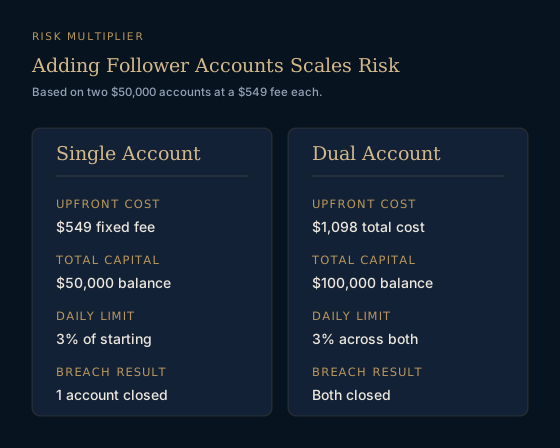
Declared inputs for this check: a $549 fee for a $50,000 account, a $549 fee for a second $50,000 account, and a $0 recurring fee. Worked arithmetic: $549 + $549 = $1098 total upfront cost.
| Risk Metric | Single Account Baseline | Dual Account Copied Portfolio |
|---|---|---|
| Upfront Capital Cost | $549 fixed fee | $1098 total upfront cost |
| Total Simulated Capital | $50,000 balance | $100,000 aggregated balance |
| Daily Loss Limit | 3 percent of starting balance | 3 percent across both accounts |
| Maximum Drawdown Floor | 5 percent static floor | 5 percent static floor on both |
| Execution Slippage Risk | Standard market conditions | Potential execution delay on follower |
| Breach Consequence | Single account closed | Both accounts closed simultaneously |
The arithmetic proves conclusively that copying does not dilute your risk; it aggregates it massively. Your total upfront cost doubles, and your exact mathematical exposure to a single bad market movement doubles. If a macroeconomic news event spikes the market against your position, the slippage on the follower account might be significantly worse than on the lead account due to execution latency, pushing the secondary account into a daily drawdown breach even faster.
How to verify a copy-trading rule before you pay, in six steps
Relying on forum advice, social media summaries, or outdated blog posts for compliance questions is a guaranteed path to a denied withdrawal. Rulebooks update frequently, and the specific clause you read last year might not exist in the current version of the contract. To secure your account and protect your capital, you must verify the exact language of the policy directly from the firm before processing any payment. Follow this rigorous six-step procedure to establish a definitive, verifiable answer regarding copy trading.
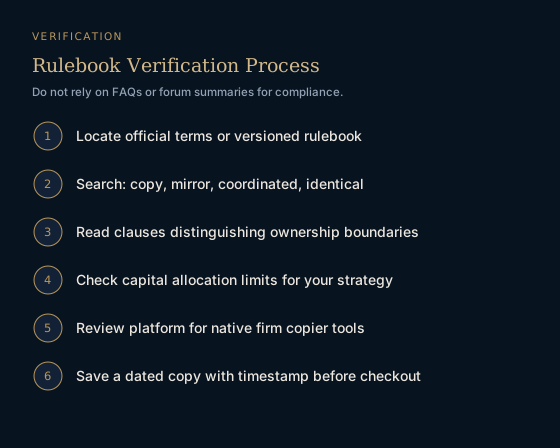
- Step 1: Locate the official terms and conditions document or the formal, versioned rulebook published directly on the firm's primary website. Do not rely on the FAQ page alone, as FAQs are marketing summaries intended for quick reading, not binding legal contracts that dictate compliance actions.
- Step 2: Use the search function within the document to look for specific critical keywords: copy, mirror, coordinated, third party, identical, and signal.
- Step 3: Read the clauses surrounding these keywords completely, paying extreme attention to whether the firm distinguishes between copying your own accounts and copying someone else's accounts. The context of the sentence is the entire rule.
- Step 4: Check the capital allocation limits to ensure your intended multi-account setup does not cross the maximum allowed simulated funding for a single trader or a single strategy.
- Step 5: Review the firm's trading platform settings and official documentation to see if they offer a native, built-in copier tool, which strongly indicates a permitted first-party solution.
- Step 6: Save a dated copy of the specific clause before you check out. Take a comprehensive screenshot that includes the full URL, the exact text of the rule, and the precise date and time on your system clock. If a compliance dispute arises later, you will need this incontrovertible evidence to prove exactly what the rulebook stated at the exact moment you purchased the account.
How Ordane draws the line on R-6(c)
The industry standard for operational clarity is publishing a definitive, exhaustive list of rules with no vague catch-all clauses that allow for retroactive punishment. The governing document is Ordane Rulebook v1.0, published July 23, 2026. The Ordane rulebook is public, numbered and versioned, and no rule is ever applied retroactively to an open account. Changes produce a new version with a dated changelog entry, and the version you sign up under is the version that governs your account.
Same person, both ends
Appendix A, entry A-3 (definitive August 9, 2026), defines R-6(c) as mirroring, copying, or mechanically linking orders across two or more Ordane accounts held by different people (different account holders or ultimate beneficial owners), so that one person's risk is transferred or duplicated onto another person's account. Copy trading is permitted exclusively between Ordane accounts that belong to the same person, meaning the same account holder and ultimate beneficial owner. Copy trading between person A and person B is always prohibited. (Ordane Rulebook v1.0, Appendix A, retrieved 2026-08-10)
This structural definition leaves absolutely no room for subjective interpretation by a compliance officer. The test for a violation is strictly and entirely based on the verified identity of the account holder on both sides of the copy connection.
Why the list being closed matters here
Traders constantly face profound anxiety about unwritten rules that are not explicitly documented in the contract. Firms historically invoke general, undefined phrases like unprofessional trading behavior or toxic order flow to justify closing accounts that use copiers successfully. Ordane operates on a fundamentally different, transparent principle. Ordane's prohibited-practice list is closed. Clause R-6 names six practices: latency, reverse or hedge arbitrage; high-frequency or bulk automated exploitation; copy trading between Ordane accounts; straddling news releases with paired opposing orders; platform or data-feed exploitation; and gap abuse. If a behavior is not listed in that section, it is not a violation. Discretion is not a rule. (Ordane Rulebook v1.0, Clause R-6, retrieved 2026-08-10)
Because the list is strictly closed, you do not have to guess whether an unwritten rule or a sudden change in management philosophy applies to your setup. If you are copying trades between two accounts that belong exclusively to you, and you are operating within the established limits, you are operating within the rules. The absolute clarity of a closed list protects the trader from retroactive interpretation and arbitrary denials. A breach closes the account. That is the whole consequence: no partial confiscations, no surprise fees, no renegotiation. If you do not breach the six items on the closed list, your trading stands.
Questions traders ask about prop firm copy trading
Does a copier itself breach anything?
The software executable or the compiled script of a trade copier does not typically breach a rulebook strictly on its own existence. The compliance violation occurs entirely based on what the software connects and who holds the legal rights to those connections. If the copier links your personal desktop terminal to your personal laptop terminal, and both are securely logged into accounts registered exclusively in your legal name, the software is merely functioning as an efficiency and execution tool. However, if the copier links your local terminal to an external master server managed by a third party, the software facilitates a direct access violation. The compliance department analyzes the origination source of the orders, the network footprint, and the legal ownership of the associated accounts, not the brand name, the developer, or the specific version number of the copier software being utilized.
Can I copy a signal service?
Copying a signal service automatically places you directly in the crosshairs of coordinated trading rules, representing one of the most common reasons for mass account terminations. A signal service broadcasts the exact same entry price, stop loss parameter, and take profit target to hundreds or thousands of distinct subscribers simultaneously. When those subscribers execute the trade, the firm's risk management dashboard detects a massive, unnatural cluster of identical orders originating from distinct, supposedly independent accounts. This immediately triggers the identical strategy limits and the strict prohibitions against acting in concert with others. Even if you manually type the trades into your terminal based on a text message alert without using automated software, the resulting execution footprint looks exactly like a mechanical copier to the compliance algorithms. Firms routinely suspend and terminate accounts that show this level of coordinated exposure, because it breaks the fundamental, independent risk model required to sustain the simulated environment.
Can two family members copy each other?
The legal rules governing identity, ownership, and contract execution are absolute, and they do not grant informal exceptions for family relations, spouses, or siblings. If a husband and a wife each independently hold an account registered in their own names and verified with their own KYC documents, they are legally recognized as two entirely different people under the terms of the contract. Copying trades between those two specific accounts constitutes copying between different people, which is a direct, undeniable violation of the standard copy trading clauses prohibiting coordinated risk transfer. The fact that the two individuals live in the same physical house, share a residential IP address, or utilize a joint bank account does not merge their legal identities for compliance purposes. The rule strictly requires the exact same account holder and the same ultimate beneficial owner. Two different names on the registration data mean two distinct legal entities, and mechanically linking their trading activity will result in the immediate closure of both accounts without recourse.
What is the penalty for copy trading between different people?
A breach closes the account. That is the whole consequence: no partial confiscations, no surprise fees, no renegotiation. If you copy trades between accounts owned by different individuals, you violate the coordinated trading and account access rules. The compliance engine flags the identical data footprint across the network, treats it as a critical violation of the simulated environment, and terminates all involved accounts immediately, voiding any simulated profits generated during the copied execution.
To verify exactly how these rules apply, read the Ordane Rulebook or compare account options for your strategy.
Sources
- Forbidden Trading Practices | FTMO ftmo.com Retrieved 2026-08-10.
- How many accounts can I have? | FTMO ftmo.com Retrieved 2026-08-10.
- TopstepX | Topstep Help Center help.topstep.com Retrieved 2026-08-10.
- Prohibited Trading Strategies at Topstep | Topstep Help Center help.topstep.com Retrieved 2026-08-10.
- Ordane Rulebook v1.0 ordanemarkets.com Retrieved 2026-08-10.