Home · The Ordane Journal · Rules and mechanics · Funded Engineer News Trading Rules Explained
Funded Engineer News Trading Rules Explained
A news trading restriction is a mathematical boundary enforced by a prop firm to prohibit the opening or closing of positions during high-impact macroeconomic data releases. Ordane accounts operate on simulated capital. No live funds are traded and no deposits are accepted.
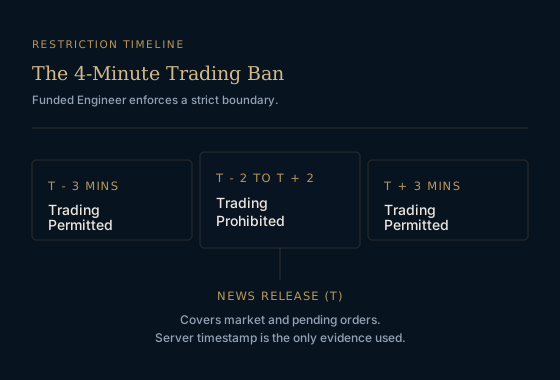
Funded Engineer (prop firm) enforces a strict restricted window for high-impact macroeconomic news releases. Traders are prohibited from opening or closing any positions two minutes before and two minutes after the scheduled event. Executing trades during this four-minute boundary results in profit deductions or a hard breach of the account.
Before examining the specific restrictions applied by this specific firm, we must clarify our own operational model. The general news trading rules discussed in this document apply specifically to Funded Engineer and their specific trading environment.
How Does the Funded Engineer News Trading Window Work?
Understanding the exact timing of news restrictions is a fundamental requirement for risk management. A trader who ignores the clock during a major economic release exposes their account to immediate penalties. The restriction is not a general suggestion to avoid volatility. It is a precise mathematical boundary enforced by the firm software.
Market participants often attempt to capture the rapid price movements that follow macroeconomic data releases. These releases include the Non-Farm Payrolls report, Consumer Price Index data, central bank interest rate decisions, and gross domestic product announcements. The sheer volume of automated orders entering the market creates extraordinary volatility. To mitigate the risk of severe negative balances caused by this volatility, many firms impose strict trading windows.
The enforcement relies on server timestamps. Every order sent to the market, whether an entry, a stop-loss modification, or a manual closure, is stamped with the exact millisecond it reaches the trading server. This timestamp is the sole piece of evidence used to determine compliance. A local computer clock that is thirty seconds slow will not protect an account from a breach if the server registers the execution inside the forbidden timeframe.
The 2-Minute Before and After Restriction
Funded Engineer enforces a restricted trading window for high-impact news, prohibiting the opening or closing of positions 2 minutes before and 2 minutes after the scheduled release. (Funded Engineer FAQ - News Trading Rules, retrieved 2026-09-05) This rule applies to all high-impact events listed on their designated economic calendar, requiring traders to maintain constant awareness of the global financial schedule.
The restriction covers both market execution and pending orders. If a trader has a buy limit or a sell stop that is triggered during this four-minute window, it constitutes a violation. Similarly, closing a position manually or having a stop-loss or take-profit triggered during this precise timeframe also falls under the prohibition. The software does not differentiate between an intentional market order and a pending order placed hours in advance.
Traders must account for the time difference between their local time zone and the server time used by the firm. A misalignment of even a few seconds can result in an accidental trade execution within the restricted window. The platform server time is the only clock that matters for compliance, making time synchronization a critical operational task for anyone holding positions near major events.
To illustrate the strict nature of this boundary, consider the total duration of the restriction.
Declared inputs for this check: a 2-minute restriction before the scheduled release (Funded Engineer FAQ - News Trading Rules, retrieved 2026-09-05), a 2-minute restriction after the release (Funded Engineer FAQ - News Trading Rules, retrieved 2026-09-05), and a 0-minute grace period. Worked arithmetic: 2 + 2 = 4 total restricted minutes.
| Event Timing | Action | Status under Funded Engineer Rules |
|---|---|---|
| 3 minutes before | Open a market buy order | Permitted |
| 1 minute before | Stop-loss triggered by spread widening | Violation |
| Exact release time | Pending order activated | Violation |
| 1 minute after | Close position manually | Violation |
| 3 minutes after | Open a market sell order | Permitted |
This 4-minute absolute restriction demands meticulous order management. Traders holding positions prior to the news must ensure their stop-loss orders are placed far enough away from the current price to avoid being triggered by the pre-release spread widening. If the spread widens and triggers the stop-loss one minute before the news, the trader has violated the rule, regardless of their intention.
Ordane approaches news trading differently. Ordane sells one product, the Ordane Instant Account: direct access, no evaluation phase and no challenge, on simulated capital. Ordane's rulebook does restrict one thing around news: clause R-6(d) prohibits straddling news releases with paired opposing orders. Because R-6 is a closed list, no other clause restricts trading during news or high-impact events.
The Impact on Swing Traders and Algorithmic Systems
Swing traders who hold positions for days or weeks face a specific challenge with these time-based restrictions. A swing position established on a Tuesday might remain open during a critical central bank announcement on a Thursday. To remain compliant, the swing trader must ensure that their take-profit or stop-loss orders are completely insulated from the price action during that specific four-minute window.
If a long-term position is closed by a sudden spike during the restricted period, the firm applies the penalty. The length of time the position was held provides no exemption.
Algorithmic traders utilizing Expert Advisors carry the burden of programming these restrictions directly into their code. An automated system must contain logic that pauses all trading activity, cancels all pending orders near the current price, and halts all position management routines exactly two minutes before the scheduled release. A failure in the code that allows an execution during the four minutes is a violation of the rule. The account holder is solely responsible for the actions of their software.
What Are the Penalties for News Trading Violations?
Failing to adhere to the trading window does not result in a simple warning. The firm employs a structured penalty system that targets the capital generated during the prohibited period and the status of the account itself. The enforcement is binary, automated, and executed without room for negotiation.
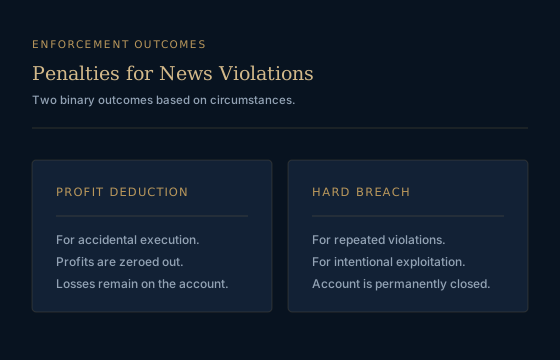
When a trader executes a transaction during the restricted window, the firm reviews the account history. The consequence depends on the specific circumstances of the infraction, as defined by the internal policy of the firm. Traders must understand the distinction between having profits removed and losing access to the platform entirely, as both outcomes severely impact the trading cycle.
| Penalty Type | Trigger | Consequence |
|---|---|---|
| Hard Breach | Repeated violations or intentional exploitation | Permanent account closure and loss of profits |
| Profit Deduction | Accidental execution during restricted window | Profits zeroed out, losses remain on account |
When Does a Violation Cause a Hard Breach?
Violating the news trading rule at Funded Engineer by executing trades within the restricted window may result in the deduction of profits from those trades or a hard breach of the account. (Funded Engineer Trading Rules, retrieved 2026-09-05) A hard breach means the account is permanently closed and access is revoked.
The firm does not provide a flexible interpretation of a hard breach. Once the account is closed, the trader loses all accumulated profits and the initial fee paid for the evaluation. There is no appeal process for a confirmed execution within the 4-minute window. The automated systems log the timestamp, and the administrative backend enforces the termination based on that irrefutable data point.
The severity of the penalty often correlates with the nature of the violation:
Repeated Violations: Multiple executions during restricted windows demonstrate a pattern of rule breaking. Firms view repeated infractions not as accidents, but as an inability to manage risk, which consistently leads to a hard breach. Intentional Exploitation: If the firm determines the trades were part of a deliberate strategy to exploit the news volatility, a hard breach is the immediate outcome. Strategies like high-frequency straddling or bracket orders placed exactly at the release time fall into this category. Significant Margin Utilization: Opening maximum lot size positions seconds before a release suggests a disregard for capital preservation. This reckless behavior often triggers an immediate hard breach, even on a first offense. Account Phase: Violations during an evaluation phase might be treated differently than violations on an active account, but a hard breach remains the maximum penalty across all stages.
A hard breach represents a total loss of the trading vehicle. The trader must purchase a new evaluation and begin the entire qualification process from the start.
How Profit Deductions Work
If the firm decides not to issue a hard breach, they will apply a targeted profit deduction. Any profits generated from trades executed within the restricted news window will be deducted, and repeated violations may lead to account termination. (Funded Engineer Trading Rules, retrieved 2026-09-05)
This deduction mechanism systematically removes the financial incentive for breaking the rule. If a trader opens a position one minute after the news release and captures a significant price movement, that profit is classified as invalid. The firm will manually or automatically subtract that specific profit amount from the total account balance. The record of the trade remains, but the financial gain is zeroed out.
However, the deduction only applies to profits. If the trade executed within the restricted window results in a loss, the loss remains permanently on the account. The trader absorbs the total negative impact of the violation, while any positive outcome is confiscated. This asymmetric risk profile transforms trading during the restricted window into an extreme mathematical disadvantage.
The deduction process frequently occurs during a payout review. Traders who assume they have successfully navigated a trading cycle may find their profits deducted at the final audit. If a deduction causes the total balance to fall below the required profit threshold for a payout, the request is denied. The trader must then return to the market and generate compliant profits to reach the threshold again.
Why Do Prop Firms Restrict High-Impact News Trading?
To understand the rigid enforcement of these rules, traders must examine the mechanics of the financial markets during a macroeconomic release. The restrictions are not arbitrary obstacles designed to frustrate participants. They are fundamental risk management protocols designed to protect the firm infrastructure from extreme, uncontrollable market conditions.
During a major news event, the architecture of the order book changes completely. Institutional liquidity providers withdraw their limit orders to avoid being caught on the wrong side of a sudden, unpredictable price spike. This massive withdrawal of liquidity creates a vacuum in the order book, fundamentally altering how trades are matched and executed.
CFTC Warnings on Execution and Volatility
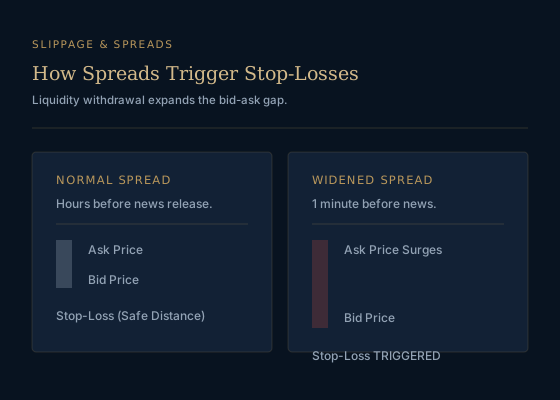
When liquidity vanishes, the spread between the bid and ask prices widens dramatically. A currency pair that normally features a spread of a fraction of a pip might suddenly exhibit a spread of twenty, fifty, or a hundred pips. This extreme widening occurs in milliseconds and persists until the market absorbs the new information.
The Commodity Futures Trading Commission (CFTC) warns that sudden market volatility, often triggered by economic news, can cause rapid price fluctuations and unexpected execution prices. (CFTC Customer Advisory: Understand the Risks of High Market Volatility, retrieved 2026-09-05) This regulatory observation highlights the core issue that forces firms to implement trading bans: execution certainty disappears entirely during news events.
Market execution orders placed during this time are subject to severe, unpredictable slippage. Slippage is the difference between the expected price of a trade at the moment the button is clicked and the actual price at which the trade is filled by the liquidity provider. Traders facing execution issues often wonder if prop firms manipulate trades, but in a highly volatile environment with thin liquidity, a stop-loss order designed to limit risk to one percent might suffer massive slippage and result in a five or ten percent loss.
Firms restrict news trading because they cannot mathematically model or control this slippage. If a trader experiences massive slippage on a simulated account, the firm absorbs the theoretical discrepancy. If this occurs on a large scale across thousands of accounts simultaneously, the internal risk model of the firm fails completely. By prohibiting trading during the most volatile minutes, the firm isolates its infrastructure from the unpredictability of a broken order book.
| Rule Component | Detail | Source |
|---|---|---|
| Restricted Window | Prohibits opening or closing positions 2 minutes before and 2 minutes after high-impact news | (Funded Engineer FAQ - News Trading Rules, retrieved 2026-09-05) |
| Penalty Type | Profit deduction or hard breach for executing trades within the window | (Funded Engineer Trading Rules, retrieved 2026-09-05) |
| Market Risk Factor | Rapid price fluctuations and unexpected execution prices caused by volatility | (CFTC Customer Advisory: Understand the Risks of High Market Volatility, retrieved 2026-09-05) |
The Challenge of Spread Widening and Stop Losses
The most common cause of accidental violations involves spread widening triggering a stop-loss. A trader may hold a position hours before a news release, confident that their stop-loss slippage buffer is placed at a safe distance from the current market price. However, they fail to account for the bid-ask spread expansion.
As the news release approaches, liquidity thins. One minute before the announcement, the spread might widen by thirty pips. If the trader has a sell position, the ask price surges upward to reflect the lack of liquidity. This surging ask price can trigger the stop-loss order exactly inside the restricted window, even though the actual bid price never moved near the level.
The firm records this as a trade closure within the two minutes prior to the news. The trader incurs the loss from the trade, and potentially faces a hard breach for violating the restriction. Managing this specific risk requires closing positions well in advance of the news or utilizing stop-losses that are mathematically outside any potential spread widening radius.
The mechanics of the financial markets dictate these strict parameters. Until liquidity providers guarantee fixed spreads and zero slippage during macroeconomic data releases, firms will continue to enforce these trading windows to ensure their own survival. Traders must adapt their strategies to operate flawlessly within these mathematical boundaries. Precision, discipline, and absolute adherence to the server clock are the only reliable methods for maintaining access to the trading infrastructure.
To understand how different prop firm models approach these restrictions, see how an instant account vs evaluation structure changes your risk profile, or read the full Ordane Rulebook to review our own terms.
Frequently Asked Questions
What is the Funded Engineer news trading rule?
Funded Engineer prohibits the opening or closing of positions two minutes before and two minutes after high-impact macroeconomic news releases. (Funded Engineer FAQ - News Trading Rules, retrieved 2026-09-05)
Does a news violation cause a hard breach at Funded Engineer?
Executing trades within the restricted window may result in the deduction of profits from those trades or a hard breach of the account. (Funded Engineer Trading Rules, retrieved 2026-09-05)
Are pending orders allowed during news releases at Funded Engineer?
No, the restriction covers both market execution and pending orders. If a pending order is triggered during the four-minute window, it constitutes a violation. (Funded Engineer FAQ - News Trading Rules, retrieved 2026-09-05)
Why do prop firms restrict news trading?
Sudden market volatility triggered by economic news can cause rapid price fluctuations and unexpected execution prices, exposing the firm to unmanageable slippage. (CFTC Customer Advisory: Understand the Risks of High Market Volatility, retrieved 2026-09-05)
Sources
- Funded Engineer FAQ - News Trading Rules fundedengineer.com Retrieved 2026-09-05T04:04:48Z.
- CFTC Customer Advisory: Understand the Risks of High Market Volatility cftc.gov Retrieved 2026-09-05T04:04:48Z.
- Funded Engineer Trading Rules fundedengineer.com Retrieved 2026-09-05T04:04:48Z.