Home · The Ordane Journal · Risk and Exposure · What Happens When You Breach a Prop Firm Account?
What Happens When You Breach a Prop Firm Account?
Ordane accounts operate on simulated capital. No live funds are traded and no deposits are accepted. Payouts depend on simulated performance under Rulebook v1.0; no level of performance is typical or assured.
Ordane sells one product, the Ordane Instant Account: direct access, no evaluation phase and no challenge, on simulated capital.
Appendix A, entry A-3 (definitive 2026-08-09), defines R-6(c) as mirroring, copying, or mechanically linking orders across two or more Ordane accounts held by different people (different account holders or ultimate beneficial owners), so that one person's risk is transferred or duplicated onto another person's account. Copy trading is permitted exclusively between Ordane accounts that belong to the same person, meaning the same account holder and ultimate beneficial owner. Copy trading between person A and person B is always prohibited.
Clause P-2 of the Ordane Rulebook v1.0 requires that declaration (retrieved 2026-07-25), and this page is information, not advice.
In one sentence: A prop firm breach is a rule violation that closes your trading account, force-closes open positions, forfeits unpaid profit, and leaves you with the choice to buy a new account or walk away.
The rest of this article is the detail behind that answer: what you keep, what you lose, which rules can actually breach you, and how one firm writes the aftermath down before you ever hit it. The rules that trigger a breach live in their own guides; this page owns what the breach does.
What is the short answer to a prop firm breach?
A breach is terminal for that account: it closes the account, force-closes every open position, and typically forfeits any profit still inside it. It is not a warning, not a pause you wait out, and not a setting you switch back. Words that sound close to breach carry different consequences, and they are separated below.
A 45-word definition, quotable as written
A prop firm breach is a rule violation that closes your trading account. Open positions are force-closed, evaluation progress is lost, and profit you have still not withdrawn is typically forfeited. The account itself is not recoverable: to continue trading, you buy a new one.
At Ordane, the aftermath is written down in advance. A breach closes the account. To trade again you purchase a new account under the rulebook version current at that time (Ordane, FAQ, retrieved 2026-07-25).
Breach vs reset vs closure, the words that get confused
These three get mixed up, and the difference decides whether your account survives the day.
| Term | What triggers it | What happens to the account | A rule violation? |
|---|---|---|---|
| Pause | Hitting the daily loss limit (Topstep) | Open positions flattened and pending orders cancelled, new trades stopped until the next session; the account stays eligible | No (Topstep Help Center, retrieved 2026-07-29) |
| Breach | The balance hitting the Maximum Loss Limit at any point in the day, including on unrealized profit and loss (Topstep) | The account is liquidated immediately and closed for good | Yes (Topstep Help Center, retrieved 2026-07-29) |
| Reset | Buying a fresh start after a breach | A new account begins with the clock at zero; the breached account is not restored | Not applicable, it follows a breach |
A breach is a violation that closes the account. At Topstep again, the Maximum Loss Limit, a threshold that trails the account's end-of-day balance rather than sitting fixed, is the hard line: if the balance hits it at any point in the trading day, including on unrealized profit and loss, the account is liquidated immediately (Topstep Help Center, retrieved 2026-07-29). The same threshold, crossed, is a different outcome.
A reset is buying a fresh start after a breach. It does not restore the account you broke. It is a new account with the clock back at zero.
The lesson for checking a firm before you pay: read each rule for its consequence, not just its number. A rule that pauses you is survivable. A rule that liquidates you ends the account.
What do you keep and what do you lose in a breach?
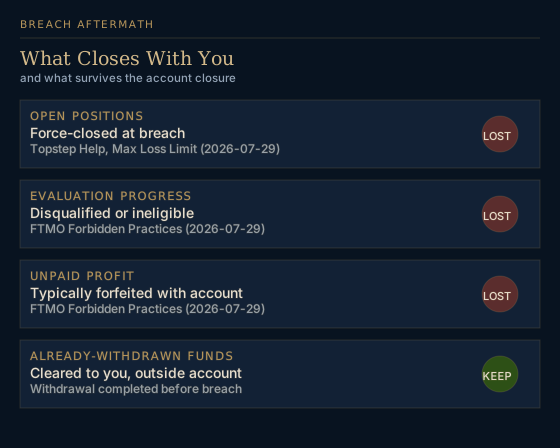
You keep withdrawals that have already cleared to you; you lose open positions, evaluation progress, unpaid profit, and the account fee. A breach sorts everything in the account into two piles: what leaves with the account, and what was already yours. The table below is drawn from the named firms' own documentation, and each row carries its own retrieval date.
| Line item | What a breach does | Where this is documented |
|---|---|---|
| Open positions | Force-closed at the moment of breach, including on unrealized profit and loss | Topstep Help Center, Maximum Loss Limit page (retrieved 2026-07-29) |
| Evaluation progress | Lost; the account is disqualified or made ineligible until reset | FTMO, Forbidden Trading Practices (retrieved 2026-07-29); Topstep Help Center, Maximum Loss Limit page (retrieved 2026-07-29) |
| Unpaid profit, earned but not withdrawn | Typically forfeited with the account | FTMO, Forbidden Trading Practices (retrieved 2026-07-29) |
| Already-paid withdrawals | Kept: a withdrawal that has cleared to you has already left the account, so it is not part of what the breach closes | Reasoning: a completed withdrawal is no longer in the account |
| The account fee | Spent; a one-time fee buys the account, not an outcome, and a breach does not refund it | Reasoning: the fee purchases access, not a result |
This is why paid withdrawals sit in the keep pile. A withdrawal that has already cleared to you is no longer part of the account, so a later breach does not reach back for it. The forfeiture applies to the balance still inside the account when it closed.
Which rules can actually breach a prop firm account?
Most breaches come from crossing the maximum drawdown or the daily loss limit. This page does not re-teach how each is measured, because each has its own guide. What matters here is that crossing either one closes the account.
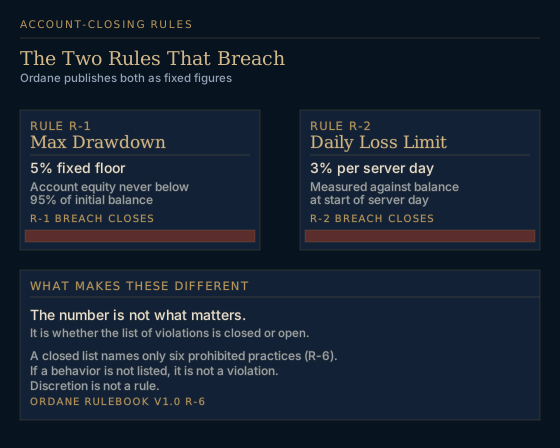
At Ordane both are published as fixed figures. Ordane's maximum drawdown is 5 percent and static: account equity may never fall below 95 percent of the initial balance. The floor is fixed on day one, never trails upward, and a breach closes the account (Ordane Rulebook v1.0, clause R-1, retrieved 2026-07-25). The daily loss limit is 3 percent, measured against the balance at the start of the server day, and a breach closes the account (Ordane Rulebook v1.0, clause R-2, retrieved 2026-07-25). Whether a floor is static or trails your balance changes how much room you actually have, a distinction covered in full in the guide on static versus trailing drawdown; how a daily limit is calculated, and where firms quietly differ, is worth checking against each firm's own published methodology.
How does Ordane handle a breach in its own words?
Ordane handles every breach the same way: it closes the account and does not restore it. The breach rule below applies to every account, because there is only the one.
The honest starting point: Ordane is new and has no payout history. There is nothing to show yet, and no payout history will be manufactured (Ordane, payout ledger, retrieved 2026-07-25). What can be checked today is not a track record but a written rule, published before the first account is sold.
Here is that rule, copied as it stands. A breach closes the account. To trade again you purchase a new account under the rulebook version current at that time (Ordane, FAQ, retrieved 2026-07-25). There is no discretionary step in between.
That path stays predictable because the prohibited-practice list is closed. Ordane's prohibited-practice list is closed. Clause R-6 names six practices: latency, reverse or hedge arbitrage; high-frequency or bulk automated exploitation; copy trading between Ordane accounts; straddling news releases with paired opposing orders; platform or data-feed exploitation; and gap abuse. If a behavior is not listed in that section, it is not a violation. Discretion is not a rule (Ordane Rulebook v1.0, clause R-6, retrieved 2026-07-25).
What Ordane can walk you through is the published Appendix A. Rulebook v1.0 states that each prohibited practice is defined with examples in Appendix A. Appendix A of Rulebook v1.0 is published (changelog dated 2026-08-01) and defines each R-6 practice with examples on the live rulebook (Ordane Rulebook v1.0, Appendix A). Read that appendix for worked examples; this article does not invent operational definitions beyond that text.
What are your options after a breach?
Once an account is closed, three real choices remain: buy a fresh account, walk away, or dispute the rule cited. Each depends on what the breach actually exposed.
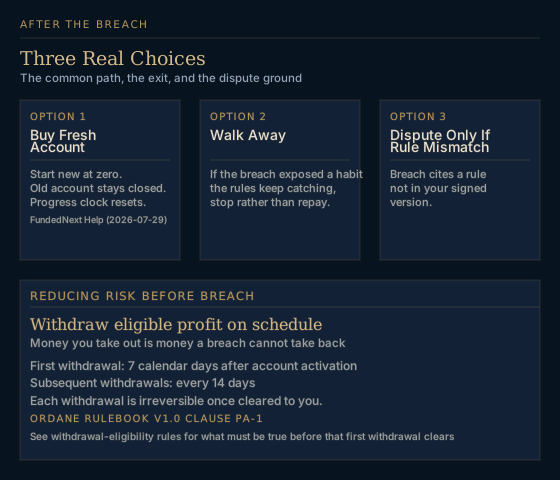
Buy a fresh account and start again. The common path. The old account stays closed; the new one begins at zero. At FundedNext, for example, a breached challenge account is not reopened as it was: a reset starts a fresh cycle before the account returns to active (FundedNext Help Center, retrieved 2026-07-29).
Walk away. If the breach exposed a habit the rules kept catching, the cheaper move can be to stop rather than re-buy the same test.
Dispute, but only on a specific ground. A dispute has weight when the breach cites a rule that was not in the version you agreed to. This is where a versioned rulebook, of the kind described above, decides the argument: the rule either appears in your version or it does not.
What questions do traders ask about a prop firm breach?
Traders usually ask whether the account can be recovered, what happens to profit and open trades, and whether they must buy again.
Can you get a breached prop firm account back?
No. A breached account stays closed. What firms call a reset is not a restore: it is a new account with the progress back at zero. FundedNext describes a breached account as one terminated for violating account rules, and resetting it starts a fresh cycle rather than reopening the old one (FundedNext Help Center, retrieved 2026-07-29).
Do you lose your profit if you breach?
You lose the profit still inside the account. FTMO states that a breach can bring forfeiture of any potential rewards (FTMO, retrieved 2026-07-29). Money you already withdrew has left the account, so the forfeiture reaches only the unwithdrawn balance. That is why withdrawing on schedule reduces what is at risk.
What happens to open trades when the account breaches?
They are force-closed at the moment of the breach, not when the trading day ends. Topstep's own help center states the account is liquidated immediately when the balance hits the Maximum Loss Limit at any point in the trading day, including on unrealized profit and loss (Topstep Help Center, retrieved 2026-07-29). You do not get to manage the positions down.
Do you have to buy a new account after a breach?
To continue trading, yes. The breached account is closed for good. At Ordane the rule is one line. A breach closes the account. To trade again you purchase a new account under the rulebook version current at that time (Ordane, FAQ, retrieved 2026-07-25).
Questions traders ask about a prop firm breach
Can you get a breached prop firm account back?
No. A breached account stays closed. What firms call a reset is not a restore: it is a new account with the progress back at zero. FundedNext describes a breached account as one terminated for violating account rules, and resetting it starts a fresh cycle rather than reopening the old one (FundedNext Help Center, retrieved 2026-07-29).
Do you lose your profit if you breach?
You lose the profit still inside the account. FTMO states that a breach can bring forfeiture of any potential rewards (FTMO, retrieved 2026-07-29). Money you already withdrew has left the account, so the forfeiture reaches only the unwithdrawn balance. That is why withdrawing on schedule reduces what is at risk.
What happens to open trades when the account breaches?
They are force-closed at the moment of the breach, not when the trading day ends. Topstep's own help center states the account is liquidated immediately when the balance hits the Maximum Loss Limit at any point in the trading day, including on unrealized profit and loss (Topstep Help Center, retrieved 2026-07-29). You do not get to manage the positions down.
Do you have to buy a new account after a breach?
To continue trading, yes. The breached account is closed for good. At Ordane the rule is one line. A breach closes the account. To trade again you purchase a new account under the rulebook version current at that time (Ordane, FAQ, retrieved 2026-07-25).
Sources
- Ordane Rulebook v1.0, clause P-2 (sentence 1); ordanemarkets.com site copy (sentence 2) Retrieved 2026-07-25.
- ordanemarkets.com, payout ledger section Retrieved 2026-07-25.
- Forbidden Trading Practices | FTMO.com Retrieved 2026-07-29.
- What do Active, Inactive, and Breached accounts mean in the FundedNext Dashboard? | FundedNext Help Center Retrieved 2026-07-29.
- What is the Daily Loss Limit and what happens if I exceed it? | Topstep Help Center Retrieved 2026-07-29.
- What is the Maximum Loss Limit? | Topstep Help Center Retrieved 2026-07-29.