Home · The Ordane Journal · Rules and mechanics · Topstep Weekend Holding Rules Explained
Topstep Weekend Holding Rules Explained
A weekend holding rule dictates whether a trader must close open positions before Friday market close to avoid penalties. Ordane accounts operate on simulated capital. No live funds are traded and no deposits are accepted. (Ordane Rulebook v1.0, clause P-2, retrieved 2026-09-05)
Topstep (prop firm) requires all positions to be closed by 3:10 PM CT every weekday, and its Friday schedule remains closed until Sunday at 5:00 PM CT (Topstep Help Center, retrieved 2026-09-08). Traders evaluating different firm rules often look for clarity on weekend holding penalties. Ordane sells one product, the Ordane Instant Account: direct access, no evaluation phase and no challenge, on simulated capital. (Ordane Rulebook v1.0, section 1, retrieved 2026-09-05) Every rule is documented and public.
Do You Pay Extra Fees for Weekend Holding?
Traders often ask if there is a specific monetary charge for holding a trade into the weekend. There is no separate invoice or holding fee applied to the balance. Instead, the consequence is structural. The firm enforces a strict operational timeline.
Before examining the weekend holding mechanics, traders must address the primary fear in this market: getting paid. A strict holding rule only matters if the firm honors withdrawal requests for successful trading. At Ordane, the payout timeline is written into the governing contract. Every withdrawal request is approved, or denied in writing citing the exact rule breached by section number, within 24 clock hours. Past that deadline the request is treated as approved and the G-1 clock starts.
This creates a verifiable timeline for every trader. A payout approved and not paid within 48 clock hours, not business hours, triggers automatic compensation: a 100 percent refund of the account fee, plus the payout owed in full. This enforcement is The Ordane Guarantee. Both G-2 exclusions (documented fraud or KYC review, and declared force majeure) are capped at 10 business days each. Past that deadline, G-1 applies regardless.
- The approval clock runs on 24 clock hours.
- The payment clock runs on 48 clock hours.
- The penalty for missing the deadline is a full fee refund plus the payout.
Returning to Topstep, its current Help Center describes automatic cancellation of open positions and pending orders at 3:10 PM CT. Risk managers begin flattening shortly before that time, but Topstep states that the trader remains responsible for being flat by the cutoff. The page does not state a separate weekend holding fee or automatic account termination.
What Is the Hidden Friday Cutoff Rule?
The cutoff time is specific to Topstep. It is not the exchange close. Topstep requires traders to be flat by 3:10 PM CT every weekday.
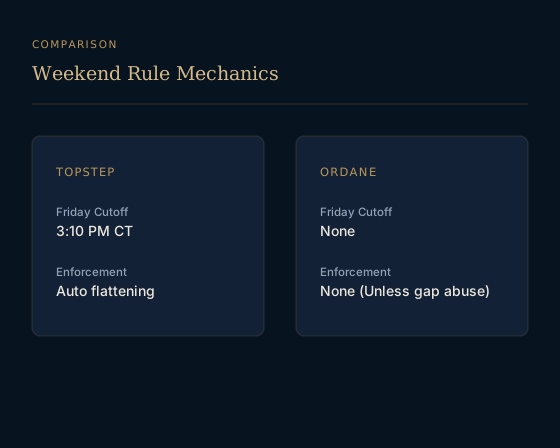
CME Group lists equity index futures trading hours as Sunday through Friday, 5:00 PM to 4:00 PM CT, with a daily halt from 4:00 PM to 5:00 PM CT (CME Group, retrieved 2026-09-08). Topstep applies its own earlier 3:10 PM CT cutoff and says Friday trading remains closed until Sunday at 5:00 PM CT.
Table 1 compares the weekend rules between the two models.
| Metric | Topstep Rule | Ordane Rule |
|---|---|---|
| Friday Cutoff | 3:10 PM CT | None |
| Weekend Holding | Prohibited | Allowed |
| Cutoff Enforcement | Automatic flattening | None (Unless gap abuse) |
| Rule Structure | Published daily cutoff | Closed list (R-6) |
Traders fear hidden rules that appear only when a withdrawal is requested. A firm that relies on discretion can classify ordinary trading as a violation. To remove this risk, the prohibited list must be finite. Ordane's prohibited-practice list is closed. Clause R-6 names six practices: latency, reverse or hedge arbitrage; high-frequency or bulk automated exploitation; copy trading between Ordane accounts; straddling news releases with paired opposing orders; platform or data-feed exploitation; and gap abuse. If a behavior is not listed in that section, it is not a violation. Discretion is not a rule.
Because the list is closed, the weekend policy is transparent. Overnight and weekend holding is allowed at Ordane. It is not on the R-6 closed list, and what is not listed is not a violation.
- Latency, reverse or hedge arbitrage.
- High-frequency or bulk automated exploitation.
- Copy trading between Ordane accounts.
- Straddling news releases with paired opposing orders.
- Platform or data-feed exploitation.
- Gap abuse.
Will Your Account Survive a Weekend Rule Violation?
The current Topstep Help Center describes automatic flattening at the cutoff. It does not say that a position open at 3:10 PM CT automatically terminates the account.
Topstep says risk managers begin flattening positions at 3:08 PM CT and that open positions and pending orders begin to cancel automatically at 3:10 PM CT. The trader is still responsible for being flat by the cutoff. The public page does not support inferring a mandatory account reset or replacement purchase from that event alone.
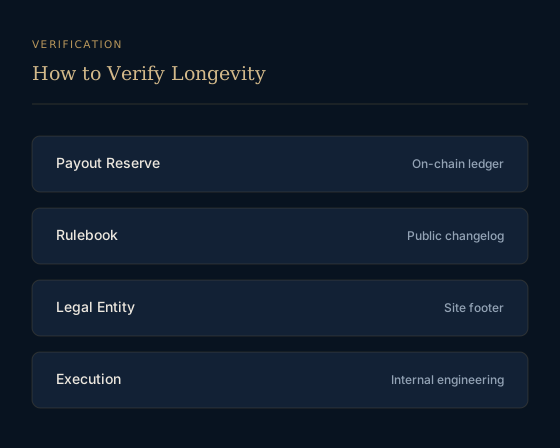
Beyond the cutoff mechanics, traders face the third fear: longevity. Will the firm exist long enough to process a payout? A sustainable model requires a capitalized reserve. Ordane's payout reserve is published at a public TRON address on ordanemarkets.com and in Rulebook v1.0 clause PR-1. The page carries a dated observed balance and states that the reserve is not a promise, it is an address.
Table 2 outlines the components of this verification.
| Longevity Component | Ordane Implementation | Verification Method |
|---|---|---|
| Payout Reserve | Public TRON address | On-chain ledger |
| Rulebook | Versioned v1.0 | Public changelog |
| Legal Entity | Ordane Markets Ltd | Site footer |
| Execution | Own trading platform | Internal engineering |
Ordane runs on a trading platform it designed and built with its own engineering team, and licenses no third-party terminal: not MatchTrader, not MetaTrader, not any external vendor. The distinction is structural, not cosmetic.
How Does This Compare With Ordane's Upfront Cost?
Topstep's current public rule does not list a separate weekend holding fee or say that flattening at the cutoff requires buying a new account. A direct replacement cost cannot be established from that source. Ordane publishes its own pricing so traders can compare the separate cost model.
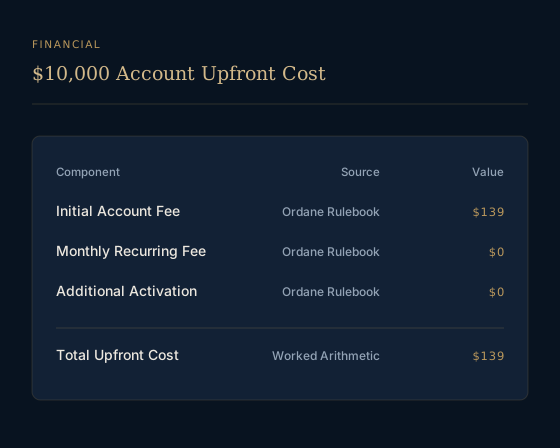
Ordane Instant Account comes in five sizes: $2,500, $10,000, $25,000, $50,000 and $100,000. The fee is one-time: $59 for the $2,500 account, $139 for the $10,000 account, $299 for $25,000, $549 for $50,000 and $999 for $100,000. There are no recurring fees, no hidden tiers and no coupon games.
To verify the exact capital requirement for a mid-tier account, we calculate the total upfront cost.
Declared inputs for this check: a $139 fee for the $10,000 account (Ordane Rulebook), a $0 recurring fee (Ordane Rulebook), and a $0 hidden tier cost (Ordane Rulebook). Worked arithmetic: $139 + $0 = $139 total upfront cost.
Table 3 details this calculation.
| Financial Component | Value | Source |
|---|---|---|
| Initial Account Fee | $139 | Ordane Rulebook |
| Monthly Recurring Fee | $0 | Ordane Rulebook |
| Additional Activation Fee | $0 | Ordane Rulebook |
| Total Upfront Cost | $139 | Worked Arithmetic |
Once trading begins, the limits are strictly mathematical. Ordane's maximum drawdown is 5 percent and static: account equity may never fall below 95 percent of the initial balance. The floor is fixed on day one, never trails upward, and a breach closes the account. The daily loss limit is 3 percent, measured against the balance at the start of the server day. A breach closes the account.
When a trader successfully navigates the market without being forced to close positions on Friday, the profit split determines the payout. Ordane's profit split starts at 60 percent and rises 5 percentage points with every completed withdrawal, reaching 100 percent from the ninth withdrawal onward. The split ladder is in writing and never resets.
To claim this split, the verification process must be simple. KYC happens once, at the first withdrawal request, not at purchase. There is no re-verification loop at every payout. The first withdrawal is available 7 calendar days after account activation, and the cycle thereafter is every 14 days.
Firms often use consistency rules to deny payouts if one trade generates too much profit. Ordane handles this mathematically. Ordane's consistency rule is 20 percent: at the moment of a withdrawal request, no single trading day may account for more than 20 percent of the cycle's total profit. If a day exceeds 20 percent, the excess profit from that day is deferred to the next cycle. It is never confiscated, and the remainder of the cycle pays out normally.
Traders looking to build a strategy without arbitrary Friday afternoon liquidations can read the Ordane Rulebook to verify the static drawdown, the transparent pricing, and the closed list of rules.
FAQ
What happens if you hold a trade over the weekend on Topstep?
Topstep requires all positions to be closed by 3:10 PM CT every weekday. Open positions and pending orders begin to cancel automatically at the cutoff (Topstep Help Center, retrieved 2026-09-08).
Does Ordane allow weekend holding?
Overnight and weekend holding is allowed at Ordane. It is not on the R-6 closed list, and what is not listed is not a violation.
What is the exact cutoff time for weekend holding on Topstep?
Positions must be closed by 3:10 PM CT on Friday. Topstep lists Friday trading as closed until Sunday at 5:00 PM CT (Topstep Help Center, retrieved 2026-09-08).
When does the CME Group officially halt trading for the weekend?
CME Group equity index futures trading halts at 4:00 PM CT on Friday and resumes at 5:00 PM CT on Sunday (CME Group, retrieved 2026-09-05).
Sources
- When and What Products Can I Trade? - Topstep Help Center help.topstep.com Retrieved 2026-09-08T16:25:38-03:00.
- S&P 500 and Nasdaq-100 Futures - CME Group cmegroup.com Retrieved 2026-09-08T16:25:38-03:00.