Home · The Ordane Journal · Rules and mechanics · Can You Use a VPS With a Prop Firm?
Can You Use a VPS With a Prop Firm?
A virtual private server (VPS) is a remote computer that allows traders to run algorithms and maintain stable platform connections. Ordane accounts operate on simulated capital. No live funds are traded and no deposits are accepted.
Most trading firms permit virtual private servers, but strict hidden rules regarding geolocation, dedicated IP addresses, and device ownership dictate whether your payouts are approved. Using an unauthorized shared connection or failing to provide pre-approval evidence can result in immediate account closure and forfeited profits.
Traders exploring remote server setups carry three primary concerns. The first is whether a technical violation will block a legitimate payout. The second is whether a buried clause regarding network sharing will trigger an automatic failure. The third is whether the firm will remain operational long enough to process the withdrawal.
To evaluate a remote connection strategy, you must first verify the exact security policies of the firm. You must document your connection setup, retain billing invoices for your server, and understand the technical limits of your platform.
Will using a VPS prevent you from getting a payout?
Using a remote server does not automatically prevent payouts, provided the connection adheres to the exact security policies of your chosen firm. While general use is widely accepted, connecting through shared public servers or locations outside your registered residence often triggers fraud detection and blocks withdrawals.
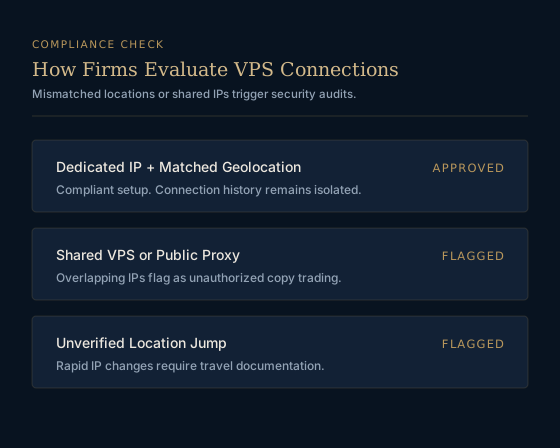
Every withdrawal request undergoes a stringent security review. The compliance department analyzes your login history, execution latency, and IP address consistency. If the system detects a mismatch between your registered address and your server location, the review stops. FTMO (prop firm) generally allows the use of VPNs and VPSs (FTMO, retrieved 2026-09-03). However, permission is rarely absolute across the industry.
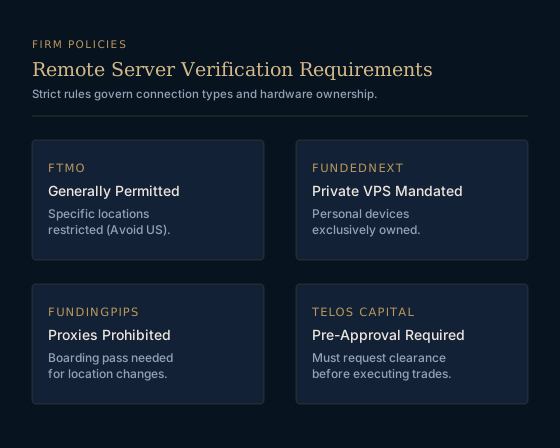
Many traders worry about whether they will actually receive their payout after passing an evaluation. The fear of passing and never getting paid is grounded in the reality of hidden network rules. Some operators require formal authorization before you place your first order. Telos Capital (prop firm) requires traders to obtain approval before trading through a VPS (Telos Capital, retrieved 2026-09-03). Failing to secure this permission turns a standard login into a compliance violation. The exact rule breached is cited, and the payout is denied.
The second major fear is discovering a hidden rule that takes you down at the exact moment you request a withdrawal. Firms demand transparency because automated trading environments are frequently used for prohibited practices. If you use a remote machine to mask your location or distribute trading signals, you violate the core agreement. The connection itself is a tool, but how you deploy it determines your standing.
The third fear is whether the firm will still exist in twelve months to honor its obligations. A firm that relies on aggressive technical denials to withhold funds signals internal instability. Transparency regarding network rules and reserve capitalization separates durable operators from temporary marketing campaigns.
Ordane sells one product, the Ordane Instant Account: direct access, no evaluation phase and no challenge, on simulated capital. Every withdrawal request is approved, or denied in writing citing the exact rule breached by section number, within 24 clock hours. Past that deadline the request is treated as approved and the G-1 clock starts. The governing document is Ordane Rulebook v1.0, published July 23, 2026. The Ordane rulebook is public, numbered and versioned, and no rule is ever applied retroactively to an open account. Changes produce a new version with a dated changelog entry, and the version you sign up under is the version that governs your account.
Ordane's prohibited-practice list is closed. Clause R-6 names six practices: latency, reverse or hedge arbitrage; high-frequency or bulk automated exploitation; copy trading between Ordane accounts; straddling news releases with paired opposing orders; platform or data-feed exploitation; and gap abuse. If a behavior is not listed in that section, it is not a violation. Discretion is not a rule. Ordane's Appendix A, entry A-1, names a normal hedge of a single Ordane position with a stop-loss under R-3, with no cross-feed exploit, as an example that does NOT close the account. Ordane's rulebook does restrict one thing around news: clause R-6(d) prohibits straddling news releases with paired opposing orders. Because R-6 is a closed list, no other clause restricts trading during news or high-impact events.
What hidden geolocation and device rules apply to remote servers?
Firms enforce precise geolocation boundaries and ownership proofs to verify trader identity. Logging in from restricted regions or changing IP addresses rapidly flags accounts for review. You must use a dedicated IP address and maintain proof of your physical location to ensure your connection complies with the standard rulebook.
Dedicated IP requirements
Compliance systems track the unique network identifier of every login. If multiple traders access their platforms from the exact same server IP, the system flags the activity as unauthorized copy trading. FundedNext (prop firm) recommends a private VPS with a dedicated IP address and completely prohibits sharing the VPS connection with others (FundedNext Help Center, retrieved 2026-09-03). A dedicated IP ensures your trading history remains isolated from other users.
Furthermore, the hardware itself matters. FundedNext requires trading activity to be conducted on personal devices exclusively owned by the trader (FundedNext Help Center, retrieved 2026-09-03). Renting a virtual machine means you control the environment, but you must ensure the network protocol does not route your traffic through a shared gateway. When a provider assigns you a static address, you establish a consistent geographical footprint that compliance teams can verify.
US geolocation restrictions
Firms restrict access from specific jurisdictions due to regulatory frameworks. If your remote server is hosted in a restricted country, your account appears to originate from that region, regardless of your actual residence. FTMO asks clients using VPNs or VPSs to avoid setting their geolocation to the United States when using MetaTrader, cTrader or TradingView (FTMO, retrieved 2026-09-03).
Selecting a server location requires matching the data center to your approved country of residence. If you reside in Europe but rent a server in New York for lower latency, the resulting IP address mismatch triggers a security audit. Administrators cross-reference your identification documents with your active network sessions.
Travel and location verification
When your connection history shows rapid geographical jumps, compliance departments require proof that you actually traveled. Logging in from London and then Tokyo within three hours is technically impossible without a network proxy. FundingPips (prop firm) may request a plane ticket or boarding pass to verify a trader's location after an unrealistic IP-location change (FundingPips, retrieved 2026-09-03).
If you cannot produce the required travel documentation, the firm concludes you shared your credentials or used an unauthorized proxy to mask your location. The resulting breach closes the account permanently. A breach closes the account. That is the whole consequence: no partial confiscations, no surprise fees, no renegotiation.
| Firm | Remote Server Policy | Verification Requirement |
|---|---|---|
| FTMO | Permitted, but specific locations restricted. | Avoid United States geolocation. |
| FundedNext | Private connection with dedicated IP mandated. | Personal devices exclusively owned by trader. |
| FundingPips | Access via proxy networks prohibited. | Plane ticket or boarding pass for location changes. |
| Telos Capital | Pre-approval required. | Request clearance before executing trades. |
Will your account be banned for using a shared VPS?
Accessing your trading platform through a shared network connection frequently results in immediate account termination. Firms prohibit shared virtual environments because overlapping IP addresses trigger automated systems designed to catch prohibited copy trading. Maintaining a private environment ensures your account remains secure and your trading data stays isolated.
Security risks of shared connections
Remote environments managed by third parties introduce severe data vulnerabilities. When you log into a platform on a machine you do not exclusively control, your credentials, trading history, and execution logic are exposed to the administrator. The SEC advises that accessing an online brokerage account from the user's own computer is generally safer than using another computer (SEC, retrieved 2026-09-03).
If a malicious actor intercepts your login tokens, they can execute unauthorized trades or attempt to withdraw funds. Furthermore, a compromised shared server can inject latency into your execution, artificially degrading your performance. Protecting your intellectual property requires absolute control over the operating system and the network interface. Every keystroke and data transmission on a public machine represents a potential security breach.
Account sharing violations
Many operators refuse to accept the risk of shared infrastructure entirely. Goat Funded Futures (prop firm) prohibits VPSs, cloud-hosted machines and other remote servers from accessing or trading an account (Goat Funded Futures FAQs, retrieved 2026-09-03). Similarly, FundingPips does not permit connecting to a VPN or VPS while accessing a trading account (FundingPips, retrieved 2026-09-03).
When multiple users share a server, their orders route through a single node. The firm's risk engine interprets this as a coordinated trading ring. Ordane's Appendix A, entry A-3 (definitive August 9, 2026), defines R-6(c) as mirroring, copying, or mechanically linking orders across two or more Ordane accounts held by different people (different account holders or ultimate beneficial owners), so that one person's risk is transferred or duplicated onto another person's account. Copy trading is permitted exclusively between Ordane accounts that belong to the same person, meaning the same account holder and ultimate beneficial owner. Copy trading between person A and person B is always prohibited.
Are there extra costs for a compliant trading VPS?
Maintaining a compliant remote setup adds fixed monthly expenses to your trading operations. Free or shared hosting tiers rarely provide the dedicated IP addresses required by compliance departments. You must purchase premium private hosting and retain the billing invoices to prove you exclusively control the connection.
Firms do not subsidize your technical infrastructure. If you require a remote machine for algorithmic execution or latency reduction, you negotiate and pay the hosting provider directly. The hardware specifications, bandwidth limits, and data center locations dictate the final price.
Top One Futures (prop firm) requires a VPS service invoice containing the VPS IP address as evidence that the service is legitimate (Top One Futures Help Center, retrieved 2026-09-03). This documentation proves that the environment is yours and not a shared proxy used to conceal your identity. You must ensure the billing details on the invoice match the personal information registered on your trading profile.
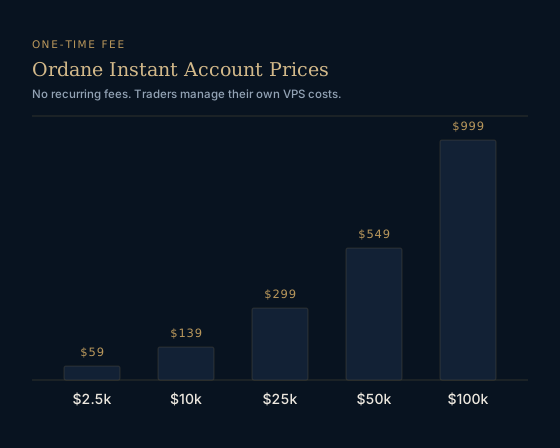
The fee is one-time: $59 for the $2,500 account, $139 for the $10,000 account, $299 for $25,000, $549 for $50,000 and $999 for $100,000. There are no recurring fees, no hidden tiers and no coupon games.
If you add a dedicated server to your operation, you assume that additional financial obligation. A payout approved and not paid within 48 clock hours, not business hours, triggers automatic compensation: a 100 percent refund of the account fee, plus the payout owed in full. This mechanism is called The Ordane Guarantee. Both G-2 exclusions (documented fraud or KYC review, and declared force majeure) are capped at 10 business days each. Past that deadline, G-1 applies regardless.
Ordane charges no commission, no spread and no swap. The account fee is the only cost the trader pays. The reason is structural, not promotional: accounts run on simulated capital, so no order is routed to an exchange and nothing is financed overnight, which means neither line has an underlying bill behind it. Payouts are paid in real money from company fee revenue. No client deposits are taken and no client capital is traded. Rulebook v1.0 clause PR-1 commits Ordane to publish the payout reserve on-chain; the live rulebook and homepage publish the TRON address.
Frequently Asked Questions about Prop Firm VPS Rules
Review these technical definitions and policy clarifications to ensure your network setup remains fully compliant. Understanding the strict distinction between private servers and prohibited proxy networks helps you preserve your trading history, protect your data, and secure your approved withdrawals without triggering automated security audits.
What is a prop firm VPS?
A virtual private server is a remote computer housed in a data center, running continuously to execute trading algorithms or maintain stable connections to market data servers. Traders rent these machines to reduce execution latency, bypass local hardware limitations, and keep automated strategies running independently of their personal computers.
Do prop firms allow VPS?
Most firms permit remote environments, provided the setup uses a dedicated IP address and does not mask the user's true geographical location. FTMO generally allows the use of VPNs and VPSs (FTMO, retrieved 2026-09-03). However, strict exceptions exist. Goat Funded Futures prohibits VPSs, cloud-hosted machines and other remote servers from accessing or trading an account (Goat Funded Futures FAQs, retrieved 2026-09-03).
How to choose a VPS for prop firm?
Select a provider that issues a static, dedicated IP address exclusively assigned to your machine. Ensure the data center is located in a jurisdiction that aligns with your registered residence, and verify that the provider issues a detailed invoice. Top One Futures requires a VPS service invoice containing the VPS IP address as evidence that the service is legitimate (Top One Futures Help Center, retrieved 2026-09-03).
What are prop firm remote server rules?
Rules mandate that the trader maintains exclusive ownership of the hardware or virtual instance. FundedNext requires trading activity to be conducted on personal devices exclusively owned by the trader (FundedNext Help Center, retrieved 2026-09-03). Furthermore, traders must not use these servers to artificially alter their geolocation or bypass restricted country filters.
Can I use VPS for prop firm trading?
You can use a remote server if you secure any required pre-approvals, document your network configuration, and avoid shared hosting environments. Telos Capital requires traders to obtain approval before trading through a VPS (Telos Capital, retrieved 2026-09-03). Always verify your specific firm's rulebook, as connecting through a restricted network architecture can result in immediate account termination. To see the exact execution policies we enforce, verify the Ordane Rulebook.
Ordane's maximum drawdown is 5 percent and static: account equity may never fall below 95 percent of the initial balance. The floor is fixed on day one, never trails upward, and a breach closes the account. The daily loss limit is 3 percent, measured against the balance at the start of the server day. A breach closes the account. Maximum risk per trade is 1.5 percent of current balance and a stop-loss is mandatory at entry. Two maximum losses equal the daily limit, which is the design rather than an accident.
Expert Advisors are fully permitted at Ordane: a trader may run an EA executing the trader's own strategy on an Ordane account. Appendix A of Rulebook v1.0 is published (changelog entry dated August 1, 2026) and defines each R-6 practice with examples. A-2 states that R-6(b) does not ban all automation, only bulk or high-frequency exploitation: a single expert advisor or script placing discretionary or rules-based trades at human-scale frequency, with a stop-loss on every position under R-3, is the example that does NOT close the account.
The first withdrawal is available 7 calendar days after account activation, and the cycle thereafter is every 14 days. Ordane's profit split starts at 60 percent and rises 5 percentage points with every completed withdrawal, reaching 100 percent from the ninth withdrawal onward. Declared inputs for this check: 60, 5, and 65. Worked arithmetic: 60 + 5 = 65. The split ladder is in writing and never resets. Withdrawals #1 and #2 are each capped at 3 percent of initial balance. From withdrawal #3 onward there is no cap. Withdrawals reduce the account balance, and the R-1 drawdown floor stays anchored to the initial balance.
Rulebook v1.0 commits Ordane to a dated payout ledger from payout number one, and to payout performance metrics published with dates on a fixed monthly schedule. As of July 25, 2026 the ledger is empty, because no payout has happened yet. Ordane is new. Its live homepage says it will not fake a history; the rulebook says payout performance metrics begin with the first month in which a payout is requested. Rulebook v1.0 clause PR-3 commits Ordane to independent third-party attestation of payout records, entering effect per the public roadmap milestone.
Accounts with no trading activity for 30 consecutive days are closed. The 30 consecutive days in clause R-5 are calendar days, not business days. Under clause R-5, trading activity means at least one filled order. Pending orders and platform logins do not count.
Sources
- Can I travel or use VPN/VPS? | FTMO ftmo.com Retrieved 2026-09-03.
- Can I use a VPN or VPS? | FundedNext Help Center help.fundednext.com Retrieved 2026-09-03.
- FundedNext Trading Device and Network Policy | FundedNext Help Center help.fundednext.com Retrieved 2026-09-03.
- Can I use a VPS? | Goat Funded Futures FAQs help.goatfundedfutures.com Retrieved 2026-09-03.
- Are There IP Address Restrictions? | Top One Futures Help Center help.toponefutures.com Retrieved 2026-09-03.
- Trading Conduct and Security Standards | FundingPips help.fundingpips.com Retrieved 2026-09-03.
- Terms & Conditions | Telos Capital telostraders.com Retrieved 2026-09-03.
- Online Brokerage Accounts: What You Can Do to Safeguard Your Money and Your Personal Information | SEC sec.gov Retrieved 2026-09-03.