Home · The Ordane Journal · Rules and mechanics · Every Clock Running on a Prop Firm Account
Every Clock Running on a Prop Firm Account

A prop firm account clock is a rule-based timer whose starting event, calendar, reset condition, and consequence must be checked independently. Several of these clocks can run on the same account at once, for trading days, loss recalculation, payout eligibility, billing and inactivity, each governed by its own document.
Ordane accounts operate on simulated capital. No live funds are traded and no deposits are accepted. (Ordane Rulebook v1.0, clause P-2, retrieved 2026-08-28)
Ordane sells one product, the Ordane Instant Account: direct access, no evaluation phase and no challenge, on simulated capital. (Ordane Rulebook v1.0, section 1, retrieved 2026-08-28)
Start with the event that begins payout eligibility. Then identify the rules that can close the account while the trader waits. Billing, inactivity, risk calculations, and payout processing may continue on separate calendars.
How many clocks can run on a prop firm account?
Five clocks commonly require separate verification:
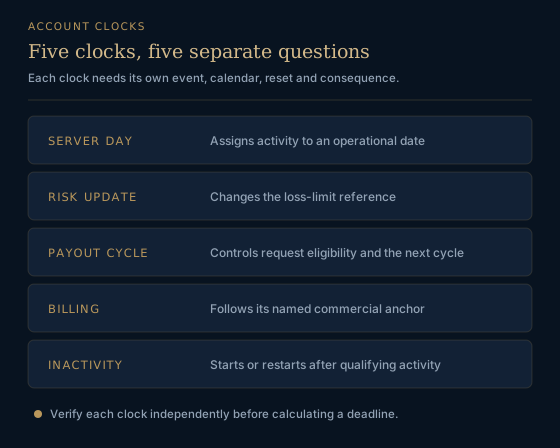
- The server trading day assigns activity to an operational date.
- The loss-limit recalculation boundary determines when a risk reference updates.
- The payout cycle determines when a request becomes eligible and how a request affects the next cycle.
- The billing cycle determines when another charge is attempted.
- The inactivity timer determines how long an account can remain without qualifying activity.
The supplied evidence does not establish a universal time zone or starting event for these clocks. Each contract must name its own event, calendar, cutoff, and consequence.
Clock 1: server trading day
The server trading day assigns trades to the firm’s operational date. That date may differ from the date displayed locally. The supplied ledger does not establish a named server-day boundary or time zone, so neither should be inferred.
Record the named time zone, rollover timestamp, governing rule version, and the event that assigns a trade to a particular day. Separately verify how a firm recognizes a counted trading day, because activity requirements may use a different definition.
Clock 2: loss-limit recalculation
Topstep (prop firm) states that its Maximum Loss Limit updates at the end of each trading day while remaining monitored in real time throughout the session. (Topstep, retrieved 2026-08-28)
The trading day and the recalculation event answer different questions. One assigns activity to a date. The other determines when a risk reference changes. The supplied evidence does not establish that every firm uses the same boundary for both. The separate comparison of fixed and moving loss floors shows why the update mechanism also matters.
Clock 3: payout cycle
A payout cycle may begin at activation, a first qualifying trade, or another contractually defined event. The starting event cannot be inferred from the phrase payout cycle alone. A separate check should establish the activation anchor and repeating withdrawal interval.
At Topstep, the trading day on which a payout is requested is excluded from the winning-day count for the next payout cycle. (Topstep, retrieved 2026-08-28)
That rule establishes a boundary for the next cycle. It does not establish when the first cycle began, what time zone assigns the request to a trading day, or whether another firm follows the same method.
Clock 4: recurring billing
A Topstep Trading Combine initially rebills every 30 days from its original signup date. (Topstep, retrieved 2026-08-28)
Applying a Trading Combine reset moves the rebill date to 30 days after the reset purchase date. (Topstep, retrieved 2026-08-28)
Billing is therefore anchored to a commercial event rather than to completion of a trading objective. An evaluation can have no completion deadline while charges continue, so compare the evaluation deadline with the subscription rebill.
Declared inputs for this check: signup position day 1, a 30-day billing interval, and rebill position day 31. Worked arithmetic: 1 + 30 = 31. The arithmetic shows the interval conversion, while the governing source determines the actual timestamp and counting convention. (Topstep, retrieved 2026-08-28)
The billing anchor is only one cost question. Before purchase, inspect charges that continue beyond the advertised ticket price.
Clock 5: inactivity
For OANDA Prop Trader (trading challenge provider), the inactivity period starts on the challenge purchase date and restarts on each date with trading activity. (OANDA Legal, retrieved 2026-08-28)
The supplied claim establishes the start and reset events. It does not establish the inactivity window’s length, governing time zone, precise definition of activity, or expiry consequence.
For the Ordane Instant Account, accounts with no trading activity for 30 consecutive days are closed. (Ordane Rulebook v1.0, clause R-5, retrieved 2026-08-28)
The 30 consecutive days in clause R-5 are calendar days (dias corridos), not business days. Under clause R-5, trading activity means at least one filled order. Pending orders and platform logins do not count. (Ordane Rulebook v1.0, clause R-5, retrieved 2026-08-28)
Why should none of the clocks be assumed to start at checkout?
Checkout is a commercial label, not a universal clock event. A rule may instead name purchase, activation, signup, a qualifying trade, a payout request, or a reset purchase.
OANDA Prop Trader expressly uses the challenge purchase date as the initial trigger for its sourced inactivity rule. (OANDA Legal, retrieved 2026-08-28)
Topstep uses the original signup date for the Trading Combine’s initial 30-day rebilling interval. (Topstep, retrieved 2026-08-28)
These facts support two specific rules. They do not prove that payout eligibility, a server trading day, or a loss calculation begins at the same moment.
Before paying, record:
- Server trading day begins at:
- Loss-limit recalculation occurs at:
- Payout eligibility begins at:
- Billing interval begins at:
- Inactivity begins or restarts at:
For each line, preserve the event, timestamp, time zone, calendar type, rule version, and consequence. A broader five-check contract audit can place those clock terms beside the firm’s payout, company, and rule-change evidence.
What evidence should be preserved for each clock?
| Record | Timestamp to preserve | Question answered |
|---|---|---|
| Purchase | Completed purchase date and time | Did a commercial or inactivity rule begin here? |
| Activation | Account activation date and time | Did payout eligibility or another operational rule begin here? |
| First qualifying trade | Timestamp recognized by the firm | Did this start eligibility or satisfy an activity requirement? |
| Payout request | Date and time assigned by the firm | Does this day affect the current or next cycle? |
| Reset purchase | Reset transaction date and time | Did the billing anchor move? |
This is a recording framework. It does not claim that every firm uses every event.
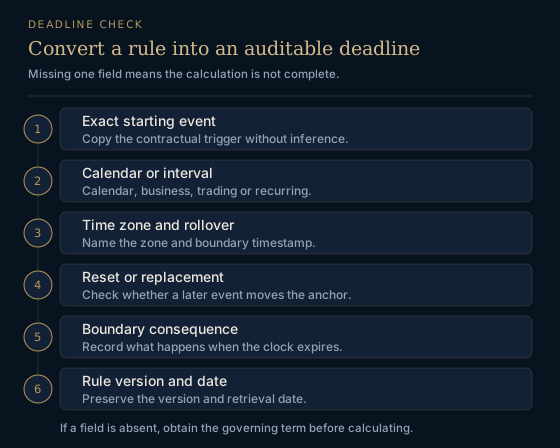
Decision tree for converting a rule into a deadline
- Identify the exact event named in the rule.
- Identify whether the rule uses calendar days, business days, trading days, or a recurring interval.
- Identify the governing time zone and rollover timestamp.
- Check whether another event resets or replaces the original anchor.
- Record the consequence at the boundary.
- Preserve the rule version and retrieval date with the calculation.
If any field is missing, the clock is not yet auditable. Obtain the missing term from the governing rule or a dated written answer instead of filling it from memory.
How do the five clocks compare?
| Clock and source | Named start or update event | Calendar or interval | Verified boundary effect |
|---|---|---|---|
| Server trading day | Not established by the supplied ledger | Not established | Assigns activity to an operational date |
| Topstep Maximum Loss Limit | End of each trading day | Trading-day cycle | Limit updates while monitoring continues during the session (Topstep, retrieved 2026-08-28) |
| Topstep next payout cycle | Trading day of the payout request | Winning-day count | Request day is excluded from the next cycle’s winning-day count (Topstep, retrieved 2026-08-28) |
| Topstep Trading Combine billing | Original signup date, or reset purchase date after a reset | 30-day interval | Subscription rebills from the applicable anchor (Topstep, retrieved 2026-08-28; Topstep Reset, retrieved 2026-08-28) |
| OANDA Prop Trader inactivity | Challenge purchase date, then each date with trading activity | Length not established by the supplied claim | Activity restarts the inactivity period (OANDA Legal, retrieved 2026-08-28) |
These rows do not describe one combined product. One firm’s payout boundary cannot supply another firm’s billing interval, inactivity duration, or time zone.
What happens when a rule counts days but omits the clock?
A sourced statement can be accurate while remaining incomplete for deadline conversion.
Topstep’s billing rule names a 30-day interval and original signup date, but the supplied claim does not name a time zone. (Topstep, retrieved 2026-08-28)
Topstep’s payout rule explains how the request day affects the next cycle, but the supplied claim does not identify the zone assigning the request to a trading day. (Topstep, retrieved 2026-08-28)
OANDA Prop Trader identifies purchase and trading-activity dates, but the supplied claim does not state the duration or time zone. (OANDA Legal, retrieved 2026-08-28)
Ask support this exact question:
If the answer says server time, request the named zone. If it says trading day, request the event that creates that day. If it says 30 days, request whether the count uses calendar, business, or qualifying trading days.
When does each clock start on an Ordane Instant Account?
The governing document is Ordane Rulebook v1.0, published 2026-07-23. (Ordane Rulebook v1.0, section 6, retrieved 2026-08-28)
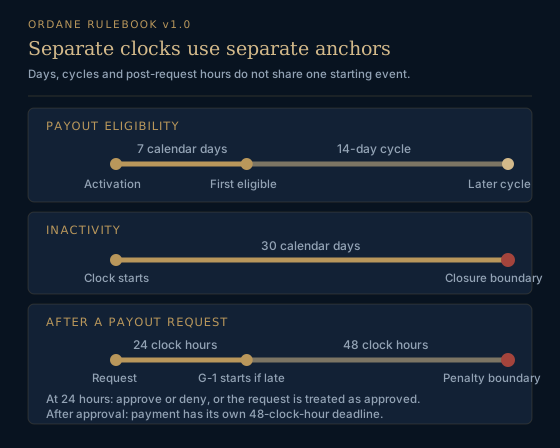
The first withdrawal is available seven calendar days after account activation. Later cycles run every 14 days. (Ordane Rulebook v1.0, clause PA-1, retrieved 2026-08-28)
The 30 consecutive days in clause R-5 are calendar days (dias corridos), not business days. Under clause R-5, trading activity means at least one filled order. Pending orders and platform logins do not count. (Ordane Rulebook v1.0, clause R-5, retrieved 2026-08-28)
The fee is paid once: $59 for the $2,500 account, $139 for the $10,000 account, $299 for $25,000, $549 for $50,000, and $999 for $100,000. There are no recurring fees. (Ordane Rulebook v1.0, section 1, retrieved 2026-08-28)
A one-time fee removes recurring rebilling from the Ordane Instant Account. It does not remove the server day, risk limits, payout cycle, inactivity timer, or post-request deadlines.
Ordane’s profit split starts at 60 percent and increases by five percentage points after every completed withdrawal, reaching 100 percent from the ninth withdrawal onward. (Ordane Rulebook v1.0, clause PA-2, retrieved 2026-08-28)
What clocks begin after an Ordane payout request?
Every withdrawal request must be approved or denied in writing, with the exact breached rule identified by section number, within 24 clock hours. After that deadline, the request is treated as approved and the G-1 clock begins. (Ordane Rulebook v1.0, clause G-0, retrieved 2026-08-28)
An approved payout not paid within 48 clock hours triggers a refund equal to 100 percent of the account fee while the payout remains owed in full. (Ordane Rulebook v1.0, clause G-1, retrieved 2026-08-28)
These post-request clocks begin from the request and approval events. They do not replace the PA-1 eligibility cycle. Compare eligibility, approval, and transfer timing rather than treating payout as one deadline.
Ordane is new. Its live homepage says it will not fake a history; the rulebook says payout performance metrics begin with the first month in which a payout is requested. (Ordane Rulebook v1.0, clause PR-2, retrieved 2026-08-28)
Sources
- Topstep: What Is the Maximum Loss Limit?, retrieved 2026-08-28.
- Topstep Payout Policy, retrieved 2026-08-28.
- Topstep Trading Combine Subscriptions, retrieved 2026-08-28.
- Topstep: What Is a Reset?, retrieved 2026-08-28.
- OANDA Legal: Rules for Trading Challenges, retrieved 2026-08-28.
Frequently asked questions
When does Topstep’s Maximum Loss Limit update?
Topstep states that the Maximum Loss Limit updates at the end of each trading day while remaining monitored in real time during the session. (Topstep, retrieved 2026-08-28)
Does a Topstep payout request day count toward the next payout cycle?
No. The trading day on which the payout is requested is excluded from the winning-day count for the next payout cycle. (Topstep, retrieved 2026-08-28)
What starts the Topstep Trading Combine rebilling clock?
The initial 30-day interval starts from the original signup date. A purchased reset moves the rebill anchor to the reset purchase date. (Topstep Subscriptions, retrieved 2026-08-28; Topstep Reset, retrieved 2026-08-28)
What restarts the OANDA Prop Trader inactivity period?
The period starts on the challenge purchase date and restarts on each date with trading activity. (OANDA Legal, retrieved 2026-08-28)
When is the first Ordane withdrawal available?
The first withdrawal is available seven calendar days after account activation. Later withdrawal cycles run every 14 days. (Ordane Rulebook v1.0, clause PA-1, retrieved 2026-08-28)
What resets Ordane’s inactivity clock?
The 30 consecutive days in clause R-5 are calendar days (dias corridos), not business days. Under clause R-5, trading activity means at least one filled order. Pending orders and platform logins do not count. (Ordane Rulebook v1.0, clause R-5, retrieved 2026-08-28)
This article is for information only and is not investment, financial, or tax advice.
Ordane accounts operate on simulated capital. No live funds are traded and no deposits are accepted. Payouts depend on simulated performance under Rulebook v1.0; no level of performance is typical or assured. To inspect the exact clocks, reset events, and consequences governing the Ordane Instant Account, verify the published Rulebook v1.0.
Sources
- Equity Index Later Close for CME Globex Trading Day, Daily Price Limits cmegroup.com Retrieved 2026-08-28.
- What is the Maximum Loss Limit? help.topstep.com Retrieved 2026-08-28.
- Topstep Payout Policy help.topstep.com Retrieved 2026-08-28.
- Trading Combine Subscriptions help.topstep.com Retrieved 2026-08-28.
- What is a Reset? help.topstep.com Retrieved 2026-08-28.
- Rules for Trading Challenges (30 Jan 2026) legal.oanda.com Retrieved 2026-08-28.