Home · The Ordane Journal · Before you pay · How to Verify Prop Firm Payout Certificates
How to Verify Prop Firm Payout Certificates

A prop firm payout certificate is a document used to advertise a trader's financial success, but visual inspection cannot authenticate it. To verify payout claims, traders must trace the transaction through an independent financial network using banking references or processor trace IDs, rather than relying on unverified digital images.
Ordane accounts operate on simulated capital. No live funds are traded and no deposits are accepted.
<a id="quote"></a>
What Is a Prop Firm Payout Certificate?
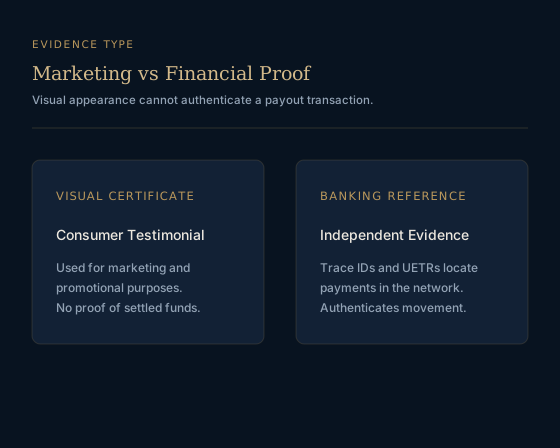
Under the FTC definition, a payout certificate presented as advertising that reflects a trader's claimed experience is a consumer testimonial. (16 CFR Part 465: Rule on the Use of Consumer Reviews and Testimonials, retrieved 2026-09-03) Ordane sells one product, the Ordane Instant Account: direct access, no evaluation phase and no challenge, on simulated capital.
Marketing Testimonials vs. Financial Receipts
Visual certificates are often used in marketing to build trust. However, these images are not financial receipts. They serve as promotional material rather than concrete proof of a completed bank transfer. Traders must understand that a graphic posted on a website does not equal settled funds. The marketing landscape often relies on these visuals to project authority. Just as you must determine if you can trust prop firm reviews, you must critically evaluate payout certificates.
The Limits of Visual Authentication
Visual appearance alone cannot reliably establish whether review-like marketing evidence is genuine. Knowing how to verify claims is an essential part of how to audit a prop firm. The FTC says real and fake reviews can be nearly impossible to distinguish by inspection. (How To Evaluate Online Reviews, retrieved 2026-09-03) Authentic financial evidence relies on verifiable data points from external banking systems.
Why Are Visual Testimonials a Verification Risk?
Many firms publish digital certificates to reassure traders. This creates a false sense of security, as digital images can be easily generated or altered without any underlying financial activity. It is crucial to understand where prop firm payout money comes from in the first place. You must treat any visual certificate as a starting point for investigation, not as the final word. A truly transparent verification process requires moving away from proprietary images and relying on standardized banking data.
Why Appearance Cannot Prove Authenticity
The visual design of a document offers no proof of its legitimacy. A document might look official, but without cryptographic verification or an independent ledger, its contents remain unverified. A valid digital signature can detect unauthorized document changes and authenticate the identity associated with the signing key. (FIPS 186-5, Digital Signature Standard (DSS), retrieved 2026-09-03)
Digital Signatures and Document Trust
Authenticating a digitally signed payout PDF requires validating the signature and checking whether the signer's certificate or its parent certificates are trusted. (Validate digital signatures in Adobe Acrobat, retrieved 2026-09-03) Even with digital signatures, the document only proves who signed it, not that the funds actually settled in the recipient account.
How Can You Independently Verify a Payout Transaction?
To confirm that a transaction occurred, you must locate the payment in an independent financial network. This process removes reliance on the firm's own marketing materials.
Locating the Banking Reference
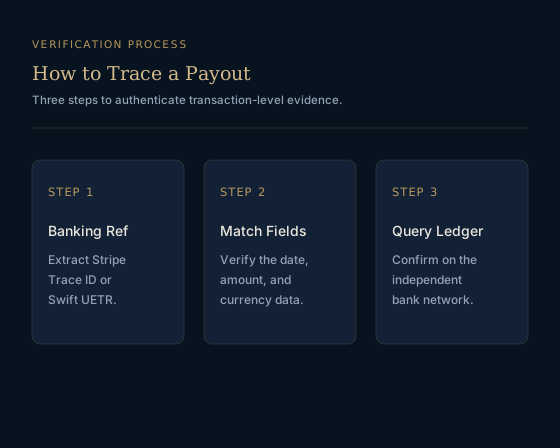
A transaction record used as payment evidence should expose the payment date, amount, currency and transaction reference so those fields can be matched against the certificate. (What is a proof of payment?, retrieved 2026-09-03) Wise permits a PDF transfer confirmation only for a transfer marked completed, and describes that confirmation as a payment receipt. (How do I download a transfer confirmation?, retrieved 2026-09-03) For eligible Wise transfers, the banking-partner reference can be supplied to the recipient's bank to locate the transfer independently of a marketing certificate. (What's a banking partner reference number?, retrieved 2026-09-03)
Matching Payment Proof Fields
For Stripe payouts, the Trace ID is a payout-specific identifier created by a banking partner and is stronger transaction-level evidence than a standalone certificate image. (Payout Trace IDs, retrieved 2026-09-03) You must ensure these IDs match the details on the presented certificate.
Tracing via Independent Networks
For payments carried over Swift, a UETR provides a unique reference that parties in the payment chain can use to locate the payment. (What is a Unique End-to-end Transaction Reference (UETR)?, retrieved 2026-09-03) Relying on these independent trace methods is the only way to authenticate the movement of funds.
What Is the Risk of Relying on Public Corporate Registers?
Some traders attempt to verify firms by checking corporate registers. While these databases show legal registration, they do not validate operational claims or financial transactions.
A firm's claimed UK regulatory identity can be checked independently against the FCA Financial Services Register. (Financial Services Register, retrieved 2026-09-03) However, appearing on a register does not mean the firm's marketing claims are accurate.
Appearance in the UK Companies House public record does not establish that company-supplied information is verified, and therefore does not authenticate an individual payout claim. (Companies House Disclaimer, retrieved 2026-09-03) You must rely on transaction-level evidence to confirm payments, which also helps prevent situations where a firm might take back your payout by retroactively disputing the transfer.
<a id="dataset"></a>
| Metric/Feature | Ordane (Simulated) | Industry Standard |
|---|---|---|
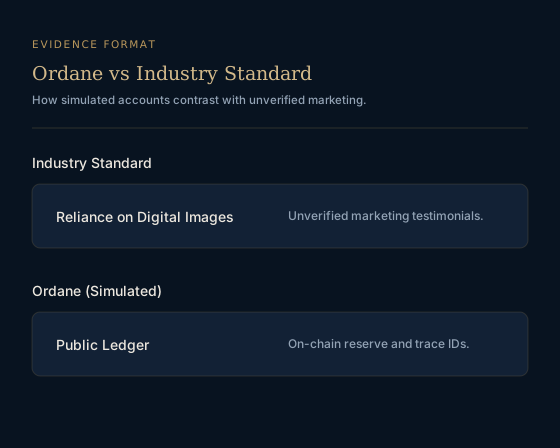
| Evidence Format | Public on-chain reserve | Visual payout certificates |
| Claim Status | Subject to FTC testimonial definitions. (16 CFR Part 465, retrieved 2026-09-03) | Often unverified marketing |
| Transaction Proof | Public ledger and trace IDs | Reliance on digital images |
| Verification Method | On-chain transparent tracking | Cannot reliably authenticate evidence. (FTC, retrieved 2026-09-03) |
| Wise Transfer | N/A (Simulated accounts) | Banking-partner reference traces transfer. (Wise, retrieved 2026-09-03) |
| Stripe Trace ID | N/A (Simulated accounts) | Stronger transaction-level evidence. (Stripe, retrieved 2026-09-03) |
| Swift UETR | N/A (Simulated accounts) | Unique reference for payment location. (Swift, retrieved 2026-09-03) |
Frequently Asked Questions
What is a prop firm payout certificate?
A prop firm payout certificate is a document often used in marketing to show that a trader received funds. Under the FTC definition, a payout certificate presented as advertising that reflects a trader's claimed experience is a consumer testimonial. (16 CFR Part 465: Rule on the Use of Consumer Reviews and Testimonials, retrieved 2026-09-03)
How do you verify payout claims accuracy?
You verify payout claims accuracy by tracing the payment through an external banking network. A transaction record used as payment evidence should expose the payment date, amount, currency and transaction reference so those fields can be matched against the certificate. (What is a proof of payment?, retrieved 2026-09-03)
What counts as a valid prop firm payout receipt?
A valid prop firm payout receipt must come directly from the payment processor. Wise permits a PDF transfer confirmation only for a transfer marked completed, and describes that confirmation as a payment receipt. (How do I download a transfer confirmation?, retrieved 2026-09-03)
How to authenticate a payout certificate?
Authentication requires matching the payout certificate details with a unique bank identifier. For payments carried over Swift, a UETR provides a unique reference that parties in the payment chain can use to locate the payment. (What is a Unique End-to-end Transaction Reference (UETR)?, retrieved 2026-09-03)
Can visual certificates prove a payout?
Visual certificates cannot prove a payout because visual appearance alone cannot reliably establish whether review-like marketing evidence is genuine. The FTC says real and fake reviews can be nearly impossible to distinguish by inspection. (How To Evaluate Online Reviews, retrieved 2026-09-03) If you are ready to trade with verified simulated capital, choose an instant account vs evaluation to skip the challenge phase.
Sources
- 16 CFR Part 465 — Rule on the Use of Consumer Reviews and Testimonials ecfr.gov Retrieved 2026-09-03.
- How To Evaluate Online Reviews consumer.ftc.gov Retrieved 2026-09-03.
- FIPS 186-5, Digital Signature Standard (DSS) csrc.nist.gov Retrieved 2026-09-03.
- Validate digital signatures in Adobe Acrobat helpx.adobe.com Retrieved 2026-09-03.
- How do I download a transfer confirmation? wise.com Retrieved 2026-09-03.
- What is a proof of payment? wise.com Retrieved 2026-09-03.
- What's a banking partner reference number? wise.com Retrieved 2026-09-03.
- Payout Trace IDs docs.stripe.com Retrieved 2026-09-03.
- What is a Unique End-to-end Transaction Reference (UETR)? swift.com Retrieved 2026-09-03.
- Financial Services Register fca.org.uk Retrieved 2026-09-03.
- Companies House Disclaimer resources.companieshouse.gov.uk Retrieved 2026-09-03.