Home · The Ordane Journal · Payouts · Where Does Prop Firm Payout Money Come From?
Where Does Prop Firm Payout Money Come From?
Ordane accounts operate on simulated capital. No live funds are traded and no deposits are accepted. Payouts depend on simulated performance under Rulebook v1.0; no level of performance is typical or assured.
Ordane sells one product, the Ordane Instant Account: direct access, no evaluation phase and no challenge, on simulated capital.
Prop firm payout money is real money paid from the firm's own revenue, chiefly fees traders pay to attempt and keep accounts, not from profits on your trades in the market. The trades are simulated and never reach a live exchange, leaving no market gains to pass on; only the source differs from a broker's.
In one sentence: Prop firm payout money is real money paid from the firm's own fee revenue, chiefly the fees traders pay to attempt and keep accounts, not from profits on your trades in the market.
Where does prop firm payout money come from?
Prop firm payout money comes from the firm's own revenue, chiefly the fees traders pay to attempt and keep accounts, not from profits earned on your trades in the market. The trades are simulated and never reach a live exchange, so there are no market gains to pass on. The payout is real money moving from the company's account to yours; only its source is different from a broker's.
Clause P-2 of the Ordane Rulebook v1.0 requires that simulated-capital declaration, and Ordane sells one product, the Ordane Instant Account: direct access, no evaluation phase and no challenge.
Why simulated does not mean unpaid
Simulated describes the trading, not the payout. Industry operators describe the category plainly: trades are placed as if live, but no real money is in the market (Forbes, Inside the Funded-Trader Boom, July 2026). A simulated result is still a result the firm agreed, in writing, to pay against. The distinction that matters is not paper versus real. It is whether the company behind the payout can cover what it owes when the result comes due.
How does a simulated trade become a real withdrawal?
A simulated trade becomes a real withdrawal when the firm measures your closed result against its published rules and pays a real amount sized to that result from company funds. Walk it end to end. You open a simulated account. You trade it. The firm measures your closed result against its published rules, and if the result qualifies, it pays you a real amount sized to that result from company funds. No client capital is traded on your behalf, and no deposit sits behind your account waiting to be returned (For Traders, How Do Prop Firms Make Money, July 2026).
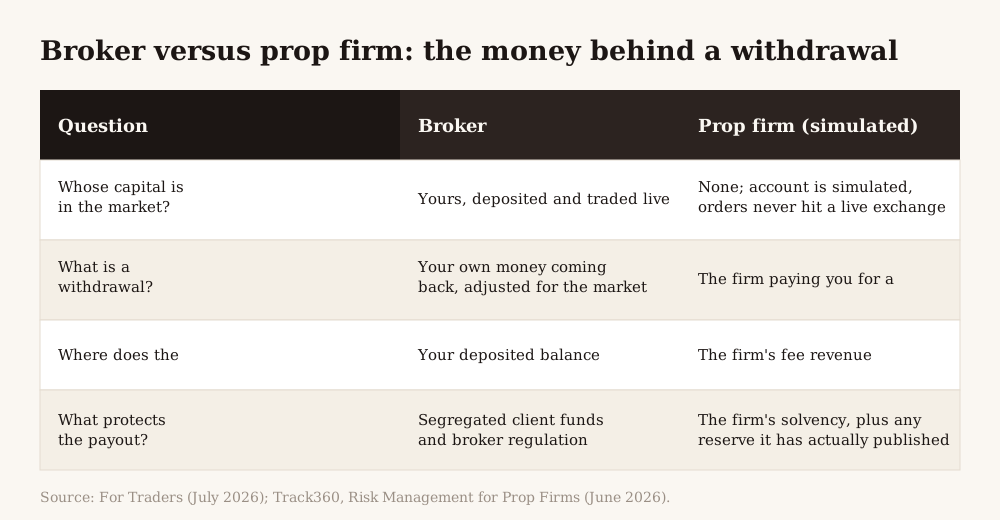
This is the line that separates a prop firm from a broker. At a broker, a withdrawal is your own money coming back to you, adjusted for what the market did to it. At a prop firm, there is no pool of your money to return. The payout is the firm paying you out of its revenue for hitting a target it set.
| Question | Broker (your own money) | Prop firm (simulated account) |
|---|---|---|
| Whose capital is in the market? | Yours, deposited and traded live | None; the account is simulated and orders never reach a live exchange |
| What is a withdrawal? | Your own money coming back, adjusted for the market | The firm paying you for a qualifying simulated result |
| Where does the paid money come from? | Your deposited balance | The firm's fee revenue |
| What protects the payout? | Segregated client funds and broker regulation | The firm's solvency, plus any reserve it has actually published |
A prop firm that runs simulated accounts and routes no order to a live exchange is the counterparty to every trader it pays (Track360, Risk Management for Prop Firms, June 2026). When you win, the firm pays from its revenue. When you lose, the firm keeps the fee. That is not a scandal by itself; it is the shape of the model, and whether a fee-funded category can be trusted at all is a broader question this cluster answers separately. It becomes your problem only when the firm cannot cover the winners, which is the next section.
What is the fee-funded model and where can it fail?
The fee-funded model means a prop firm makes money primarily from the fees traders pay to attempt evaluations, plus reset fees, add-ons, and spread or commission markups, and it fails when fee income cannot cover a sudden spike in payouts (For Traders, How Do Prop Firms Make Money, July 2026). At industry pass rates of about 5 to 10 percent, most of that fee income comes from traders who never reach the payout stage (For Traders, July 2026). The winners are paid out of the same pot the rest filled.
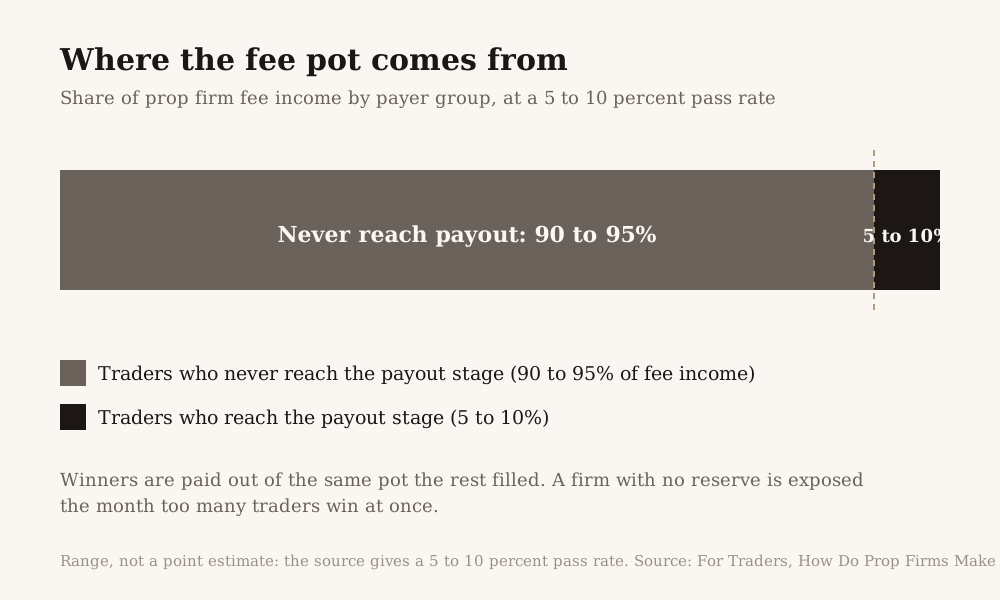
This is why the honest question is about solvency, not simulation. A fee-funded firm is fine as long as fee income exceeds payouts. A fee-funded firm is exposed the month too many traders win at once, when a single good month for traders becomes the month the firm cannot pay (Track360, Risk Management for Prop Firms, June 2026). A firm with no reserve behind its payouts is one good trading month away from a liquidity problem, and that problem lands on the trader waiting to be paid.
The category has one documented case every trader should know. On August 29, 2023, the CFTC filed against Traders Global Group Inc. (My Forex Funds) (CFTC, retrieved 2026-08-16). The complaint alleged a simulated retail platform that profited from trader losses while presenting itself as backing winners in real markets. In 2025 the court dismissed the case with prejudice and sanctioned the CFTC (Quinn Emanuel, 2025). Simulated trading is legal; the right question before you pay is still where payout money comes from.
What does Ordane say funds its payouts?
Ordane says payouts are paid in real money from company fee revenue, with no client deposits taken and no client capital traded, though it is new and has no payout history yet. There is nothing to show yet, and no payout history will be manufactured. (ordanemarkets.com, payout ledger section)
Here is what Ordane states about the money. Payouts are paid in real money from company fee revenue. No client deposits are taken and no client capital is traded. Rulebook v1.0 clause PR-1 commits Ordane to publish the payout reserve at a publicly verifiable address, and that address is now live on ordanemarkets.com with a dated observed balance. (Ordane Rulebook v1.0, clause PR-1; ordanemarkets.com FAQ)
The reserve is a commitment, not a receipt, and the tense matters. Ordane's payout reserve is published at a public TRON address on ordanemarkets.com, with a dated observed balance, before the first account is sold. (Ordane Rulebook v1.0, clause PR-1; ordanemarkets.com reserve section) Read that as written: there is no live reserve to inspect today. What exists today is the funding source, stated plainly, and a written commitment to prove the reserve before selling anything.
As of 2026-07-25 the payout ledger is empty because no payout has happened yet (Ordane Rulebook v1.0, clause PR-2). Two clauses stand behind the payout when it comes due. Every withdrawal request is approved, or denied in writing citing the exact rule breached by section number, within 24 clock hours. Past that deadline the request is treated as approved and the G-1 clock starts. (Ordane Rulebook v1.0, clause G-0) A payout approved and not paid within 48 clock hours, not business hours, triggers automatic compensation: a 100 percent refund of the account fee, plus the payout owed in full. (Ordane Rulebook v1.0, clause G-1) The entity carrying those commitments is Ordane Markets Ltd (in formation).
Checklist of the same commitments:
| Commitment | What Rulebook v1.0 says | Status as of 2026-07-25 |
|---|---|---|
| Funding source | Payouts paid in real money from company fee revenue; no client deposits taken | Stated on ordanemarkets.com FAQ |
| Reserve (PR-1) | Payout reserve at a public TRON address, with a dated observed balance, published before the first account is sold | Address live on ordanemarkets.com |
| Ledger (PR-2) | Dated payout ledger from payout number one, with monthly metrics | Empty; no payout has happened yet |
| Approval clock (G-0) | Approve or deny in writing within 24 clock hours, or the request is treated as approved | Written clause in force |
| Late-pay penalty (G-1) | Approved payout unpaid after 48 clock hours refunds the full account fee; payout still owed | Written clause in force |
What three questions should you ask any firm about payout money?
Ask three questions: where the money comes from, whether a reserve is inspectable, and what happens if a payout is late. That separates a firm that can pay from one that hopes to.
First, where does the payout money come from? Fee revenue is the real answer. A firm that only says it is well capitalised has not answered.
Second, is there a reserve, and can you inspect it? A pot of fee income with no ring-fenced reserve is exposed the month payouts spike. Ask for the address or the proof, and note whether it exists today or is promised for later. A promise with a date on it is worth more than a claim with none, but only if the date arrives.
Third, what happens if a payout is late? A firm with a written penalty for its own lateness has priced its promise. A firm with only a target has not. Ordane's answer is clause G-1 above: a payout not paid within 48 clock hours costs the firm the fee and still owes the payout in full.
One neighbouring question sits outside this page. How long the money takes once it is owed is a question of timing, answered separately in this cluster. This page stays on where the money originates.
What do traders ask about where payout money comes from?
Where does prop firm payout money come from?
Prop firm payout money comes from the firm's own revenue, overwhelmingly the fees traders pay to attempt and keep accounts, not from profits on your trades. The trades are simulated and never reach the market, so there are no market gains to pay from. The payout is real money moving from the company's account to yours (For Traders, July 2026).
Who funds prop firm withdrawals?
The firm does, out of its own fee revenue. There is no pool of client capital being traded on your behalf that a withdrawal draws down. Most of the fee pool is filled by traders who never qualify for a payout, so a withdrawal is covered by the firm's operating revenue, not by anyone's deposit (For Traders, July 2026).
Do prop firm payouts come from other traders' fees?
Largely, yes. At pass rates of about 5 to 10 percent, most fee income comes from traders who never reach the payout stage, and winners are paid from that pot (For Traders, July 2026). It is not a pool of client capital being traded on your behalf; it is the firm's operating revenue.
How do prop firms afford to pay traders?
Fee income exceeds payouts in a normal month, so the difference covers the winners (For Traders, July 2026). The risk is the abnormal month: if too many traders win at once, a firm without a reserve can face a month it cannot pay (Track360, June 2026).
Is there a reserve behind prop firm payouts?
There should be, and you should be able to see it. Ordane's payout reserve is published at a public TRON address on ordanemarkets.com, with a dated observed balance, before the first account is sold (Ordane Rulebook v1.0, clause PR-1). Treat any reserve you cannot inspect as a claim, not a fact; this one you can inspect.
Worked payout arithmetic scenario
Declared inputs: balance 10000; split 0.80; first request 500; second request 700.
| Input | Value | Arithmetic |
|---|---|---|
| Split | 0.80 | Declared |
| First net | 500 | Declared |
| Gross first | 625 | 500 / 0.80 = 625 |
| Second net | 700 | Declared |
| Gross second | 875 | 700 / 0.80 = 875 |
| Combined | 1500 | 625 + 875 = 1500 |
Assumptions: published split only; no fee on these requests. Arithmetically: 500 / 0.80 = 625; 700 / 0.80 = 875; 625 + 875 = 1500 under these declared inputs.
Questions traders ask
Where does prop firm payout money come from?
Prop firm payout money comes from the firm's own revenue, overwhelmingly the fees traders pay to attempt and keep accounts, not from profits on your trades. The trades are simulated and never reach the market, so there are no market gains to pay from. The payout is real money moving from the company's account to yours.
Who funds prop firm withdrawals?
The firm does, out of its own fee revenue. There is no pool of client capital being traded on your behalf that a withdrawal draws down. Most of the fee pool is filled by traders who never qualify for a payout, so a withdrawal is covered by the firm's operating revenue, not by anyone's deposit.
Do prop firm payouts come from other traders' fees?
Largely, yes. At pass rates of about 5 to 10 percent, most fee income comes from traders who never reach the payout stage, and winners are paid from that pot. It is not a pool of client capital being traded on your behalf; it is the firm's operating revenue.
How do prop firms afford to pay traders?
Fee income exceeds payouts in a normal month, so the difference covers the winners. The risk is the abnormal month: if too many traders win at once, a firm without a reserve can face a month it cannot pay.
Is there a reserve behind prop firm payouts?
There should be, and you should be able to see it. Ordane's payout reserve is published at a public TRON address on ordanemarkets.com, with a dated observed balance, before the first account is sold. Treat any reserve you cannot inspect as a claim, not a fact; this one you can inspect.
Sources
- For Traders, How Do Prop Firms Make Money (July 24, 2026) Retrieved 2026-07-28.
- Ordane Rulebook v1.0, clause P-2 (sentence 1); ordanemarkets.com payout-funding statement (sentence 2) Retrieved 2026-07-28.
- Forbes, Inside the Funded-Trader Boom (July 22, 2026) Retrieved 2026-07-28.
- Track360, Risk Management for Prop Firms 2026 (June 3, 2026) Retrieved 2026-07-28.
- CFTC Press Release 8771-23; Track360 case summary Retrieved 2026-07-28.
- Track360, MyForexFunds Aftermath 2026 (May 27, 2026) Retrieved 2026-07-28.
- Historic Rule 11 Dismissal and Fee Victory Against the CFTC, Quinn Emanuel (defendants' counsel) Retrieved 2026-07-24.
- ordanemarkets.com, payout ledger section Retrieved 2026-07-28.
- Customer Advisory: Understand the Risks of Virtual Currency Trading | CFTC Retrieved 2026-08-10.
This article is for information only and is not investment, financial, or tax advice.