Home · The Ordane Journal · Before you pay · How to Get a Funded Trading Account
How to Get a Funded Trading Account
A funded trading account is a simulated environment where a proprietary trading firm allocates capital to a trader who has successfully passed a strict risk management evaluation. Ordane accounts operate on simulated capital. No live funds are traded and no deposits are accepted.
Getting a funded trading account requires passing this simulated evaluation, completing identity verification, and signing a formal agreement. Traders pay an upfront fee to prove their risk management skills on simulated capital. Once approved, the firm grants access to an account where traders earn a percentage of the generated profit.
When researching the market, traders often look for direct paths. Ordane sells one product, the Ordane Instant Account: direct access, no evaluation phase and no challenge, on simulated capital. Other proprietary trading firms require a distinct evaluation phase before granting access. Understanding the exact mechanics of these evaluations separates successful candidates from those who repeatedly pay challenge fees without ever reaching a payout.
What is a funded trading account?
A funded trading account is an arrangement where a proprietary trading firm allocates capital to a trader who has successfully demonstrated profitable risk management. In the modern retail environment, this capital is simulated.
Retail prop trading firms typically charge an upfront evaluation fee, allowing traders to prove their skills on simulated accounts before earning a funded account. (Finance Magnates, retrieved 2026-09-05) You are not depositing funds to a broker to trade real markets. You are purchasing an assessment. If you pass the assessment, the firm provides you with a simulated account that mirrors live market conditions. The firm then pays you a share of the simulated profits you generate, backing those payouts with their own corporate revenue or real market hedging operations.
This structure protects the firm from inexperienced traders losing corporate money. It also protects the trader from losing more than the initial evaluation fee. Because the entire arrangement rests on a simulation, the rules governing that simulation are the most critical factor in your success.
Traders must read the documentation carefully. The market is full of firms offering massive leverage, but the true test of a firm is how it handles the rules of the simulation and the transparency of its payout mechanism.
What hidden rules govern the evaluation process?
The profit target is the headline, but the risk management rules are the actual test. Firms use these rules to filter out traders who rely on luck or reckless leverage.
Many candidates fail because they misunderstand how drawdowns are calculated or how consistency clauses restrict their trading style. Reading the rulebook is mandatory. If a behavior is not listed in a transparent firm's documentation, it might be allowed, but assumptions often lead to breached accounts and forfeited evaluation fees.
Maximum daily loss and drawdown limits
The daily loss limit dictates how much equity you can lose in a single server day before the account is closed. This limit is often calculated based on the balance at the start of the server day. A breach of this limit results in immediate failure of the evaluation phase.
Drawdown limits track the total acceptable loss on the account. Some firms use a trailing drawdown, which moves up as your account reaches new high water marks. A trailing drawdown squeezes your available risk buffer as you generate profit. Other firms use a static drawdown. Ordane's maximum drawdown is 5 percent and static: account equity may never fall below 95 percent of the initial balance. The floor is fixed on day one, never trails upward, and a breach closes the account. Maximum risk per trade is 1.5 percent of current balance and a stop-loss is mandatory at entry. Two maximum losses equal the daily limit, which is the design rather than an accident.
Consistency rules and minimum trading days
Consistency rules prevent traders from passing an evaluation with one massive, lucky trade. A common consistency rule dictates that no single trading day can account for more than a certain percentage of the total profit generated during the challenge. This forces the trader to demonstrate a repeatable edge rather than a gambling mentality.
Minimum trading days force the trader to execute positions over a sustained period. This proves that the strategy generates repeated results over various market conditions. Traders must understand that holding a position overnight or trading during high impact news events might violate specific clauses, depending on the firm. The evaluation measures discipline over time, ensuring the trader can manage risk consistently.
Will your funded account actually exist? (KYC and agreements)
Passing the evaluation is only the first phase. The second phase involves strict legal compliance.
Proprietary trading firms follow strict onboarding protocols to ensure they are dealing with verified individuals and to comply with international anti money laundering directives. You will be required to submit government issued identification and proof of address before any payout can be processed.
This step addresses a common fear among traders regarding whether the firm might disappear or deny a payout on a technicality. Legitimate firms conduct KYC transparently and securely.
Government issued identification is mandatory for all successful applicants. Proof of residence must be recent, typically issued within the last three months. * The final agreement defines your status as an independent contractor, not an employee.
Once the KYC is approved, the firm issues the final agreement. Reading this contract ensures you understand the payout schedule, the profit split, and the data feed terms. The Ordane rulebook is public, numbered and versioned, and no rule is ever applied retroactively to an open account. Changes produce a new version with a dated changelog entry, and the version you sign up under is the version that governs your account.
How much does it cost to get a funded account?
The cost of acquiring a funded trading account varies based on the firm, the account size, and the evaluation structure. Traders must calculate the total upfront cost, not just the advertised challenge fee. Some firms advertise low entry fees but add hidden costs later in the process, such as platform fees or data subscriptions.
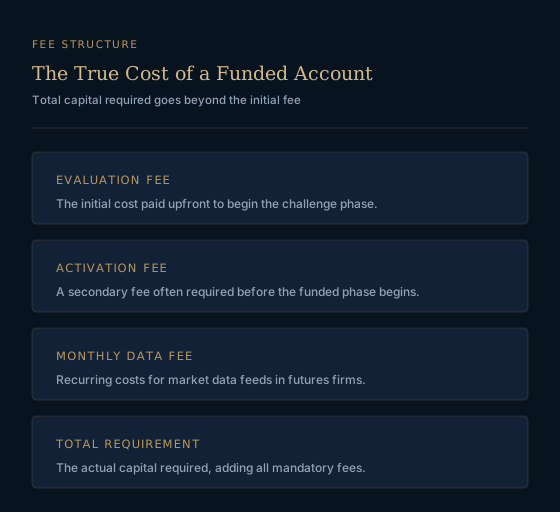
| Cost Component | Description | Industry Context |
|---|---|---|
| Evaluation Fee | The initial cost to start the assessment. | Paid upfront to begin the challenge phase. |
| Activation Fee | A secondary fee charged after passing. | Often required before the funded phase begins. |
| Monthly Data Fee | Recurring costs for market data feeds. | Common in futures proprietary trading firms. |
| Total Requirement | The actual capital required to trade. | Calculated by adding all mandatory fees. |
Traders should seek transparent pricing models. The fee is one-time: $59 for the $2,500 account, $139 for the $10,000 account, $299 for $25,000, $549 for $50,000 and $999 for $100,000. There are no recurring fees, no hidden tiers and no coupon games.
How to get a funded trading account (Step-by-Step)
The journey to managing simulated capital requires a methodical approach. Traders who treat the process as a structured business venture are more likely to succeed than those who treat it as a gamble. Follow these precise steps to navigate the industry and secure a funded account.
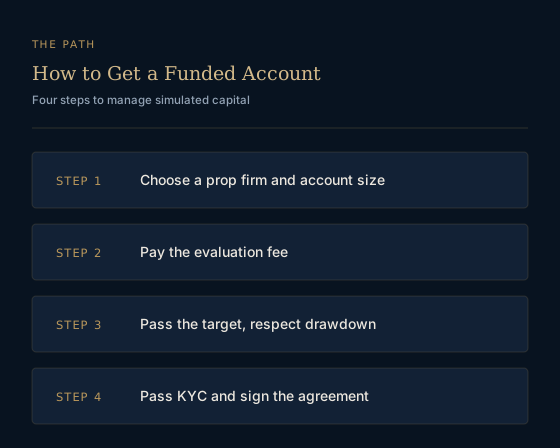
Step 1: Choose a prop firm and select an account size
The first step is evaluating the market. Look for firms with public rulebooks, verifiable reserves, and clear payout mechanisms. Review the allowed instruments, leverage limits, and trading platforms. Assess your own trading strategy to ensure it aligns with the firm's specific risk parameters, particularly regarding news trading and weekend holding.
Selecting the right account size is equally important. A common mistake is purchasing the largest available account before proving consistency on a smaller scale. Start with a size that matches your current risk tolerance and financial situation.
Step 2: Pay the evaluation fee
Once you have selected a firm, you must pay the evaluation fee to begin the challenge. This fee grants you access to the simulated trading environment and the firm's proprietary dashboard.
Ensure you are using a secure payment method and retain all receipts for your records. The moment your payment clears, the firm will email your login credentials. Take the time to log into the platform, configure your charts, and verify that the data feed matches your expectations before placing the first trade. Familiarize yourself with the dashboard where your daily loss limit will be tracked.
Step 3: Pass the profit target without breaching drawdown
This is the execution phase. You must achieve the required profit target while strictly adhering to the daily loss limit and the maximum trailing or static drawdown.
Discipline is paramount here. The evaluation is designed to test your emotional control as much as your technical edge. Use a position size calculator for every single trade. Keep your risk per trade strictly below the threshold that would trigger a daily loss breach. If you hit a losing streak, step away from the terminal rather than revenge trading. The rules are absolute, and a breached account requires starting the process over with a new fee.
Step 4: Pass KYC and sign the agreement
After successfully hitting the profit target and completing any minimum trading day requirements, your account will be reviewed. The firm will verify that no prohibited practices, such as latency arbitrage or unauthorized copy trading, were used during the evaluation.
You will then submit your KYC documents. Upon approval, the firm issues the independent contractor agreement. Sign this document, and the firm will provision your new funded trading account on simulated capital. You are now eligible to request payouts based on the profits you generate, subject to the firm's withdrawal schedule. The first withdrawal is available 7 calendar days after account activation, and the cycle thereafter is every 14 days.
Declared inputs for this check: 7 (days to first withdrawal), 14 (days in subsequent cycle), and 21 (days to second withdrawal). Worked arithmetic: 7 + 14 = 21.
Every withdrawal request is approved, or denied in writing citing the exact rule breached by section number, within 24 clock hours. Past that deadline the request is treated as approved and the G-1 clock starts. This mechanism is known as The Ordane Guarantee.
FAQ on getting a funded account
Traders entering the proprietary trading industry often face a steep learning curve. The following answers address the most common questions about the mechanics of acquiring and managing these accounts.
How to get a funded trading account?
You get a funded trading account by paying an evaluation fee to a proprietary trading firm, successfully passing their simulated trading challenge, passing identity verification, and signing a contractor agreement. The process tests your ability to generate profit while strictly managing risk and adhering to documented drawdown limits.
How to become a funded trader?
Becoming a funded trader requires mastering a consistent trading strategy, understanding firm specific rules like daily loss limits, and maintaining emotional discipline. You must shift your mindset from merely seeking high returns to prioritizing capital preservation within a simulated framework. Consistency over time is valued above single large wins.
How to get funded by a prop firm?
To get funded by a prop firm, select a company with a transparent rulebook, purchase an evaluation phase, and reach the required profit target without violating their drawdown rules. Once you pass the assessment, you must complete their KYC onboarding process and sign an independent contractor agreement to access the simulated capital.
How do you get a funded account?
You get a funded account by proving your risk management skills in a controlled test environment. You pay for the assessment, trade simulated funds according to strict risk parameters, and if successful, you are granted access to an account where your simulated profits translate into real payouts based on a predefined profit split.
Do you need a license to be funded?
No, you do not need a financial license to trade a funded account with a retail proprietary trading firm. Because you are trading simulated capital and operating as an independent contractor rather than managing real client funds, traditional financial advisory or brokerage licenses are not required by most regulatory bodies governing these retail assessments.
| Query Topic | Essential Requirement | Verification Stage |
|---|---|---|
| Evaluation Process | Strict adherence to drawdown limits. | Monitored daily by the firm's automated systems. |
| Identity Checks | Submission of valid government ID. | Conducted prior to issuing the funded agreement. |
| Payout Mechanics | Signing the contractor agreement. | Required before the first withdrawal request. |
Understanding these requirements ensures you approach the evaluation process with clarity, treating the assessment as a rigorous test of discipline rather than a shortcut. Read the Ordane Rulebook to verify exactly how these conditions are enforced.
Sources
- Prop Trading: The New Retail Forex Boom? | Finance Magnates financemagnates.com Retrieved 2026-09-05T09:55:13-03:00.