Home · The Ordane Journal · Payouts · Can a Prop Firm Take Back Your Payout After Approval?
Can a Prop Firm Take Back Your Payout After Approval?
Ordane accounts operate on simulated capital. No live funds are traded and no deposits are accepted. Clause P-2 of the Ordane Rulebook v1.0 requires that declaration (retrieved 2026-07-29), so an Ordane payout settles a simulated result rather than returning a deposit.
This page is about the last fear before you pay: passing, requesting the money, then watching it shrink or disappear on a rule that surfaces only at withdrawal.
What decides whether a prop firm can take back your payout?
A payout is only as final as the clause behind it. The word "guaranteed" on a sales page carries no weight, because it is a promise the same firm can reinterpret at the moment you ask to be paid. What decides finality is structure: whether the reasons your money can be held or reversed are written down before you trade, whether that list is closed, and whether the firm pays a price for missing its own deadline.
What is the gap between approval and finality?
Approval and finality are not the same event, and the gap between them is where clawbacks live. Approval is the firm saying yes to one request. Finality is that yes being irreversible. A firm can approve a payout, then reopen it under a discretion clause, a review with no end date, or a rule it changed after you passed. If nothing in the contract stops that, approval is a status, not a settlement. So the question to ask before you pay is not "does this firm approve payouts," it is "once approved, what still lets them take it back."
How do prop firms actually deny or reverse a payout?
Payouts rarely vanish for no reason; they vanish through a small set of mechanisms that are visible in the terms before you pay, if you know what to read for.
The clearest recent example was public and dated. According to Finance Magnates (retrieved 2026-07-29), the futures prop firm FundingTicks changed its trading rules in December 2025. Finance Magnates reported that the same changes were applied to accounts that had already passed under the old rules. Earlier trades that did not meet the new conditions were treated as breaches or had their profit reduced, and trades that had been valid when placed were invalidated, per Finance Magnates. FundingTicks' December 2025 changes included a one-minute minimum trade hold where there had been none, according to Finance Magnates. The minimum daily profit was raised to $200 from $150, six profitable days were required instead of five, the profit split was cut to 80 percent from up to 90 percent, and withdrawals were reduced and capped, per Finance Magnates. One FundingTicks trader reported an account that showed about $3,200 in profit on a Friday and $751.62 after the change was applied, according to Finance Magnates. FundingTicks' Trustpilot score fell to 3.2 from 4.1 in October across more than 1,000 reviews, Finance Magnates reported. Thirty-eight percent of those ratings were one star, per Finance Magnates. By January 2026 the episode had an ending. FundingTicks announced on 18 January 2026 that it was winding down operations, according to Finance Magnates (retrieved 2026-07-29). All active evaluation and master accounts were refunded in full regardless of profit or drawdown, Finance Magnates reported. The firm that supplied the clearest recent clawback did not outlast the backlash it caused.
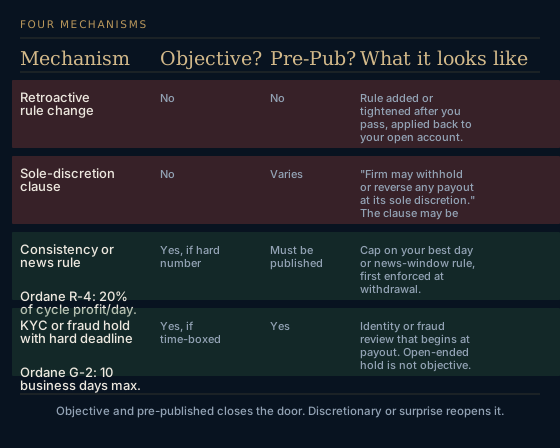
Retroactivity is one of four common ways a payout gets denied or reversed. The table below names them, and the two columns that matter: whether the reason is objective, meaning it does not depend on how the firm feels that day, and whether it was pre-published, meaning it existed in the terms before you traded.
| How a payout gets denied or reversed | Objective? | Pre-published? | What it looks like |
|---|---|---|---|
| Retroactive rule change | No | No | A rule added or tightened after you passed, applied back to your open account, as at FundingTicks |
| Sole-discretion clause | No | The clause may be published, its use is not | "The firm may withhold or reverse any payout at its discretion" |
| Consistency or news rule surfaced at payout | Only if published with a hard number | Varies | A cap on your best day, or a news-window rule, first enforced at withdrawal |
| KYC or fraud hold with no deadline | The check is objective, an open-ended hold is not | The step may be listed, the time limit rarely is | Identity or fraud review that begins at payout and never closes |
Read the middle two columns of any firm's terms the same way. A reason that is objective and pre-published is one you can plan around. A reason that is discretionary, or that can be created after you pass, is one no amount of good trading protects you from.
What makes a prop firm payout genuinely final?
A payout is safe when three things hold at once. Miss any one and finality is an opinion, not a term.
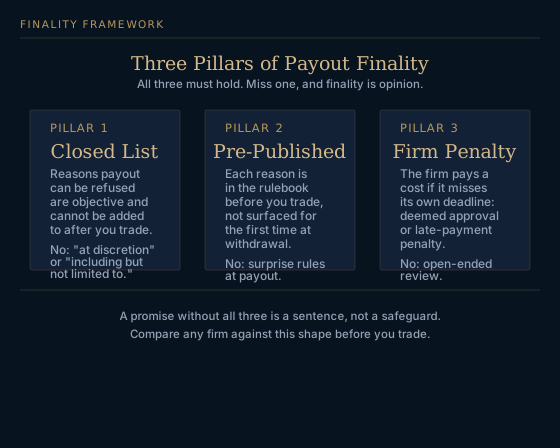
First, the reasons it can be refused are a closed, objective list. Closed means nothing can be added to it later. Objective means each item is a fact anyone can check, not a judgment the firm makes alone. An open-ended clause, "including but not limited to," or "at the firm's discretion," fails this test by design, because it leaves room to invent a reason after you pass.
Second, those reasons are pre-published, not surfaced at withdrawal. A consistency cap or a news-trading limit is fair only if it was in the version you traded under. The same rule produced for the first time at payout is a denial dressed as a rule.
Third, there is a consequence on the firm for missing its own deadline. This is the part almost no marketing page carries. Two mechanisms turn a promise into a term. Deemed approval means silence past the decision clock counts as a yes, so a request cannot sit forever under review. A late-payment penalty means the firm owes more if it pays late, so delay costs the firm rather than the trader. A guarantee with neither is a sentence, not a safeguard.
Those three tests are how you compare any firm's exclusion list against the shape that actually protects a payout.
How does Ordane's guarantee prevent clawbacks?
Ordane's guarantee is built to the shape that makes a payout genuinely final, and the contract is what can be verified today. Concession first, and no dressing it up. Ordane is new and has no payout history. There is nothing to show yet, and no payout history will be manufactured (Ordane, payout ledger section, ordanemarkets.com, retrieved 2026-07-29).
Ordane sells one product, the Ordane Instant Account: direct access, no evaluation phase and no challenge, on simulated capital.
Start with the rule that answers FundingTicks directly. The Ordane rulebook is public, numbered and versioned, and no rule is ever applied retroactively to an open account. Changes produce a new version with a dated changelog entry, and the version you sign up under is the version that governs your account (Ordane Rulebook v1.0, section 0 notice and section 6 Changelog, retrieved 2026-07-29). A rule written after you passed cannot reach the account you already hold. That is the single clause that makes a retroactive clawback impossible rather than merely unlikely.
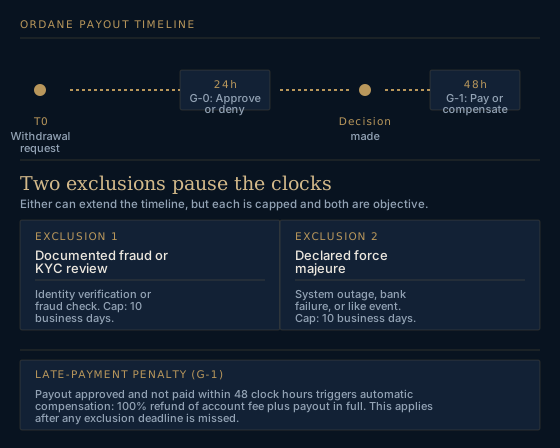
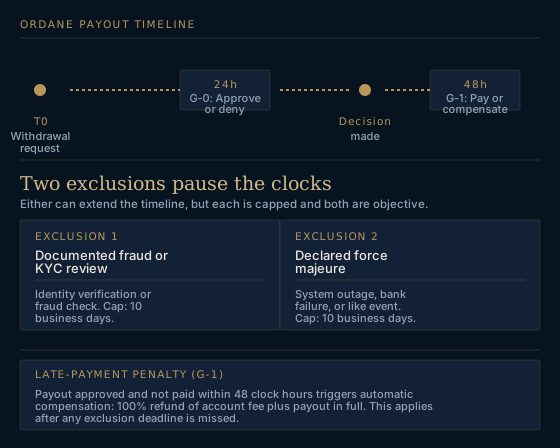
On the decision itself, clause G-0 sets the answer clock. Every withdrawal request is approved, or denied in writing citing the exact rule breached by section number, within 24 clock hours. Past that deadline the request is treated as approved and the G-1 clock starts (Ordane Rulebook v1.0, clause G-0, retrieved 2026-07-29). The second sentence is the load-bearing one: a missed deadline counts as an approval, which removes the open-ended "under review" that stalls a payout elsewhere. A denial must also name a section number, so it cannot be a vague "you broke a rule."
Clause G-1 then prices the payment deadline. A payout approved and not paid within 48 clock hours, not business hours, triggers automatic compensation: a 100 percent refund of the account fee, plus the payout owed in full (Ordane Rulebook v1.0, clause G-1, retrieved 2026-07-29). Late payment costs Ordane, not the trader.
The exclusions are where most guarantees quietly reopen, so read this one closed. The Ordane Guarantee has two objective exclusions: documented fraud or KYC review, and declared force majeure. Both carry a hard deadline, and beyond it G-1 applies regardless (Ordane Rulebook v1.0, clause G-2, retrieved 2026-07-29). The deadline is not open-ended. Both G-2 exclusions, documented fraud or KYC review, and declared force majeure, are capped at 10 business days each, and past that deadline, G-1 applies regardless (Ordane Rulebook v1.0, clause G-2, retrieved 2026-07-29). Two exclusions, both objective, both time-boxed. No third reason can be added, because the list is the list.
Two smaller clauses close the usual side doors. The first is the consistency rule, pre-published rather than sprung at payout, and structured to defer rather than confiscate. Ordane's consistency rule is 20 percent: at the moment of a withdrawal request, no single trading day may account for more than 20 percent of the cycle's total profit. If a day exceeds 20 percent, the excess profit from that day is deferred to the next cycle, never confiscated, and the remainder of the cycle pays out normally (Ordane Rulebook v1.0, clause R-4, retrieved 2026-07-29). The second is identity. KYC happens once, at the first withdrawal request, not at purchase. There is no re-verification loop at every payout (Ordane, ordanemarkets.com FAQ, retrieved 2026-07-29). A one-time check cannot be reused as a fresh stall on your second payout.
On the proof behind the clauses, the honest tense is now present. Ordane's payout reserve is published at a public TRON address on ordanemarkets.com, with a dated observed balance, before the first account is sold (Ordane Rulebook v1.0, clause PR-1, retrieved 2026-08-09). That was a commitment recorded as clause PR-1 and it is now kept; a published address is still not a payout history, and this page will not call it anything else.
The clauses above compress into a single view. Each row restates a term already quoted and cited in full earlier in this section; no row adds anything new.
| Clause in Rulebook v1.0 | The hard number | What happens at the limit |
|---|---|---|
| Section 0 notice and section 6 Changelog | The version you sign up under governs your account | No rule is ever applied retroactively to an open account; changes produce a new version with a dated changelog entry |
| G-0, the decision clock | 24 clock hours to approve, or deny in writing citing the exact rule breached by section number | Past the deadline the request is treated as approved and the G-1 clock starts |
| G-1, the payment clock | 48 clock hours, not business hours | A payout approved and not paid in time triggers automatic compensation: a 100 percent refund of the account fee, plus the payout owed in full |
| G-2, the exclusion list | Two exclusions only, documented fraud or KYC review and declared force majeure, capped at 10 business days each | Past that deadline G-1 applies regardless |
| R-4, the consistency rule | 20 percent: at a withdrawal request, no single trading day may account for more than 20 percent of the cycle's total profit | Excess profit from that day is deferred to the next cycle, never confiscated; the remainder of the cycle pays out normally |
| KYC timing | Once, at the first withdrawal request, not at purchase | No re-verification loop at every payout |
| PR-1, the payout reserve | A public TRON address on ordanemarkets.com, with a dated observed balance, published before the first account is sold | Address live; the reserve is not a promise, it is an address |
How can you protect your payout before and at withdrawal?
You cannot rewrite a firm's terms, but you can close the openings a clawback needs. Four habits do most of the work.
Screenshot the live terms before every withdrawal. If a rule changes later, your dated copy is the evidence of what you agreed to. Trade only on rules confirmed in the current version, not on a forum's memory of last month. Complete identity verification early, on day one if the firm allows it, so KYC can never be used as a reason to hold a cleared payout. And if a request is denied, get it in writing, citing the exact rule and the exact trades, because a denial that cannot name a section number is not a rule, it is a decision looking for one.
Two of these connect to questions this page does not own. What you must satisfy before a payout is even owed, the eligibility gates, is its own checklist, covered in full in a separate guide on this site. How long the money takes to arrive once approved, against any pay-or-refund clock, is a separate timing question, covered in a separate guide on this site. Whether a firm pays at all, before the question of taking it back, is covered in a separate guide on this site as well.
Which payout clawback questions do traders ask most often?
Traders ask five questions most often, and each answer below is self-contained and names the entity it depends on.
Can a prop firm take back your payout?
Yes, if its terms allow it. A firm can reverse or reduce a payout through a discretion clause, an open-ended review, or a rule it applies retroactively to your account. It cannot do so when the reasons for refusal are a closed, objective, pre-published list, which is why the exclusion clause matters more than the word "guaranteed."
Can a prop firm deny a payout after it has approved it?
It can if approval is reversible under the contract. Approval is a yes to one request; finality is that yes being permanent. A firm that reserves discretion, or runs a review with no deadline, can reopen an approved payout. A deemed-approval clock, where silence counts as yes, closes that gap: Ordane's clause G-0 treats a missed 24-hour deadline as approved (Ordane Rulebook v1.0, clause G-0, retrieved 2026-07-29).
Do prop firms claw back profits?
Some have. According to Finance Magnates (retrieved 2026-07-29), in December 2025 FundingTicks changed its rules and applied them to accounts that had already passed, reducing booked profit; one trader reported a balance cut from about $3,200 to $751.62. Finance Magnates reported that FundingTicks then wound down operations in January 2026, refunding active evaluation and master accounts in full (retrieved 2026-07-29). The defense against it is a never-retroactive term, so a rule written after you passed cannot reach your open account.
What are the only reasons a payout should be refused?
A short list of objective, pre-published exclusions, and nothing else. Documented fraud or an identity check, and genuine force majeure, are defensible when each carries a hard deadline. Ordane's guarantee caps each of its two exclusions at 10 business days, after which the late-payment clause applies regardless (Ordane Rulebook v1.0, clause G-2, retrieved 2026-07-29). A discretionary clause, an "under review" with no end date, or a rule introduced at payout are not reasons, they are openings.
Is a prop firm payout final once approved?
Only when the contract makes it so. Finality needs three things: a closed and objective exclusion list, published before you traded, plus a consequence on the firm for missing its own deadline. A payout approved and unpaid within 48 clock hours at Ordane owes the account fee back plus the payout in full (Ordane Rulebook v1.0, clause G-1, retrieved 2026-07-29). Without all three, "approved" is a status the firm can revisit, not a settlement you can count on.
Sources
- Finance Magnates, on FundingTicks changing its trading rules in December 2025 and applying the changes to accounts that had already passed, on the one-minute minimum hold, the $200 minimum daily profit, the six profitable days, the 80 percent split and the capped withdrawals, on the trader account that showed about $3,200 on a Friday and $751.62 after the change, and on the Trustpilot score falling to 3.2 from 4.1 across more than 1,000 reviews. financemagnates.com Retrieved 2026-07-29.
- Finance Magnates, on FundingTicks announcing on 18 January 2026 that it was winding down operations, with all active evaluation and master accounts refunded in full regardless of profit or drawdown. financemagnates.com Retrieved 2026-07-29.
- Ordane Rulebook v1.0, clause P-2, on all accounts operating on simulated capital with no live funds traded and no deposits accepted. ordanemarkets.com/rulebook Retrieved 2026-07-29.
- Ordane Rulebook v1.0, notice above section 0 and section 6 Changelog, on the rulebook being public, numbered and versioned, on no rule ever being applied retroactively to an open account, and on the version you sign up under governing your account. ordanemarkets.com/rulebook Retrieved 2026-07-29.
- Ordane Rulebook v1.0, clause G-0, on every withdrawal request being approved, or denied in writing citing the exact rule breached by section number, within 24 clock hours, and on the request being treated as approved past that deadline. ordanemarkets.com/rulebook Retrieved 2026-07-29.
- Ordane Rulebook v1.0, clause G-1, on a payout approved and not paid within 48 clock hours, not business hours, triggering a 100 percent refund of the account fee plus the payout owed in full. ordanemarkets.com/rulebook Retrieved 2026-07-29.
- Ordane Rulebook v1.0, clause G-2, on the two objective exclusions, documented fraud or KYC review and declared force majeure, each capped at 10 business days, past which G-1 applies regardless. ordanemarkets.com/rulebook Retrieved 2026-07-29.
- Ordane Rulebook v1.0, clause R-4, on the 20 percent consistency rule, where excess profit from a single day is deferred to the next cycle rather than confiscated. ordanemarkets.com/rulebook Retrieved 2026-07-29.
- Ordane Rulebook v1.0, clause PR-1, on the payout reserve published at a public TRON address with a dated observed balance before the first account is sold. ordanemarkets.com/rulebook Retrieved 2026-07-29.
- Ordane Markets, homepage FAQ, on KYC happening once, at the first withdrawal request rather than at purchase, with no re-verification loop at every payout. ordanemarkets.com Retrieved 2026-07-29.
- Ordane Markets, payout ledger section, on Ordane being new with no payout history to show and none that will be manufactured. ordanemarkets.com Retrieved 2026-07-29.
This article is for information only and is not investment, financial, or tax advice.
Ordane accounts operate on simulated capital. No live funds are traded and no deposits are accepted. Payouts depend on simulated performance under Rulebook v1.0; no level of performance is typical or assured.