Home · The Ordane Journal · Rules and mechanics · Apex Trader Funding Max Loss Limit Explained
Apex Trader Funding Max Loss Limit Explained
Evaluating a simulated trading environment requires reading the exact rulebook clauses that govern account closures. The Apex Trader Funding max loss limit is an intraday trailing threshold that tracks the highest account equity, including unrealized profits, during the trading session. Ordane accounts operate on simulated capital. No live funds are traded and no deposits are accepted.
Many operators in the retail trading space advertise large account sizes, favorable profit splits, and low upfront costs. However, the specific mechanism that determines whether a trader survives the evaluation phase or retains access to the trading platform is the drawdown rule. Understanding the structural mechanics of these rules is the only way to accurately evaluate the statistical probability of retaining an account over a long time horizon. This analysis examines the specific drawdown mechanics and trailing thresholds utilized by Apex Trader Funding (prop firm).
What Is the Apex Trader Funding Max Loss Limit?
Apex Trader Funding utilizes an intraday trailing threshold that tracks the highest account balance during the trading day, including unrealized profits, to calculate the daily loss limit. (Apex Trader Funding Official Website, retrieved 2026-09-13) This means the system calculates the high-water mark of the account not at the end of the trading day, but continuously throughout the session in real time.
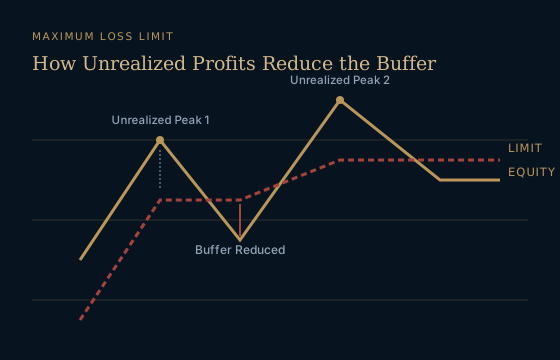
If a trader enters a position that immediately moves into profit, the trailing threshold moves up simultaneously. The highest point the open equity reaches becomes the new benchmark for the maximum loss limit. The critical factor is that this benchmark is established before the trader closes the position. The unrealized gain is treated as the new account high, and the drawdown limit is anchored to that specific peak.
The Official CFTC Definition of Drawdown
Regulatory bodies maintain strict definitions for financial terminology to ensure standard reporting across the industry. A drawdown in futures trading refers to the decline in account equity from its historical peak. (CFTC Glossary, retrieved 2026-09-13) This classical definition is based on realized equity over a specific reporting period. In traditional finance and institutional portfolio management, a drawdown is calculated based on closed positions and settled capital.
It measures the distance between the highest confirmed balance of a portfolio and its subsequent lowest point before a new high is achieved. When trading firms adapt this concept for retail simulated accounts, they often alter the parameters. Instead of measuring the decline from a historical peak of closed profits, the firm may measure the decline from a temporary, unrealized peak.
How Does Tracking Unrealized Intraday Profits Affect Risk?
The most significant structural element of an intraday trailing threshold is the inclusion of unrealized profits in the calculation. This mechanism is frequently misunderstood by participants who assume that only closed trades affect their account standing. Tracking unrealized equity fundamentally changes the risk-reward mathematics of a trading system.
When a limit tracks open equity, a winning trade that reverses can cause a breach even if the trade is eventually closed for a profit or a breakeven result. Consider a scenario where a trader enters a long position. The market rallies, and the open position shows a substantial floating profit. The trailing threshold immediately moves upward to shadow this peak.
If the market then retraces heavily, the floating profit evaporates. Even if the trader exits the position exactly at their original entry price, resulting in zero realized loss on the trade, the account may still be breached. The breach occurs because the distance between the highest floating equity peak and the exit price exceeded the maximum allowed drawdown limit.
Strategies Under an Intraday Trailing Threshold
This dynamic forces a shift in trade management. Strategies that rely on wide stops, scale-ins, or letting winners run through significant retracements are heavily penalized by an intraday trailing threshold.
The trader is incentivized to adjust execution in specific ways:
- Close positions quickly to capture the floating profit before a retracement occurs.
- Avoid holding through major structural pullbacks.
- Utilize rigid, tight take-profit orders rather than discretionary trailing stops.
In contrast, other operators utilize fixed limits. Ordane sells one product, the Ordane Instant Account: direct access, no evaluation phase and no challenge, on simulated capital. Ordane's maximum drawdown is 5 percent and static: account equity may never fall below 95 percent of the initial balance. The floor is fixed on day one, never trails upward, and a breach closes the account. (Ordane Rulebook v1.0, clause R-1, retrieved 2026-09-13) A static floor means that unrealized profits during a trade do not pull the failure line upward.
When Does the Trailing Stop Moving?
A trailing threshold that moves infinitely upward would make long-term account survival mathematically impossible, as any normal market drawdown would eventually intersect the trailing failure line. To mitigate this, firms implement a lock-in mechanism where the trailing threshold stops moving once a specific profit target is achieved and maintained.
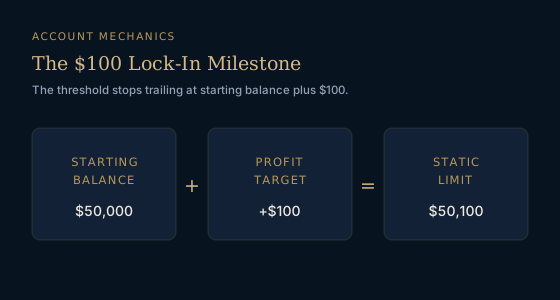
The trailing threshold on an Apex Trader Funding account stops trailing once it reaches the initial starting balance plus $100. (Apex Trader Funding FAQ, retrieved 2026-09-13) This is a critical structural milestone for the account. Once the trailing failure line touches this specific dollar amount, the rule changes from a trailing drawdown to a static drawdown. The limit is permanently anchored at the starting balance plus $100, regardless of how much additional profit the trader generates thereafter.
Declared inputs for this check: 50000, 100, and 50100. Worked arithmetic: 50000 + 100 = 50100.
The Transition to a Static Risk Environment
Reaching this milestone completely alters the risk profile of the account. During the initial phase, the trader is fighting a moving target. Every floating profit peak drags the failure line higher, compressing the available buffer.
However, once the threshold locks at the starting balance plus $100, the trader finally gains the ability to build a permanent cushion. Any realized profit generated above this locked level serves as a true buffer against future losses.
How Do Apex Drawdown Limits Scale by Account Size?
The absolute dollar value of the trailing threshold is not a fixed percentage across all account sizes. It scales according to the specific tier purchased by the trader. Understanding these exact nominal values is necessary for proper position sizing and risk allocation.
Risk Allocation and True Purchasing Power
A trader must calculate their maximum risk per trade based on the absolute dollar limit of the trailing threshold, not the nominal account size. To protect the account, the allocation must be strictly calibrated against the buffer limit.
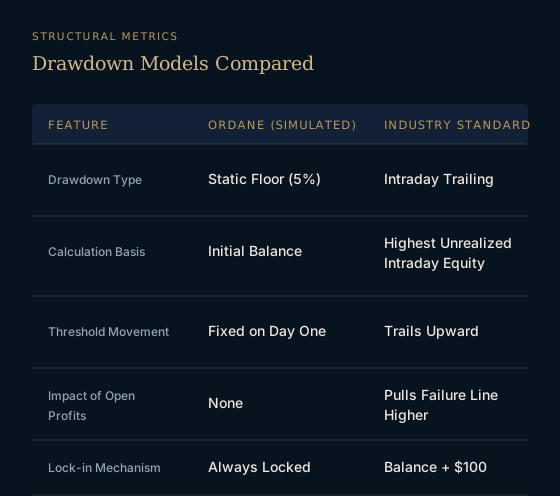
The following table compares how a static model differs from an intraday trailing model across key structural metrics.
| Metric/Feature | Ordane (Simulated) | Industry Standard |
|---|---|---|
| Drawdown Type | Static Floor (5 percent) | Intraday Trailing Threshold |
| Calculation Basis | Initial Starting Balance | Highest Unrealized Intraday Equity |
| Threshold Movement | Fixed on Day One | Trails Upward with Floating Profit |
| Impact of Open Profits | None | Pulls Failure Line Higher |
| Lock-in Mechanism | Always Locked | Locks at Starting Balance Plus $100 |
What Is the Impact of Intraday Calculations on Trade Management?
When a trading firm measures drawdown based on the highest unrealized equity point, the trader's approach to trade management must undergo a radical adjustment. In a traditional account, a trader might enter a position and set a profit target based on a major support or resistance level. They accept that the market will not move in a straight line, and they are prepared to endure minor pullbacks as long as the structural trend remains intact.
Under an intraday trailing threshold, this patience is actively penalized. Every minor peak in equity establishes a new failure line. If a trader holds a position through a pullback, they are not simply enduring a temporary reduction in floating profit; they are moving closer to an elevated breach level.
Psychological and Mechanical Pressures
This structural reality creates a strong incentive to employ scalp trading methodologies. Scalping involves entering the market, capturing a small, immediate price movement, and exiting the position before any significant retracement can occur. By closing the position quickly, the trader secures the realized profit and prevents the trailing threshold from climbing excessively high without locking in the corresponding capital.
However, this approach also limits the potential upside of any single trade. The trader is forced to accept smaller wins to protect the account from the mechanics of the drawdown rule. This creates a challenging mathematical environment, as the trader must maintain an exceptionally high win rate to offset the accumulated costs of minor losses and transaction fees.
The psychological toll of an intraday trailing limit is also significant. Traders are forced to constantly monitor their floating equity, knowing that a sudden spike in price followed by a sharp rejection can terminate their account. This constant pressure can lead to premature exits, overtrading, and a breakdown of trading discipline. The trader is no longer simply fighting the market; they are fighting the internal mechanics of the account structure itself.
How Should You Adjust Strategies for Intraday Thresholds?
Traders migrating from traditional brokerage accounts to simulated proprietary firm environments must completely overhaul their risk management frameworks. Traditional trading allows for wide stops and scaling into positions as they move against the entry price, provided the overall portfolio margin can sustain the drawdown. In an environment governed by an intraday trailing threshold, this approach is mathematically destructive.
When the failure line moves with unrealized profits, a trader can no longer afford to let winning positions retrace to breakeven in the hopes of capturing a larger trend. The retracement itself consumes the available drawdown buffer. Therefore, the strategy must pivot toward high-probability setups with immediate momentum, where the position either hits the profit target quickly or is closed for a minor loss before the failure line can advance significantly.
Evaluating the Statistical Probability of Success
The transition from the trailing phase to the locked phase represents the most difficult period for the trader. During this initial phase, the account is highly vulnerable. Every trade carries the dual risk of a realized loss and an elevated failure line.
Once the threshold locks at the starting balance plus $100, the mathematical pressure eases, and the trader can begin to allocate risk based on the accumulated realized buffer. However, reaching that lock-in point requires flawless execution and a complete understanding of how unrealized equity impacts the maximum loss limit.
Ultimately, evaluating a trading platform requires reading the explicit clauses of the rulebook. The terminology used in marketing materials rarely dictates the outcome of an account. The mechanical execution of the drawdown rule, the calculation basis of the threshold, and the treatment of unrealized profits are the objective factors that govern account survival. Participants must align their trading methodology with the mathematical realities of the platform's specific ruleset to maintain longevity in a simulated environment. If you are evaluating different structural models, you should compare an instant account to an evaluation to determine which ruleset aligns with your trading methodology.
Frequently Asked Questions
What Is the Apex Trader Funding Max Loss Limit?
Apex Trader Funding utilizes an intraday trailing threshold that tracks the highest account balance during the trading day, including unrealized profits, to calculate the maximum loss limit. (Apex Trader Funding Official Website, retrieved 2026-09-13)
Does the trailing limit lock at a specific balance?
Yes. The trailing threshold on an Apex Trader Funding account stops trailing once it reaches the initial starting balance plus $100. (Apex Trader Funding FAQ, retrieved 2026-09-13)
How is a drawdown defined by the CFTC?
A drawdown in futures trading refers to the decline in account equity from its historical peak. (CFTC Glossary, retrieved 2026-09-13)
What is the max loss limit at Ordane?
Ordane's maximum drawdown is 5 percent and static: account equity may never fall below 95 percent of the initial balance. The floor is fixed on day one, never trails upward, and a breach closes the account. (Ordane Rulebook v1.0, clause R-1, retrieved 2026-09-13)
Sources
Primary sources are linked inline above.
This article is for information only and is not investment, financial, or tax advice.
Ordane accounts operate on simulated capital. No live funds are traded and no deposits are accepted. Payouts depend on simulated performance under Rulebook v1.0; no level of performance is typical or assured.
Sources
- CFTC Glossary cftc.gov Retrieved 2026-09-13.
- Apex Trader Funding Official Website apextraderfunding.com Retrieved 2026-09-13.