Home · The Ordane Journal · Rules and Mechanics · The Funded Trader Max Loss Limit Explained
The Funded Trader Max Loss Limit Explained
The Funded Trader maximum loss limit is the strict boundary of capital drawdown the firm allows before automatically terminating a trader's evaluation account. Ordane accounts operate on simulated capital. No live funds are traded and no deposits are accepted.
In one sentence: The Funded Trader maximum loss limit is the strict boundary of capital drawdown the firm allows before automatically terminating a trader's evaluation account.
The Funded Trader (prop firm) imposes two strict risk parameters on its Standard Challenge. The daily loss limit restricts losses to a specific percentage of the starting day balance, while the overall loss limit caps the total drawdown from the initial balance. Violating either rule results in an immediate account closure.
Maximum drawdown limits are a standard risk management rule enforced by proprietary trading firms (Finance Magnates, retrieved 2026-09-05). Understanding these metrics is critical because an accidental breach eliminates the trader from the evaluation program instantly. Traders must monitor both their daily equity fluctuations and their absolute account balance to survive the mandatory trading period.
How Does The 5% Daily Loss Limit Work?
The daily loss limit dictates exactly how much capital a trader can lose in a single trading day before the system disables the account entirely. The Funded Trader Standard Challenge has a maximum daily loss limit of 5% (The Funded Trader, retrieved 2026-09-05). This specific calculation relies on the higher of the account balance or the account equity at the daily reset time. If a trader starts the day with a defined balance and takes multiple losing positions that push the floating equity below the daily threshold, the breach occurs immediately.
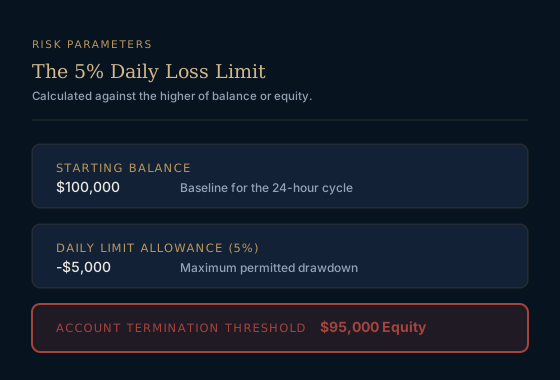
Declared inputs for this check: 100000, -5000, and 95000. Worked arithmetic: 100000 + -5000 = 95000. If the trader executes a position that drops to a $5,001 floating loss, the account is terminated instantly, even if the market price reverses one second later and closes in profit. The infrastructure monitors equity tick by tick, meaning there is absolutely no margin for error when approaching the boundary.
Managing a daily limit requires precise position sizing and execution. If the limit is strictly enforced by the server infrastructure, traders cannot rely on floating profits from the previous day to infinitely expand their daily allowance. The server reset time establishes a new high-water mark for the next twenty-four hours of market exposure.
Here is how the daily loss calculation impacts decision making:
- Traders must size their positions to withstand normal intraday volatility.
- Stop-loss orders become mandatory tools to prevent unexpected news spikes from triggering a breach.
- Floating equity must be monitored constantly during active trading sessions.
- Carrying trades across the server reset time alters the baseline for the next day.
How Does The 10% Overall Loss Limit Work?
The overall loss limit functions as the ultimate baseline floor for the trading account. The Funded Trader Standard Challenge has a maximum overall loss limit of 10% (The Funded Trader, retrieved 2026-09-05). Unlike the daily limit, which resets every cycle to reflect the current balance, the overall limit remains completely static against the initial starting balance during the entire evaluation phase.
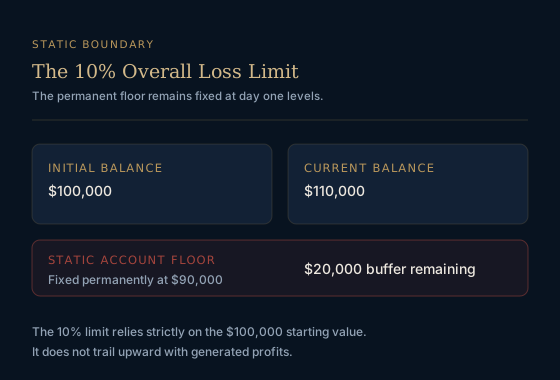
The math behind the overall limit requires continuous monitoring. If a trader starts with $100,000 and the overall limit is 10 percent, the account floor is permanently fixed at $90,000. If the trader loses $4,000 on the first day, the new balance is $96,000. The overall floor remains exactly $90,000, meaning the trader now only has a $6,000 absolute buffer remaining before total failure. This static floor is generally preferred by traders over trailing drawdowns, as it allows them to build a robust buffer once they secure initial profits. A trader who reaches a balance of $110,000 still has the same $90,000 floor, providing a massive $20,000 operational runway.
A trader might survive the daily limit for several consecutive days but still breach the overall limit if the cumulative losses steadily reach the ten percent threshold. This creates a dual-layered risk environment where both immediate market volatility and long-term negative expectancy can terminate the trading session permanently.
To visualize the interaction between these two limits, consider the following parameters:
- The starting balance dictates the absolute floor.
- The daily reset dictates the short-term floor.
- The most restrictive of the two floors is the one that triggers the breach.
Do You Pay Extra for Drawdown Buffers?
Traders often wonder if they must purchase additional margin to survive volatile market conditions. The standard drawdown buffers are built directly into the initial evaluation fee, meaning the capital buffer is defined definitively at the moment of purchase.
Firms structure these limits to filter out high-risk trading styles that rely on deep drawdowns to recover losing positions. Purchasing a larger account size naturally provides a larger absolute dollar amount for the drawdown buffer, but the percentage allowance remains absolutely fixed. A larger account inherently requires a proportionally larger upfront fee to access the environment.
When navigating these offerings, the participant is paying for the opportunity to demonstrate risk management within the predefined buffers.
The Evaluation Business Model
In the standard evaluation model, the firm generates revenue primarily from the upfront fees paid by traders who fail to respect the loss limits. The buffer itself is not an additional product; it is the core constraint of the test.
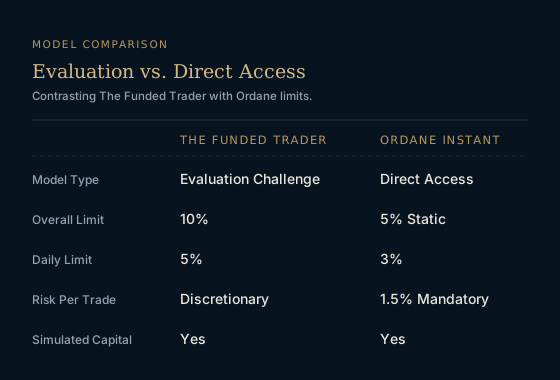
Ordane sells one product, the Ordane Instant Account: direct access, no evaluation phase and no challenge, on simulated capital. Ordane's maximum drawdown is 5 percent and static: account equity may never fall below 95 percent of the initial balance. The floor is fixed on day one, never trails upward, and a breach closes the account. The daily loss limit is 3 percent, measured against the balance at the start of the server day. A breach closes the account.
| Parameter | The Funded Trader Standard | Ordane Instant Account |
|---|---|---|
| Account Type | Evaluation Challenge | Direct Access |
| Overall Loss Limit | 10% | 5% Static |
| Daily Loss Limit | 5% | 3% |
| Risk Per Trade | Discretionary | 1.5% Mandatory |
Are There Hidden Rules in the TFT Drawdown?
The calculation method for equity and balance often confuses market participants attempting their first evaluation. The daily loss limit calculation explicitly includes floating unrealized losses. If a trader holds a position that goes deeply negative but eventually closes in profit, the account will still breach if the floating drawdown breaches the daily limit percentage at any millisecond during the life of the trade.
This automated mechanism prevents traders from holding massive losing positions in the desperate hope of a sudden market reversal. It strictly enforces stop-loss discipline at the server level.
Another critical factor in drawdown calculations is the impact of market slippage and execution latency. During high-impact macroeconomic news releases, liquidity often vanishes from the order book. If a trader holds a position during these events, a stop-loss order might experience severe slippage. The trading server executes the order at the next available price, which can easily push the total loss beyond the daily limit. The system does not forgive breaches caused by slippage; the responsibility for managing event risk rests entirely with the trader.
Furthermore, holding positions over the weekend introduces gap risk. When markets reopen on Sunday evening, prices frequently gap significantly above or below the Friday closing price. If a position gaps against the trader and the opening equity breaches the overall or daily limit, the account is closed the moment the market opens.
At Ordane, maximum risk per trade is 1.5 percent of current balance and a stop-loss is mandatory at entry. Two maximum losses equal the daily limit, which is the design rather than an accident.
Static versus Trailing Limits
Some firms implement a trailing drawdown that moves upward dynamically as the trader secures profits. A trailing system means the loss limit follows the highest equity point of the account, constantly reducing the available buffer if profits are not immediately protected. Understanding whether the limit is static or trailing defines the entire trading strategy for the lifecycle of the specific account.
The mechanics of a static limit are inherently more transparent:
- The overall floor never moves up, regardless of how much profit the trader accumulates.
- Once a trader secures profits equal to the drawdown percentage, they are effectively trading with their generated buffer.
- The mathematical baseline remains tied to the initial starting balance on day one.
What Happens to Your Account After a Breach?
A breach triggers an immediate and automated response from the trading infrastructure. The platform disables trading access in real time, closes all open positions at the current market quote, and completely cancels all pending orders. The trader receives an automated notification regarding the specific rule violation that occurred.
Once an evaluation account is breached, it cannot be recovered or restored. The evaluation is permanently failed, and the trader must start a completely new evaluation from the beginning to re-enter the ecosystem. There is no partial credit awarded for passing phase one if the account subsequently breaches during phase two.
For direct access models, the consequence is identical and equally final. A breach closes the account. That is the whole consequence: no partial confiscations, no surprise fees, no renegotiation. There are no penalty fees or hidden charges applied to the trader after a breach occurs, but the initial fee paid to access the environment is entirely consumed.
The Psychological Impact of Rule Breaches
Experiencing an automated account closure often forces traders into a cycle of revenge trading. Understanding the finality of the breach is essential for maintaining long-term discipline.
Key aspects of post-breach reality include:
- The trading terminal immediately transitions to read-only mode.
- All historical data remains accessible for review and journaling purposes.
- The trader must acknowledge the failure before initiating a new purchase.
- The system applies the rules equally to all participants without exception.
Is the Cost to Retry Justified?
When an evaluation is failed, the only path forward is purchasing a completely new challenge at retail price. This introduces a significant recurring cost for traders who struggle with consistent risk management. The industry standard model relies heavily on traders paying multiple evaluation fees in rapid succession before ever reaching a payout stage.
The psychological toll of the evaluation cycle is compounded by the financial cost. Traders who consistently fail challenges often spend thousands of dollars in cumulative fees. This cycle generates significant friction and frustration. The traditional model forces the trader to prove their consistency repeatedly before ever accessing an environment where profits are eligible for withdrawal.
The direct access model removes this repetitive financial burden by aligning the cost directly with the trading environment. Because there is no phase one or phase two, the trader is immediately operating under the final ruleset. This eliminates the pressure to artificially inflate risk simply to pass an arbitrary profit target within a time limit. Removing the profit target allows the trader to focus exclusively on capital preservation and executing their designated strategy.
Ordane eliminates the evaluation cycle entirely from the process. The fee is one-time: $59 for the $2,500 account, $139 for the $10,000 account, $299 for $25,000, $549 for $50,000 and $999 for $100,000. There are no recurring fees, no hidden tiers and no coupon games. The cost is transparent and grants immediate access to the trading environment on day one.
If a trader breaches the static limit, they must purchase a new account to continue operating on the platform. However, they are not paying to take a test; they are paying for direct access to the trading infrastructure.
| Action Taken | Impact on Account Status | Required Next Steps |
|---|---|---|
| Breach 5% Daily Limit | Immediate Closure | Purchase new account |
| Breach 10% Overall Limit | Immediate Closure | Purchase new account |
| Breach 1.5% Trade Risk (Ordane) | Position rejected or closed | Adjust risk sizing |
Frequently Asked Questions
Is the loss limit based on balance or equity?
The daily loss limit calculations typically use the higher of the starting day balance or the starting day equity. This specific baseline means floating profits from the previous day that are intentionally carried over into the new day will raise the baseline for the subsequent daily loss calculation. The overall loss limit is strictly calculated against the initial starting balance of the account, ensuring the absolute floor remains unchanged.
Does a payout change the drawdown?
In an evaluation model, traders do not receive payouts during the testing phases. Once an account successfully reaches the active stage, requesting a payout usually reduces the total account balance. If the overall drawdown is static, withdrawing profits brings the current balance closer to the hard floor, significantly reducing the absolute dollar buffer available for future trades. Traders must weigh the benefit of realizing capital against the reduction of their operational buffer.
Can a trader scale the loss limit?
Loss limits are definitively defined by percentages and remain entirely fixed throughout the lifecycle of the account. While successful traders might eventually qualify for account scaling plans that increase their total simulated capital base, the risk parameters of 5 percent daily and 10 percent overall remain mathematically consistent. The absolute dollar amount of the buffer increases proportionally, but the relative risk boundary does not expand.
Are there hidden fees after a breach?
Proprietary trading firms do not charge traders additional penalties, recurring subscriptions, or hidden fees when an account is officially breached. The ultimate consequence of a rule violation is simply the immediate termination of the account and the permanent forfeiture of the initial fee paid to access the platform. The trader's personal capital is never exposed to the financial markets during this process.
What time does the daily loss reset?
The exact reset time for the daily loss calculation depends entirely on the server configuration of the specific firm. Traders must be acutely aware of this specific reset window, as holding floating losses across the reset boundary establishes a new, lower high-water mark for the following day, drastically increasing the probability of a daily limit violation.
Sources
- Prop Trading Evaluation Metrics: Drawdowns (Finance Magnates, retrieved 2026-09-05)
- Standard Challenge | The Funded Trader (retrieved 2026-09-05)
Important: Ordane accounts operate on simulated capital. No live funds are traded and no deposits are accepted. Ordane is not a regulated broker or financial advisor. This content is educational only and does not constitute investment advice, financial advice, or a recommendation. Do not risk more than you can afford to lose. Past performance and simulated results do not guarantee future results. All proprietary trading involves risk of loss.