Home · The Ordane Journal · Rules and Mechanics · Topstep EA Rules: Custom vs. Commercial Bots
Topstep EA Rules: Custom vs. Commercial Bots
EA rules define the strict parameters proprietary trading firms use to distinguish between permitted custom algorithms and prohibited mass-market commercial bots. Ordane accounts operate on simulated capital. No live funds are traded and no deposits are accepted.
In one sentence: Topstep EA rules permit custom algorithms but strictly prohibit commercial bots to prevent identical order flow across multiple accounts.
Topstep (prop firm) maintains specific regulations regarding the deployment of Expert Advisors. Traders often seek clarity on the exact parameters governing algorithmic trading within proprietary trading environments. The boundary between permitted automation and prohibited behavior is a critical factor for anyone deploying custom code. Evaluating these boundaries requires a careful reading of the published contracts. Understanding the mechanics of algorithmic execution across different platforms helps traders configure their systems to remain compliant.
Algorithmic trading introduces unique challenges for risk management departments. Firms must distinguish between a trader automating their own unique logic and a thousand traders buying the same commercial robot. The latter creates concentrated risk, where a single market event triggers identical positions across numerous accounts simultaneously. This concentration is why clear definitions matter. Ordane sells one product, the Ordane Instant Account: direct access, no evaluation phase and no challenge, on simulated capital. Every platform approaches this distinction differently, relying on their specific terms of service to govern execution.
What EA Rules Apply to Topstep Evaluations?
Topstep permits the use of Expert Advisors and automated trading algorithms during evaluations and in simulated environments, provided you develop or parameterize the strategy yourself. The firm strictly prohibits off-the-shelf commercial bots that execute identical trades across multiple accounts, classifying such behavior as illicit copy trading.
The primary mechanism Topstep uses to govern algorithmic activity revolves around originality and independence. This means the core logic, or at least the specific parameter configuration, must belong to the individual running the software. A trader who codes a proprietary trend-following algorithm, compiles it, and runs it on their own machine is operating within the permitted boundaries. The objective is to evaluate the individual trader's ability to construct and manage a strategy, rather than their ability to purchase a pre-packaged product from a vendor.
Firms require this independence because identical order flow from multiple users presents systemic issues. When a large group of individuals run the exact same logic with the exact same inputs, their orders aggregate into a massive, coordinated block.
- Systemic Risk: Identical algorithms enter and exit at the exact same price levels.
- Capacity Limits: Massive simultaneous orders strain simulated server infrastructure.
- Evaluation Failure: Purchasing a bot demonstrates no individual trading ability.
To prevent this, proprietary trading providers enforce strict prohibitions against mass-market automation. The firm prohibits the use of off-the-shelf, commercially available EAs that execute identical trades across multiple user accounts, classifying this behavior as an illicit copy trading practice. By contrast, the rules governing the Ordane environment are structured around a definitive, public list. The Ordane rulebook is public, numbered and versioned, and no rule is ever applied retroactively to an open account. Changes produce a new version with a dated changelog entry, and the version you sign up under is the version that governs your account. Ordane's prohibited-practice list is closed. Regarding automation, Expert Advisors are fully permitted at Ordane: a trader may run an EA executing the trader's own strategy on an Ordane account.
Custom EAs vs. Commercial Bots
The distinction between custom development and commercial acquisition forms the foundation of modern algorithmic compliance. A custom Expert Advisor is a piece of software where the logic is bespoke or the parameters are uniquely tuned by the operator. Even if the underlying code framework uses open-source libraries, the specific moving average periods, risk multipliers, and time filters must reflect an independent decision-making process. This independence ensures that the resulting trades do not perfectly mirror the activity of other participants on the network.
Commercial bots represent the opposite end of the spectrum. These are systems sold or distributed to the public, designed to be deployed with zero modification. Vendors often market these products with unverified claims, instructing buyers to load the exact same configuration files. When twenty users deploy the exact same commercial file, the trading server receives twenty identical market orders at the exact same millisecond.
Compliance algorithms flag this pattern instantly. Firms categorize this as unauthorized copy trading because the individual account holder is no longer the author of the trading decisions.
Traders must understand that the prohibition targets the resulting order flow, not necessarily the programming language or the trading terminal used. If a trader purchases a foundational code template but heavily modifies the entry criteria and risk management rules so that the output becomes unique, they move from the commercial category into the custom category. The defining metric is always the uniqueness of the execution signature on the server.
The CFTC Algorithmic Trading Definition
Regulatory frameworks provide essential context for how trading firms define automation. This definition emphasizes autonomy. An algorithm removes the human from the immediate execution loop, transferring the decision of when and how much to buy or sell to a mathematical construct.
Because the software determines the timing and the price autonomously, firms providing simulated capital must ensure that the autonomy belongs to the account owner, not to a third-party developer distributing identical code. The regulatory focus on market integrity and orderly execution mirrors the internal risk controls of proprietary trading providers. When autonomous systems malfunction or operate in perfectly synchronized herds, they create instability. Restricting mass-market commercial bots is a direct response to the risks associated with coordinated, autonomous order flow.
What Happens If You Breach the EA Policy?
Violating execution policies carries immediate consequences. When a compliance department detects unauthorized commercial bot usage, the standard industry response is account termination. The logic is straightforward: deploying a banned system invalidates the evaluation parameters. The firm cannot assess a trader's risk management skills if a prohibited third-party algorithm is making all the decisions. Therefore, the account is closed, and any simulated profits generated by the banned software are voided.
Many traders worry about hidden clauses that might trigger an unexpected closure. They ask what hidden rule applies to their account. Clarity requires a defined standard. At Ordane, the standard is explicit. A breach closes the account. That is the whole consequence: no partial confiscations, no surprise fees, no renegotiation. The rules are published in the versioned rulebook, and the prohibited practices are confined to a closed list. Traders know exactly what behavior constitutes a violation because it must be listed in the contract.
If a trader is flagged for copy trading under a commercial EA ban, the firm will typically notify them via email, citing the specific terms of service violation. The detection is usually automated, based on algorithmic matching of trade data. Once the match is confirmed, the termination is final. Traders do not receive refunds for accounts closed due to a deliberate policy violation. This underscores the necessity of reading the governing documents before connecting any automated system to the server.
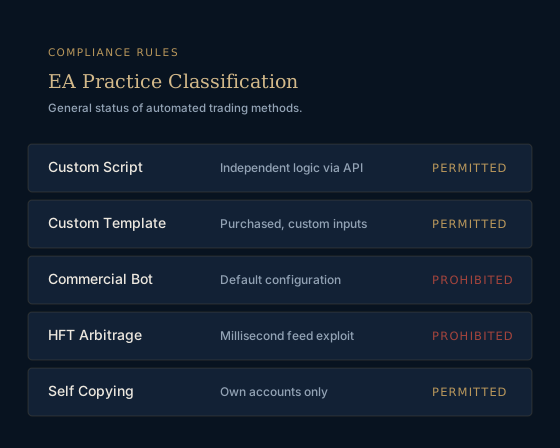
To provide a clear view of how different practices are categorized, the following table summarizes common algorithmic activities and their typical compliance status.
| Algorithmic Practice | Description | General Compliance Status |
|---|---|---|
| Custom Python Script | Independently coded logic interacting via API. | Permitted |
| MQL4 Commercial Bot | Purchased off-the-shelf and run with default settings. | Prohibited |
| Parameterized Template | Purchased base code with uniquely customized inputs. | Permitted |
| HFT Arbitrage | Millisecond exploitation of feed delays. | Prohibited |
| Trade Copier (Self) | Copying trades between a trader's own accounts. | Permitted |
Are There Extra Costs for Using EAs?
Traders deploying Expert Advisors must consider the infrastructure required to run them continuously. While the proprietary trading firm itself may not charge a specific fee for the privilege of using an EA, the technical requirements generate external costs. A reliable algorithm cannot run on a laptop that goes to sleep or loses a network connection.
The primary external cost is a Virtual Private Server (VPS). A VPS provides a stable, always-on environment hosted in a data center, ensuring the trading terminal remains connected to the broker's server twenty-four hours a day. Depending on the processing power and RAM required, a standard VPS can cost a fixed amount per month. Additionally, traders developing custom algorithms in languages like Python or C# may need to pay for premium data feeds or API bridge software to connect their logic to the trading platform.
When evaluating costs, traders ask if they will actually get paid after investing money in evaluations and infrastructure. They fear passing an evaluation, paying the fees, and never receiving the payout. To address this, a firm must provide a binding mechanism.
The Ordane Guarantee provides this mechanism. Every withdrawal request is approved, or denied in writing citing the exact rule breached by section number, within 24 clock hours. Past that deadline the request is treated as approved and the payout clock starts. A payout approved and not paid within 48 clock hours, not business hours, triggers automatic compensation: a 100 percent refund of the account fee, plus the payout owed in full. The guarantee includes specific boundaries. Both exclusions (documented fraud or KYC review, and declared force majeure) are capped at 10 business days each. Past that deadline, automatic compensation applies regardless. This structure ensures that the financial commitment of the firm is defined by a clock, not by discretion.
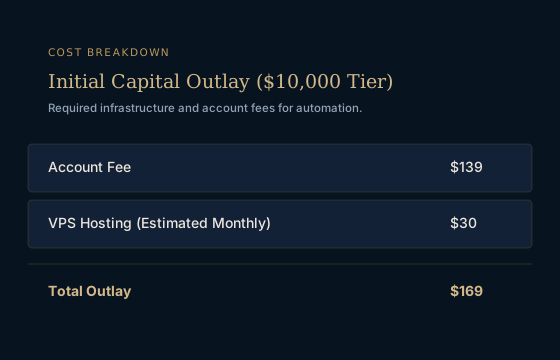
To provide a clear view of standard costs, here is a cost scenario. Declared inputs: a $139 account fee, a $30 server fee, and a 60 percent payout split. Calculated total initial outlay: $169.
| Cost Component | Value | Description |
|---|---|---|
| Account Size | $10,000 | The simulated balance of the selected tier. |
| Account Fee | $139 | The upfront price for the account. |
| VPS Server Fee | $30 | The estimated monthly cost for hosting. |
| Total Outlay | $169 | The combined upfront capital required. |
This scenario uses the pricing structure of the Ordane product line. Ordane Instant Account comes in five sizes: $2,500, $10,000, $25,000, $50,000 and $100,000. The fee is one-time: $59 for the $2,500 account, $139 for the $10,000 account, $299 for $25,000, $549 for $50,000 and $999 for $100,000. There are no recurring fees, no hidden tiers and no coupon games. The payout model is equally defined. Ordane's profit split starts at 60 percent and rises 5 percentage points with every completed withdrawal, reaching 100 percent from the ninth withdrawal onward. Developers migrating a custom algorithm from a challenge model to direct access can compare the structure or select a balance at a list of accounts.
How to Ensure Your Bot Complies?
Deploying an automated strategy requires procedural discipline to ensure the code does not inadvertently trigger a compliance violation. The goal is to separate your execution signature from the mass market.
- Parameter Customization: If you purchase an algorithmic framework or collaborate on open-source code, you must alter the default settings. Change the look-back periods on your indicators, adjust the risk multipliers, and modify the stop-loss logic. Do not use the out-of-the-box configuration files.
- Rigorous Backtesting: Prove to yourself that your modified logic works in simulated conditions before deploying it in a live evaluation. This step confirms that the changes you made to avoid compliance flags have not destroyed the viability of the strategy.
- Frequency Monitoring: Ensure your bot operates at human-scale frequency. High-frequency trading models that place hundreds of orders per second will trigger infrastructure alarms and violate rules against bulk automated exploitation. The system must trade based on structural market decisions, not millisecond arbitrage.
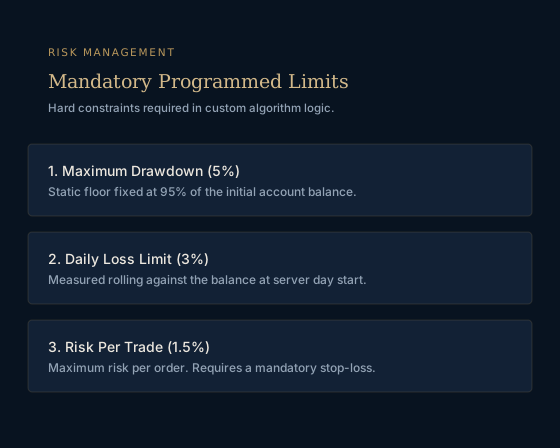
When designing a custom EA, the developer must program hard stops that respect the firm's specific drawdown parameters. An algorithm without a coded safety net will inevitably breach the account during a volatility spike. Understanding the specific drawdown architecture is mandatory. Ordane's maximum drawdown is 5 percent and static: account equity may never fall below 95 percent of the initial balance. The floor is fixed on day one, never trails upward, and a breach closes the account. Therefore, an EA designed for this environment must calculate risk based on the initial balance and possess a strict logic gate that halts trading before the 5 percent threshold is reached.
Similarly, daily loss limits require precise coding. The daily loss limit is 3 percent, measured against the balance at the start of the server day. A breach closes the account. An EA must be able to track realized and unrealized losses on a rolling 24-hour basis, resetting its internal counters at the exact start of the server day.
Risk per trade is another critical variable that the algorithm must enforce autonomously. Maximum risk per trade is 1.5 percent of current balance and a stop-loss is mandatory at entry. Two maximum losses equal the daily limit, which is the design rather than an accident. A compliant EA must automatically calculate position sizing based on the distance to the stop-loss and the current balance, ensuring that no single order ever exposes more than 1.5 percent of the equity. Furthermore, the bot must transmit the stop-loss order to the server simultaneously with the entry order to comply with the mandatory stop-loss rule.
Consistency rules also impact algorithmic design. Algorithms that rely on infrequent, massive wins might struggle with payout conditions. Ordane's consistency rule is 20 percent: at the moment of a withdrawal request, no single trading day may account for more than 20 percent of the cycle's total profit. If a day exceeds 20 percent, the excess profit from that day is deferred to the next cycle. It is never confiscated, and the remainder of the cycle pays out normally. An EA developer might need to program a daily profit cap, instructing the bot to cease trading once a specific profit target is reached, thereby ensuring a smooth equity curve that complies with the consistency mandate.
Inactivity is the final technical hurdle. An EA designed for extreme long-term swing trading must not remain dormant for too long. Accounts with no trading activity for 30 consecutive days are closed. The EA must be active enough to register a filled order within that window. By programming these specific constraints directly into the algorithmic logic, a trader transforms a generic piece of code into a bespoke system tailored for a specific proprietary trading environment.
Traders often wonder if the firm they are trading with will still exist in 12 months, fearing the company might vanish with their fees. Transparency regarding capital reserves is the only verifiable answer to this fear. Ordane is new. Its live homepage says it will not fake a history; the rulebook says payout performance metrics begin with the first month in which a payout is requested. Ordane's payout reserve is published at a public TRON address on ordanemarkets.com and in the rulebook. Payouts are paid in real money from company fee revenue. No client deposits are taken and no client capital is traded. The commitment to publish the payout reserve on-chain stands firm.
Topstep EA Rule FAQ
Can I use a purchased EA?
Purchasing the foundational code of an Expert Advisor is generally acceptable, but running it with the exact same configuration as every other buyer is not. The system must be independently parameterized to ensure your execution logic is unique and does not mirror other accounts.
Are EAs allowed in funded accounts?
Yes, Topstep permits the use of automated strategies across both the evaluation phase and the simulated live environment, provided the software complies with the independence and originality requirements.
How does Topstep detect commercial bots?
Firms utilize automated compliance algorithms that monitor trade data across the entire user base. They look for identical entry times, pricing, and position sizing that occur simultaneously across multiple accounts, which is the signature of a mass-distributed commercial bot.
Does the CFTC oversee EA usage?
The CFTC oversees algorithmic trading broadly within US derivatives markets to maintain market integrity. While they do not review individual retail EAs, their regulations influence how firms structure their rules against disruptive automated practices.
Do I need to submit my EA source code?
Typically, traders are not required to submit their proprietary source code for review. Compliance is monitored via the resulting order flow on the server, not by analyzing the code itself.
Sources
- Topstep Help Center, on whether automated strategies and EAs can be used. help.topstep.com Retrieved 2026-09-05.