Home · The Ordane Journal · Rules and Mechanics · The Funded Trader Inactivity Rule Explained
The Funded Trader Inactivity Rule Explained
The inactivity rule in proprietary trading is an automated administrative threshold that closes dormant accounts to optimize server resources. For The Funded Trader (prop firm), participants must execute at least one simulated trade every 30 days to avoid a permanent account breach and loss of accumulated simulated profits.
Ordane accounts operate on simulated capital. No live funds are traded and no deposits are accepted.
In one sentence: The Funded Trader requires a new simulated trade every 30 days to prevent an inactivity breach, differing from regulated brokerages which typically allow twelve months of dormancy before freezing accounts.
Proprietary trading firms operate strict risk management frameworks to monitor participant activity, manage server exposure, and maintain the integrity of their trading infrastructure. Understanding the specific thresholds for inactivity is critical for participants managing multiple accounts, utilizing automated systems, or taking extended breaks from the financial markets.
When a trading account goes dormant, the firm's automated risk engine triggers a breach protocol. This action closes the account permanently and voids any accumulated simulated profit, regardless of how successful the participant was prior to the period of inactivity. The strict enforcement of this rule highlights the operational reality of proprietary firms: they require active data generation and must continually clear inactive server resources to optimize platform performance for active participants.
What Is The Funded Trader Inactivity Rule?
The Funded Trader inactivity rule dictates that a participant must execute at least one simulated trade every 30 days to avoid account closure. Logging into the platform does not count as activity. Failure to place a simulated trade within this specific timeframe results in an automatic inactivity breach.
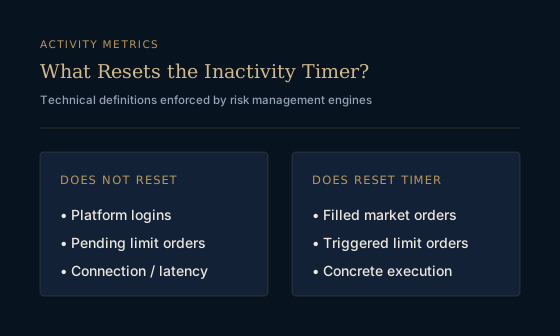
To understand how this mechanic functions in practice, participants must look at the technical definitions of trading activity applied by the firm's risk management engine. The system requires a verifiable order execution logged directly on the trading server, completely independent of user interface interactions or portal logins. The architecture of these monitoring systems ensures that only concrete market exposure resets the internal countdown timers.
- Account connection status and ping latency are ignored by the inactivity monitor.
- Platform logins through a web portal or desktop terminal do not generate a valid trading ticket.
- Pending limit or stop orders that sit on the book and are never triggered do not constitute execution.
- The system timer operates on a continuous rolling basis, calculated from the exact timestamp of the last closed or opened position.
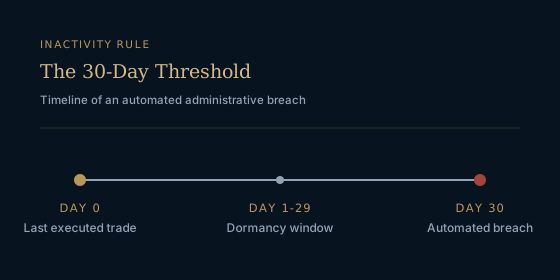
The 30-day simulated trading requirement
Proprietary trading firms set hard administrative deadlines to clear inactive users from their infrastructure. The Funded Trader requires participants to place at least one simulated trade every 30 days to prevent their account from being breached due to inactivity. This timeline is absolute and operates independently of market conditions, national holidays, server maintenance windows, or participant availability. The burden of tracking the exact date of the last execution falls entirely on the individual managing the account.
For structural comparison, Ordane enforces a similar administrative threshold for its environment to maintain system efficiency. Accounts with no trading activity for 30 consecutive days are closed. The measurement of this period relies on strict calendar logic rather than active trading sessions or exchange open hours. The 30 consecutive days in clause R-5 are calendar days (dias corridos), not business days. Participants managing medium-term swing positions or taking extended time away from the screens must track their last execution date meticulously. A participant who takes a four-week hiatus risks returning to a permanently closed account if the exact calendar threshold is crossed before a new order is logged by the matching engine.
To manage this requirement, participants holding multiple accounts often utilize automated systems or scheduled manual interventions. Expert Advisors are fully permitted at Ordane: a trader may run an EA executing the trader's own strategy on an Ordane account. However, if an automated system crashes, loses server connection, or simply finds no valid technical setups for a full month, the account will still breach. The risk engine does not differentiate between intentional abandonment and a malfunctioning algorithmic script.
Why simply logging in does not reset the timer
A common misconception among newer participants is that maintaining an active server session, analyzing charts, or opening the trading terminal registers as activity. Simply logging into the trading platform is not sufficient to reset the inactivity timer; a new simulated trade must actually be executed.
Risk management systems read database entries related exclusively to order tickets, not authentication tokens or login session logs. When a proprietary firm audits an account for dormancy, the query scans the trade ledger for the most recent timestamp of a market order or a triggered limit order. If the calculated delta between the current server time and that last execution timestamp exceeds the 30-day limit, the breach protocol executes instantly.
Ordane applies an equally strict technical definition to this activity metric. Under clause R-5, trading activity means at least one filled order. Pending orders and platform logins do not count. This rigid definition prevents participants from parking accounts indefinitely without engaging with the simulated market environment. To reset the timer safely, a participant must send an order that crosses the spread and registers a distinct ticket number in the trading history. Many participants handle this by executing a micro-lot position and closing it immediately, absorbing a minor spread cost solely to generate the required execution timestamp.
How Does Prop Firm Inactivity Differ From Regulated Brokers?
The regulatory environment governing traditional retail brokerages establishes fundamentally different baseline rules for dormant accounts compared to the proprietary trading industry. Proprietary firms provide software evaluations and operate entirely in simulated environments, freeing them from the strict asset custody regulations that govern standard financial institutions and registered brokers.
This structural difference dictates exactly how long an account can remain inactive before the provider is legally or operationally compelled to take action. Regulated entities must protect real client capital, navigate escheatment laws, and adhere to federal guidelines regarding abandoned property. Proprietary firms, free from these custody burdens, focus entirely on server efficiency, risk exposure management, and removing inactive software licenses from their operating overhead.
- Traditional brokerages hold client deposits in segregated accounts and must follow statutory timelines for dormancy.
- Proprietary firms provide simulated capital and clear out inactive data aggressively to optimize server load and reduce licensing fees.
- Regulatory baselines for traditional finance are measured in months or years, while prop firm administrative limits are measured strictly in days.
- A dormant regulated account is frozen pending verification, whereas a dormant prop firm account is permanently terminated.
The CFTC 12-month dormant account baseline
In regulated traditional markets, the Commodity Futures Trading Commission (CFTC) defines a dormant account as one that has not traded for a period of twelve months, contrasting with the much shorter inactivity windows enforced by proprietary trading firms. This twelve-month standard exists explicitly because the regulated broker is custodying actual client assets and must operate within legal frameworks designed to protect consumer funds.
Closing a regulated brokerage account due to inactivity involves complex, legally mandated procedures. Brokers must issue formal written warnings, attempt contact across multiple channels, and eventually transfer abandoned funds to state treasury departments under escheatment laws. Because proprietary trading firms do not take deposits or custody client funds, they bypass these heavy administrative requirements entirely.
Ordane sells one product, the Ordane Instant Account: direct access, no evaluation phase and no challenge, on simulated capital. Without the legal burden of client asset custody, proprietary firms can implement aggressive 30-day administrative closures to keep their active participant pool accurate and their infrastructure costs tightly controlled. The 30-day rule acts as an automated cleanup mechanism, sweeping the database of accounts that are no longer generating useful simulated trading data or progressing toward a payout cycle.
The following table compares the structural and operational differences between traditional regulated brokers and typical proprietary trading firms regarding account inactivity and dormancy protocols.
| Operational Metric | Regulated Broker (CFTC Standard) | Proprietary Trading Firm Model |
|---|---|---|
| Underlying Capital Type | Verified client deposits | Simulated capital |
| Standard Dormancy Threshold | 12 continuous months | Typically 30 consecutive days |
| Primary Action on Inactivity | Account frozen, funds secured or returned | Account breached and permanently closed |
| Required Reset Mechanism | Trade execution or new account funding | Simulated trade execution exclusively |
| Consequence to Account Balance | Funds remain property of the client | Accumulated simulated profit is voided |
| Governing Legal Framework | Federal financial regulation | Private firm contractual rulebook |
What Happens if You Breach the Inactivity Rule?
A breach of the inactivity rule triggers the immediate, irreversible, and permanent closure of the trading account. Proprietary risk engines monitor the 30-day threshold automatically via continuous database queries, and the resulting closure action requires absolutely no manual intervention, review, or approval from the firm's support staff. Once the breach condition is logged by the system, the trading credentials are automatically revoked, the server connection is severed, and the participant instantly loses all access to the simulated trading environment.
The finality of this automated process is a standard operational procedure across the proprietary trading industry. Firms do not offer grace periods, issue preliminary email warnings, or provide temporary extensions before executing an inactivity breach. The responsibility for monitoring the timeline rests entirely on the participant.
- All open simulated positions are immediately liquidated at the current market price.
- The participant's web dashboard updates automatically to reflect a breached or failed status.
- Any accumulated simulated profit sitting in the account is permanently forfeited and deleted.
- The specific account instance cannot be reactivated, rolled back, or appealed through customer support.
Account closure and loss of simulated profit
When an inactivity breach occurs, the participant loses the trading account and all associated historical progress. The most severe consequence for many participants is the financial impact on pending balances. If the account holds a significant simulated profit at the exact moment the 30-day timer expires, that entire profit is erased. Proprietary trading firms do not process payouts or honor balances on breached accounts, regardless of whether the breach was triggered by a catastrophic risk management violation or a simple administrative oversight like the inactivity rule.
Ordane operates with similar absolute finality regarding rulebook violations and account closures. A breach closes the account. That is the whole consequence: no partial confiscations, no surprise fees, no renegotiation. Participants must manage their trading schedule meticulously to ensure a valid simulated trade is placed and filled before the deadline, or they must accept the total loss of the account equity. The automated system does not differentiate between a participant who suffered a medical emergency, one who experienced a technical failure with an automated script, or one who abandoned the evaluation intentionally. The rule is applied uniformly across the entire participant base based strictly on server execution timestamps.
Do you have to pay a new evaluation fee?
Because a violation of the inactivity rule results in a hard, permanent breach, the only available method to resume trading with the specific proprietary firm is to purchase a completely new account. The previous entry fee is considered fully consumed by the provision of the breached account, and firms explicitly do not offer free retries, discounted reactivations, or partial credits for administrative failures. Once the server registers the 30-day lapse, the commercial relationship regarding that specific account is terminated.
To illustrate the concrete financial mechanics of restarting after an administrative inactivity breach, consider the baseline costs associated with acquiring a new account tier. The following scenario outlines the replacement cost calculation for a standard entry-level account, assuming no promotional discounts are applied.
Declared inputs for this check: a $139 evaluation fee, a $0 reactivation fee, and a $0 platform access surcharge. Worked arithmetic: $139 + $0 = $139 total replacement cost.
| Cost Component | Applied Value | Operational Notes |
|---|---|---|
| Initial Evaluation Fee | $139 | The standard upfront cost for the selected account size tier. |
| Reactivation Fee | $0 | Breached accounts are permanently closed and cannot be reactivated. |
| Platform Access Surcharge | $0 | Platform access is typically included in the base evaluation fee. |
| Total Replacement Cost | $139 | The participant must pay the full market price to re-enter the environment. |
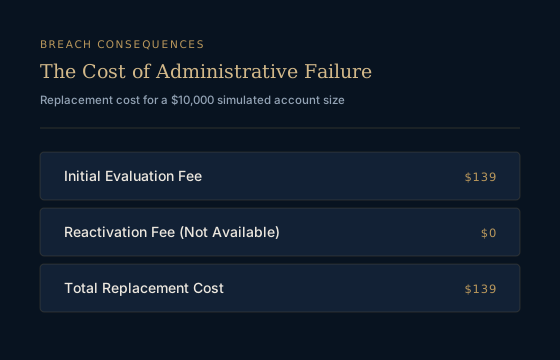
For a clear example of how account pricing structures function in this context, Ordane publishes a transparent, fixed fee schedule for its simulated capital products. The fee is one-time: $59 for the $2,500 account, $139 for the $10,000 account, $299 for $25,000, $549 for $50,000 and $999 for $100,000. There are no recurring fees, no hidden tiers and no coupon games. Consequently, if a participant breaches a $10,000 simulated account strictly due to a 30-day lapse in activity, returning to the platform requires a completely new $139 payment at checkout. The firm does not issue refunds for dormant accounts.
Proprietary firms enforce these rigid administrative rules to maintain an active, engaged participant base that continually tests the simulated market environment. Active participants generate the necessary volume metrics and eventually participate in the payout cycle, which is itself governed by strict service level agreements that demand operational efficiency from the firm.
For example, Ordane commits to rigorous, legally binding payout timelines for compliant, active accounts. Every withdrawal request is approved, or denied in writing citing the exact rule breached by section number, within 24 clock hours. Under The Ordane Guarantee, a payout approved and not paid within 48 clock hours, not business hours, triggers automatic compensation: a 100 percent refund of the account fee, plus the payout owed in full. These strong protective mechanisms and guarantees only apply to active, compliant accounts in good standing, making strict adherence to all administrative guidelines, including the 30-day inactivity rule, an essential operational priority for any participant seeking to extract value from the proprietary trading industry. Review the Ordane Rulebook to see all rules and guarantees in writing.
FAQ
Does logging into the platform count as activity for The Funded Trader?
No. Simply logging into the trading platform is not sufficient to reset the inactivity timer; a new simulated trade must actually be executed. Risk engines require a filled market or limit order to reset the 30-day counter.
How many days of inactivity cause a breach at The Funded Trader?
The Funded Trader requires participants to place at least one simulated trade every 30 days to prevent their account from being breached due to inactivity.
How does the CFTC define a dormant account in regulated markets?
In regulated traditional markets, the Commodity Futures Trading Commission (CFTC) defines a dormant account as one that has not traded for a period of twelve months, contrasting with the much shorter inactivity windows enforced by proprietary trading firms.
Can I reactivate my account after an inactivity breach at The Funded Trader?
No. The Funded Trader requires participants to place at least one simulated trade every 30 days to prevent their account from being breached due to inactivity. Once breached, the account is permanently closed and cannot be reactivated.
Sources
- What is the Inactivity Rule? | The Funded Trader Help Center, retrieved 2026-09-05
- Federal Register / Vol. 71, No. 138 / Rules and Regulations (CFTC), retrieved 2026-09-05