Home · The Ordane Journal · Rules and Mechanics · Prop Firm Thin Liquidity Rules
Prop Firm Thin Liquidity Rules
Thin liquidity in prop firm trading is a market condition where trading volume drops significantly, causing the spread between bid and ask prices to mechanically expand. Ordane accounts operate on simulated capital. No live funds are traded and no deposits are accepted.
In one sentence: Thin liquidity periods expand spreads artificially, triggering automated risk engines to close prop firm accounts due to temporary equity drops, making avoidance or strict position sizing the only reliable defense.
Thin liquidity and rollover hours cause mechanical spread widening that triggers hidden prop firm daily loss limit breaches. When institutional volume drops between sessions, the order book thins out. This resulting spread expansion creates temporary equity drops, acting as a strict vulnerability for simulated accounts.
Many market participants are unaware of how automated risk engines process these off-market fluctuations. You follow the strategy, but a mechanical risk engine closes the account due to an equity spike caused by the spread, not the asset price. Everyone promises a smooth trading environment. Ordane published the contract, the reserve, and the penalty. Ordane sells one product, the Ordane Instant Account: direct access, no evaluation phase and no challenge, on simulated capital. The industry often obscures how trading limits are calculated, but understanding the underlying mechanics of market liquidity provides a direct defense against unexpected breaches.
What Is the Hidden Rule of Prop Firm Rollover Spreads?
The market is not a single, continuous entity with uniform characteristics throughout the day. It is a network of regional sessions that overlap and hand off volume. When that handoff is inefficient, the cost of participating in the market rises abruptly, directly impacting an account's available floating equity.
What Are Low Liquidity Hours?
Liquidity refers to the market's capacity to absorb large orders without significant price impact. High liquidity means many buyers and sellers are actively quoting tight prices. Low liquidity means the opposite. During this window, major banks and institutional market makers withdraw their active orders to reconcile their daily books.
The order book is composed of limit orders placed by market participants. The highest price a buyer is willing to pay is the bid, and the lowest price a seller is willing to accept is the ask. The difference between these two prices is the spread. During high liquidity periods, such as the overlap between the London and New York sessions, competition among market makers keeps this distance minimal. When the New York session closes at 5:00 PM EST, this intense competition vanishes. The remaining liquidity providers widen their quotes to protect themselves against unexpected price gaps, forcing retail traders to cross a much wider spread to enter or exit a position. The structural changes during this period include:
- Reduced active bids and asks across major currency pairs.
- Wider distance between the highest buyer and lowest seller.
- Increased mechanical risk for holding open positions.
This gap creates a temporary but severe expansion in the spread, affecting every retail platform connected to those data feeds.
Are There CFTC Warnings on Off-Market Spreads?
Regulators closely monitor the impact of these thin markets on retail execution. When the order book lacks depth, even a small market order can consume the available liquidity at the best price and slip to the next available tier. In a simulated environment, this slippage is replicated mechanically by the firm's trading platform. The risk engine does not pause during the rollover hour; it continues to mark positions to market based on the widened spread. If that calculation crosses a hard limit, the system acts immediately to terminate the evaluation or the funded stage.
Will Thin Liquidity Cost You Your Account?
Traders often assume that a position is safe as long as the asset's mid-price does not reach the stop-loss order. This assumption ignores how automated risk management systems operate. Prop firm rules evaluate account health based on floating equity, which includes the active spread of all open positions.
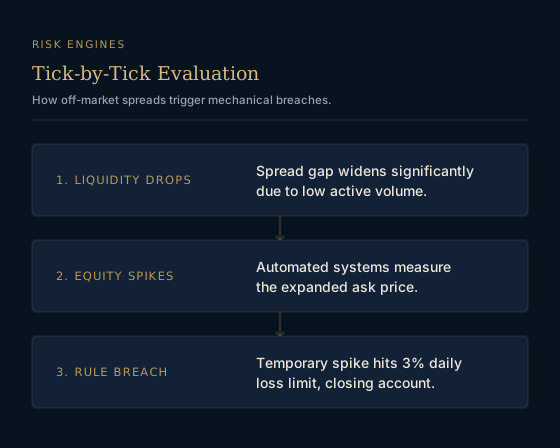
Daily Loss Limits vs. Equity Spikes
The interaction between thin markets and strict loss limits is a primary cause of unexpected account closures. If a trader holds a position into the rollover hour, the sudden spread expansion can cause a sharp, temporary drop in floating equity. If this drop breaches the firm's daily threshold, the account is terminated automatically, even if the spread normalizes minutes later and the trade ultimately becomes profitable.
Most risk engines operate on a tick-by-tick basis. They do not wait for a 1-minute or 5-minute candle to close before evaluating the account status. If a single tick registers an expanded ask price that pushes the floating loss beyond the daily limit, the system triggers a liquidation event instantly. This means that even a momentary spike in the spread lasting only a fraction of a second is enough to fail an evaluation or terminate an account. The underlying asset price could remain completely flat, yet the account is closed because the expanded spread briefly breached the mechanical equity threshold.
FTMO (prop firm) warns traders that spreads can widen significantly during the rollover hour (midnight CE(S)T) and advises caution or avoiding holding positions over this period. (FTMO, retrieved 2026-09-05) The rules must be defined clearly to prevent surprises.
The Ordane daily loss limit is 3 percent, measured against the balance at the start of the server day. A breach closes the account. (Ordane Rulebook v1.0, clause R-2, retrieved 2026-09-05)
Knowing exactly where the limit stands allows traders to calculate whether their positions can survive a typical rollover spread expansion.
Holiday and Asian Session Trading Restrictions
Because the risk of spread-induced breaches is high, some firms restrict trading entirely during known periods of low liquidity. Topstep (prop firm) restricts trading on specific market holidays due to low liquidity and high volatility risks, requiring traders to close positions before the holiday close. (Topstep, retrieved 2026-09-05) Traders must scrutinize the rulebook to understand whether holding a position is permitted or if it constitutes a direct violation. A closed list of prohibited practices provides clarity on what is actually allowed. Overnight and weekend holding is allowed at Ordane. It is not on the R-6 closed list, and what is not listed is not a violation. (Ordane Rulebook v1.0, clause R-6, retrieved 2026-09-05) Traders can maintain their positions through the rollover hour, provided their equity can absorb the temporary spread widening without breaching the daily or maximum loss limits.
What Is the Cost of Slippage During the Asian Session?
Spread widening and slippage are not just technical inconveniences; they carry a direct financial impact on the account's available margin and drawdown allowances. When the market is thin, the execution of stop-loss orders suffers, slipping to worse prices and pushing the account closer to a mechanical termination.
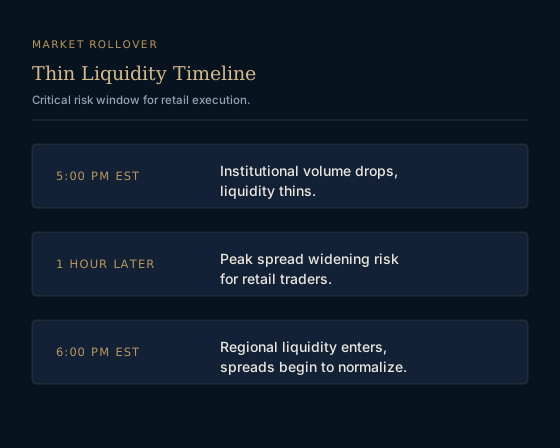
The critical period for spread widening is the transition window between major sessions.
| Market Phase | Time | Characteristic |
|---|---|---|
| New York Close | 5:00 PM EST | Institutional volume drops, liquidity thins. |
| Transition Window | 1 hour | Peak spread widening risk for retail traders. |
| Asian Session Resumes | 6:00 PM EST | Regional liquidity enters, spreads begin to normalize. |
Understanding this timeline is mandatory for any trader managing overnight positions. The artificial depth created by the spread counts against the account's total limits. Ordane's maximum drawdown is 5 percent and static: account equity may never fall below 95 percent of the initial balance. The floor is fixed on day one, never trails upward, and a breach closes the account. (Ordane Rulebook v1.0, clause R-1, retrieved 2026-09-05) A severe spread expansion during the transition window can push a borderline account below this static floor, executing a closure based purely on the temporary lack of market liquidity rather than an adverse price movement.
How Can You Avoid Rollover Breaches?
Protecting an account from off-market spread expansion requires structural discipline around trading hours. Traders cannot control the liquidity of the global currency markets, but they can strictly limit their exposure to it. Implementing a defensive routine around the rollover hour prevents mechanical risk engine breaches entirely.
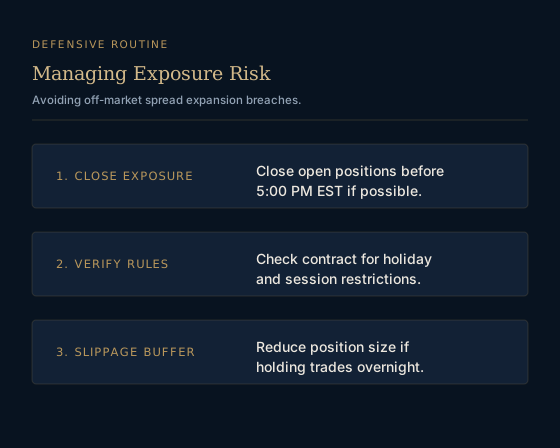
The first step is active exposure management. Close positions before 5:00 PM EST. Managing the time exposure is the direct defense against sudden spread widening. If the strategy does not require holding through the New York close, exiting the market entirely eliminates the risk of a rollover-induced equity spike.
The second step is verifying specific prop firm holiday and session restrictions. Check the governing contract to see if holding into a holiday violates a specific clause.
| Prop Firm Risk Policy | Rollover Stance | Source |
|---|---|---|
| FTMO | Advises caution or avoiding holding positions during midnight CE(S)T rollover. | (FTMO, retrieved 2026-09-05) |
| Topstep | Requires traders to be flat during specific holidays due to low liquidity. | (Topstep, retrieved 2026-09-05) |
The third step is using a wider slippage buffer if overnight holding is allowed. If the firm permits overnight holding, account for the expanded spread in the stop-loss calculation and position sizing. Reduce the position size so that an unexpected spread expansion does not mathematically breach the daily loss limit.
These defenses rely on the firm operating a transparent and predictable rulebook. Subjective enforcement creates an environment where any spread widening could be retroactively labeled as an exploit. Ordane's prohibited-practice list is closed. Clause R-6 names six practices: latency, reverse or hedge arbitrage; high-frequency or bulk automated exploitation; copy trading between Ordane accounts; straddling news releases with paired opposing orders; platform or data-feed exploitation; and gap abuse. If a behavior is not listed in that section, it is not a violation. Discretion is not a rule. (Ordane Rulebook v1.0, clause R-6, retrieved 2026-09-05) Traders manage their risk against the published numbers, not against discretionary interpretations. Furthermore, the payment mechanics must be as predictable as the trading rules. The Ordane Guarantee enforces this standard. A payout approved and not paid within 48 clock hours, not business hours, triggers automatic compensation: a 100 percent refund of the account fee, plus the payout owed in full. (Ordane Rulebook v1.0, clause G-1, retrieved 2026-09-05)
Understanding how an instant account works compared to an evaluation provides a clearer view of execution environments. Review the full trading specifications and limits directly in the Ordane Rulebook.
Prop Firm Low Liquidity FAQ
The mechanics of market liquidity directly affect the survival rate of simulated trading accounts. Understanding the definitions and consequences of these thin liquidity periods is a strict requirement for maintaining access to the platform and avoiding unnecessary violations caused by temporary off-market spread expansions.
What is thin liquidity in prop firm trading?
Thin liquidity refers to periods where market trading volume drops significantly, causing the gap between the bid and ask price to widen. This mechanical expansion can trigger automated risk limits in prop firm accounts, even if the underlying asset price does not move. The lack of active buyers and sellers forces the order book to expand to find counterparties.
How does the rollover hour affect prop firm accounts?
During the rollover hour, spreads widen significantly, temporarily reducing available floating equity. FTMO (prop firm) warns traders that spreads can widen significantly during the rollover hour (midnight CE(S)T) and advises caution or avoiding holding positions over this period. (FTMO, retrieved 2026-09-05) This temporary equity reduction can trigger a daily loss limit breach mechanically.
Why do spreads widen during the Asian session?
Spreads widen because institutional participants withdraw their active orders to reconcile their books. The reduced volume naturally creates wider pricing gaps.
Can low liquidity cause a prop firm breach?
Yes, low liquidity is a common cause of unexpected breaches. The automated risk engines monitor floating equity, and a severe spread widening counts as an active loss until the market normalizes.
How can I avoid spread widening during rollover?
The most reliable method is to close active positions before the New York session ends. If the strategy requires holding overnight, traders must reduce their position sizes to ensure the account equity has enough buffer to absorb the temporary spread expansion without hitting the maximum daily loss limit.
Questions traders ask about thin liquidity and rollover breaches
What is thin liquidity in prop firm trading?
Thin liquidity refers to periods where market trading volume drops significantly, causing the gap between the bid and ask price to widen. This mechanical expansion can trigger automated risk limits in prop firm accounts, even if the underlying asset price does not move. The lack of active buyers and sellers forces the order book to expand to find counterparties.
How does the rollover hour affect prop firm accounts?
During the rollover hour, spreads widen significantly, temporarily reducing available floating equity. FTMO warns traders that spreads can widen significantly during the rollover hour (midnight CE(S)T) and advises caution or avoiding holding positions over this period. This temporary equity reduction can trigger a daily loss limit breach mechanically.
Why do spreads widen during the Asian session?
Spreads widen because institutional participants withdraw their active orders to reconcile their books. The reduced volume naturally creates wider pricing gaps.
Can low liquidity cause a prop firm breach?
Yes, low liquidity is a common cause of unexpected breaches. The automated risk engines monitor floating equity, and a severe spread widening counts as an active loss until the market normalizes.
How can I avoid spread widening during rollover?
The most reliable method is to close active positions before the New York session ends. If the strategy requires holding overnight, traders must reduce their position sizes to ensure the account equity has enough buffer to absorb the temporary spread expansion without hitting the maximum daily loss limit.
Sources
- FTMO, on restrictions and warnings regarding trading during the rollover hour (midnight CE(S)T) when spreads widen significantly. ftmo.com, FAQ: Are there any restrictions on my trading? Retrieved 2026-09-05.
- Topstep, on holiday trading schedule and restrictions on trading during specific market holidays due to low liquidity and high risk. help.topstep.com, Holiday Trading Schedule Retrieved 2026-09-05.
- Ordane Rulebook v1.0, clause R-1, on the 5 percent static maximum drawdown measured from initial balance. ordanemarkets.com/rulebook Retrieved 2026-09-05.
- Ordane Rulebook v1.0, clause R-2, on the daily loss limit calculation and account closure mechanics. ordanemarkets.com/rulebook Retrieved 2026-09-05.
- Ordane Rulebook v1.0, clause R-6, on the closed list of prohibited trading practices and what constitutes a violation. ordanemarkets.com/rulebook Retrieved 2026-09-05.
- Ordane Rulebook v1.0, clause G-1, on the Ordane Guarantee and automatic compensation for unpaid approved payouts within 48 hours. ordanemarkets.com/rulebook Retrieved 2026-09-05.