Home · The Ordane Journal · Rules and Mechanics · Funded Trader: What the Term Really Means
Funded Trader: What the Term Really Means
A funded trader is a customer assigned an account stage or programme label by a proprietary trading firm; the contract, not the label, defines the customer's rights, status and trading environment.
Ordane accounts operate on simulated capital. No live funds are traded and no deposits are accepted.
In one sentence: A funded trader is a prop-firm customer whose account stage, trading environment, payment rights and legal status must be verified in the applicable contract rather than inferred from the title.
Ordane sells one product, the Ordane Instant Account: direct access, no evaluation phase and no challenge, on simulated capital.
The distinction between direct access and a staged challenge is explained in this comparison of instant accounts and evaluations.
What Is a Funded Trader, and Who Pays Them?
CONSOB identifies "funded trading" and "financed trading accounts" as names used for a commercial phenomenon involving companies that describe themselves as proprietary firms. The regulator treats funded as market vocabulary, not a legal status.
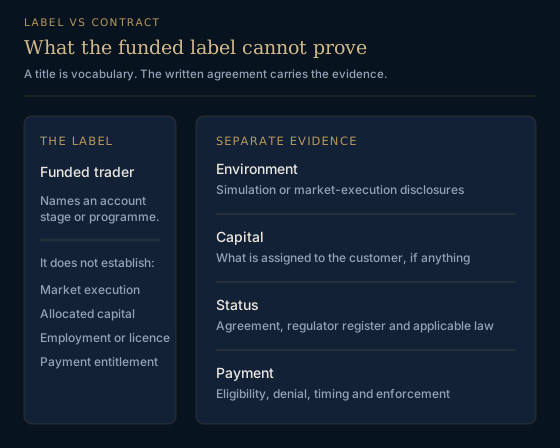
The label identifies an account stage or programme title. It does not establish employment, professional qualification, regulatory permission, allocated capital or market execution. Those questions require the written agreement and the applicable law.
Does funded mean that orders reach a real market?
No. Belgium's FSMA describes a model in which the consumer trades on a demo account and never places an actual trade. The firm may decide whether to reproduce one or more demo transactions on an actual platform.
CONSOB describes customers trading without their own capital in a simulated test environment through demo-type accounts opened with foreign prop firms.
Firm disclosures reach the same distinction. FTMO (prop firm) states that every client account it provides is a demo account with fictitious funds and that trading occurs only in a simulated environment.
Topstep (prop firm) identifies its Express Funded Account as part of a simulated trading programme operated by TopstepTrader, LLC. It assigns separate live proprietary trading services to TopstepFunded LLC.
United States regulation also separates simulated results from actual trading. The disclosure prescribed by 17 CFR 4.41 states that simulated or hypothetical results do not represent actual trading.
For the operational distinction, see how a simulated prop-firm account differs from a broker demo.
| Question | What the funded label establishes | What requires separate evidence |
|---|---|---|
| Do orders reach a market? | Nothing about execution | Account-environment and execution disclosures |
| Is capital allocated to the customer? | Nothing about capital assignment | The contract and account disclosures |
| Is the customer licensed or employed? | No professional or employment status | The agreement, regulator register and applicable law |
| Is payment owed? | No payment entitlement by itself | Eligibility, denial, timing and enforcement clauses |
How is a payout agreement different from trading capital?
A firm may calculate a payment from simulated performance without placing the customer's trades in a real market. Payment entitlement and execution environment are separate contract terms.
For the Ordane Instant Account, the payment mechanism is written into The Ordane Guarantee. Every withdrawal request is approved, or denied in writing citing the exact rule breached by section number, within 24 clock hours. Past that deadline the request is treated as approved and the G-1 clock starts.
A payout approved and not paid within 48 clock hours, not business hours, triggers automatic compensation: a 100 percent refund of the account fee, plus the payout owed in full.
These clauses identify the party owing payment, the decision deadline, the payment deadline and the consequence of delay. The funded-trader label identifies none of them. The separate approval and payment clocks behind a payout show what a timing claim must actually specify.
Which Rules Can Stop Someone Becoming Funded?
Passing a challenge may be only one gate
The5ers (prop firm) states that after a customer completes its evaluation and verification process, the firm may offer that customer the opportunity to become a Professional User. The offer remains discretionary. Its terms also state that supplying all requested verification information does not assure acceptance. The stated reasons can include legal restrictions or commercial considerations.
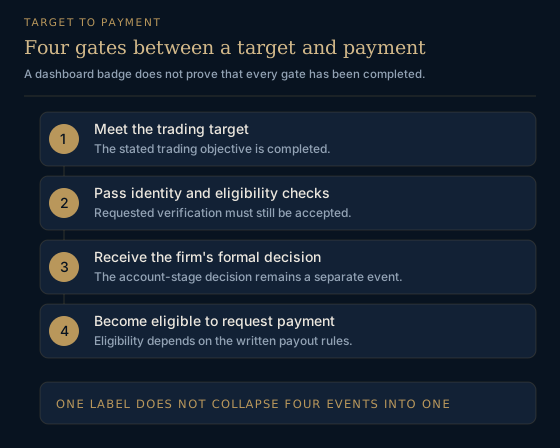
A reader should distinguish four events:
- Meeting the trading target.
- Passing identity and eligibility checks.
- Receiving the firm's formal account-stage decision.
- Becoming eligible to request payment under the written payout rules.
A dashboard badge is not evidence that all four events occurred.
Can repeated attempts increase the customer's cost?
Yes. CONSOB states that the challenges it examined were designed not to be easily passed and could increase in difficulty through further customer payments.
The FSMA warns that some consumers may never pass and states that firms earn money from those consumers.
Before paying, record the attempt fee, reset charge, activation charge, verification conditions and every event that could require another payment. Compare the complete path to payment eligibility, not only the advertised entry price. A full fee audit beyond the ticket price helps expose those additional charges.
Does the Funded-Trader Label Protect You if the Firm Disappears?
A brand name does not prove authorisation
The FCA maintains a Warning List entry for an entity named Funded Trader and states that the specifically identified firm may be providing or promoting financial services or products without FCA permission. The words in its brand name create no authorisation.
That warning concerns the entity and domain named in the FCA entry. It does not apply automatically to every business using the generic phrase. It shows why the exact legal entity and website must be checked.
Can a funded-account arrangement sit outside a regulator's complaint perimeter?
Yes. Spain's CNMV reported receiving questions and complaints about websites offering funded trading accounts.
The same notice states that the courses and account openings discussed did not fall within the CNMV's scope.
A regulator recognising the vocabulary does not prove that it supervises the contract, protects the payment or provides a complaint route.
What legal details should you verify?
Confirm the contracting company's full name, official registration record, address, applicable law and dispute process. Match those details across the checkout, terms, invoice and payment recipient. Use the company-verification process for official registers and identity mismatches before relying on a programme label.
Do not treat proprietary as a universal exemption. In the United States, 17 CFR 3.10 provides a specific registration carve-out for a person trading solely for proprietary accounts while leaving that person subject to the remaining provisions of the statute and rules.
That narrow carve-out concerns a firm's proprietary trading. It does not automatically define the legal status of a customer paying to enter an evaluation.
What Does It Cost to Become a Funded Trader?
There is no universal funded-trader price established by the verified sources used here. Fees differ by firm, programme, account size and date. The defensible amount is the figure in the current contract at purchase.
For comparison, the Ordane Instant Account has no evaluation phase. The fee is one-time: $59 for the $2,500 account, $139 for the $10,000 account, $299 for $25,000, $549 for $50,000 and $999 for $100,000. There are no recurring fees, no hidden tiers and no coupon games.
Repeated attempts can raise total exposure where a programme charges for new challenges. CONSOB connects further customer payments with access to challenges of increasing difficulty.
How Can You Test an Account-Size Claim?
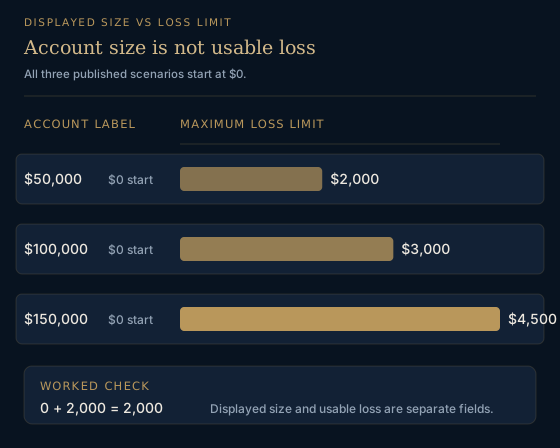
Topstep states that each Express Funded Account begins with a $0 balance. Its published maximum loss limits are $2,000 for a $50K account, $3,000 for $100K and $4,500 for $150K.
Declared inputs for this check: $0 starting balance, a $50,000 account-size label, and a $2,000 maximum loss limit. Worked arithmetic: 0 + 2,000 = 2,000.
The worked result shows why the displayed account size and the usable loss limit must be read as separate fields. It does not show $50,000 deposited into the account.
| Displayed account size | Starting balance | Maximum loss limit |
|---|---|---|
| $50,000 | $0 | $2,000 |
| $100,000 | $0 | $3,000 |
| $150,000 | $0 | $4,500 |
How Should You Read a Funded-Trader Offer?
Use this evidence sequence:
- Environment: Find the clause stating whether the account is simulated or connected to market execution.
- Transition: Separate the trading objective from verification and the firm's final account-stage decision.
- Economics: Add every attempt, reset, activation and verification charge that can occur before payment eligibility.
- Risk limits: Read the starting balance, maximum loss, daily loss, trailing rules and withdrawal effects separately from the account-size label.
- Payment: Locate the eligibility formula, request window, denial conditions, deadline and enforcement mechanism.
- Legal identity: Match the contracting entity to the regulator register, invoice and payment recipient.
- Version: Save the dated terms governing the purchase. The practical method is to preserve a dated copy of the rules before paying.
If any answer depends only on the word funded, the evidence check is incomplete.
Funded Trader FAQ
What is a funded trader?
A funded trader is a customer assigned an account stage or programme label by a prop firm. The contract defines the customer's actual rights and status.
Does a funded trader trade real money?
Not necessarily. Regulators and firm disclosures document funded-labelled programmes operating through simulated or demo accounts.
Is a funded trader an employee or licensed professional?
The label proves neither. The FSMA describes prop traders in the model it examined as consumers who completed a course, not authorised investment professionals.
Does passing a challenge guarantee advancement?
No. A firm may retain separate verification and acceptance gates after the trading objective is completed.
Does being funded guarantee a payout?
No. Payment depends on the applicable eligibility, verification, account-status, denial, timing and enforcement clauses. The account-stage label alone creates no payment term.
Before choosing an offer, review the Ordane account structure and verify every governing clause in the public rulebook.
Sources
- CONSOB communication to savers, Consob Informa Anno 30 N. 25, 8 luglio 2024, on the spread of funded trading and financed trading accounts. consob.it Retrieved 2026-08-28.
- FSMA warning on the shadow investment game, 7 March 2024, stating that consumers never make actual trades and firms decide execution. fsma.be Retrieved 2026-08-28.
- FTMO Terms and Conditions, stating all client accounts are demo accounts with fictitious funds. ftmo.com Retrieved 2026-08-28.
- Topstep Express Funded Account Rules, stating that Express Funded is a simulated programme operated by TopstepTrader, LLC, separate from live services operated by TopstepFunded LLC. topstep.com Retrieved 2026-08-28.
- 17 CFR 4.41, Cornell Legal Information Institute, on prescribed wording for simulated or hypothetical performance results. law.cornell.edu Retrieved 2026-08-28.
- The5ers Terms and Conditions, on discretionary Professional User offer after evaluation and verification. the5ers.com Retrieved 2026-08-28.
- FCA Warning List entry for Funded Trader, dated 12 August 2025, on the entity providing or promoting financial services without FCA permission. fca.org.uk Retrieved 2026-08-28.
- CNMV investor notice, 6 June 2019, on queries and complaints regarding cuentas de trading financiadas and stating they fall outside CNMV scope. cnmv.es Retrieved 2026-08-28.
- 17 CFR 3.10, Cornell Legal Information Institute, on the registration carve-out for proprietary-trading-only persons. law.cornell.edu Retrieved 2026-08-28.
- Ordane Rulebook v1.0, section 1, on Ordane Instant Account fees and terms. ordanemarkets.com/rulebook Retrieved 2026-08-28.