Home · The Ordane Journal · Payouts · Prop Firm Payout Invoice: Approval vs Transfer
Prop Firm Payout Invoice: Approval vs Transfer
A prop firm payout invoice is an internal accounting record confirming the firm approved a withdrawal request, not a proof of bank transfer. Ordane accounts operate on simulated capital. No live funds are traded and no deposits are accepted.
The actual payment clock starts only after this invoice is generated, and traders must track external bank receipts to measure the true transfer timeline. Traders often confuse the approval of an invoice with the execution of a wire transfer. This confusion creates blind spots in tracking payments.
Ordane sells one product, the Ordane Instant Account: direct access, no evaluation phase and no challenge, on simulated capital. Understanding the gap between approval and transfer protects you from empty promises. The prop firm industry relies heavily on complex terminology to manage expectations. Firms create layered dashboards with multiple statuses like requested, under review, approved, invoiced, and paid. Each status change provides a psychological update to the trader, creating the illusion of progress even when the capital has not moved.
This operational opacity allows firms to hold funds longer while appearing responsive. You must look past the dashboard graphics and demand verifiable proof of transmission. If a firm controls the dashboard, they control the narrative. The only truth in financial transactions is the movement of capital across external banking rails.
The industry operates on varied timelines and definitions. Some firms consider a payout complete the moment they click approve in their internal dashboard. Others recognize that the process is only complete when the funds land in your account. The governing document is Ordane Rulebook v1.0, published 23 July 2026. The market requires objective metrics to measure these processes, relying on verifiable rules rather than marketing statements.
To evaluate a firm, you must look at their binding contracts. Everyone promises. Ordane published the contract, the reserve, and the penalty. When you request a withdrawal, the sequence of events determines your legal standing. The internal invoice is simply step one.
When is the Payout Invoice Actually Generated?
The payout invoice is generated at the end of the review cycle, serving as the official bridge between your trading performance and the firm's accounting department. It only materializes after compliance teams verify that no rules were broken during the trading period, acting as an internal green light.
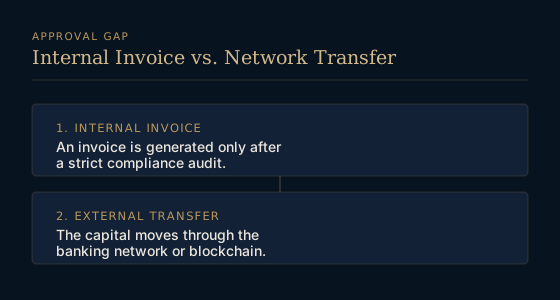
When you submit a withdrawal request, the firm initiates a compliance audit to confirm all first withdrawal conditions are met. This audit reviews your trades against their rulebook. They check for prohibited practices, consistency rule violations, and drawdown breaches. Only if your account passes this audit does the firm generate the payout invoice. In FTMO Futures' documented workflow, the payout invoice is confirmed only after FTMO approves the payout.
This step is strictly internal. The invoice generation means the risk department has handed the file to the finance department. The finance department then prepares the documentation required to initiate the transfer. MyFundedFutures says a trader making a first payout receives an agreement signing email after submitting the request. This administrative layer adds time to the process.
Firms use this period to prepare the funds. Many prop firms do not hold excess capital in their hot wallets. They must move capital from cold storage or secondary accounts to their primary disbursement accounts, a process dictated by the source of the firm's real capital. The invoice signals that this internal capital movement should begin. It does not mean the capital has already been sent to your bank.
The industry advertises the split. Ordane publishes the reserve. Ordane's payout reserve is published at a public TRON address on ordanemarkets.com and in Rulebook v1.0 clause PR-1. The page carries a dated observed balance and states that the reserve is not a promise, it is an address. You can verify the capital exists before you even request a withdrawal.
A clear rulebook speeds up the invoice generation. If a firm has vague rules, the compliance audit takes longer. Discretionary reviews lead to delayed invoices. Ordane's prohibited practice list is closed. Clause R-6 names six practices: latency, reverse or hedge arbitrage, high-frequency or bulk automated exploitation, copy trading between Ordane accounts, straddling news releases with paired opposing orders, platform or data-feed exploitation, and gap abuse. If a behavior is not listed in that section, it is not a violation. Discretion is not a rule.
Ordane's consistency rule is 20 percent: at the moment of a withdrawal request, no single trading day may account for more than 20 percent of the cycle's total profit. If a day exceeds 20 percent, the excess profit from that day is deferred to the next cycle. It is never confiscated, and the remainder of the cycle pays out normally. This transparent mathematical formula prevents subjective denials. The compliance team simply calculates the daily profit ratios. If the math clears, the invoice is generated.
Furthermore, Ordane's maximum drawdown is 5 percent and static: account equity may never fall below 95 percent of the initial balance. The floor is fixed on day one, never trails upward, and a breach closes the account. Because the rules are absolute and measured electronically, the audit phase is fast. Firms that use trailing drawdowns or hidden consistency metrics often spend days manually reviewing trades to find a reason to deny the invoice. A static rulebook removes the manual bottleneck.
Because the list is closed, the audit is binary. The review process does not rely on subjective interpretations. Every withdrawal request is approved, or denied in writing citing the exact rule breached by section number, within 24 clock hours. Past that deadline the request is treated as approved and the G-1 clock starts. This strict timeline forces the invoice generation to occur promptly.
Does an Approved Invoice Mean the Money is Sent?
An approved invoice only means the firm has authorized the payment internally, not that the bank has processed the transfer. The money remains with the firm until their finance team instructs the payment processor, and banking networks add their own clearing delays before funds reach your account.
The gap between invoice approval and fund transmission is where many delays occur. Once the finance team receives the approved invoice, they must submit a batch of payments to their bank or payment gateway. This submission is subject to business hours, bank holidays, and processing queues. FTMO says a CFD Reward is typically sent within 1 to 2 business days after the invoice is approved.
Even after the firm clicks send, the payment processor takes over. If the firm uses a third party service, those platforms have their own internal compliance checks. They verify your identity and ensure the transfer complies with international regulations. FundedNext says its 24 hour processing period starts when the trader initiates the Performance Reward request.
Once the processor releases the funds, the banking network adds further delays. A SWIFT wire transfer can take several days to clear intermediary banks. SEPA transfers in Europe are faster but still depend on batch processing times. In Wise's tracker, "Transfer Sent" means Wise has sent the money to the recipient's bank, which must still process and deliver it.
Firms operate on different timelines. These compounding delays mean that an approved invoice on Monday might not result in cleared funds until Friday or later. The trader remains exposed to the firm's operational efficiency during this entire window.
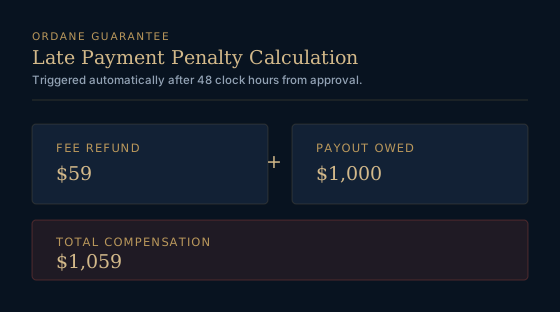
Ordane addresses this gap with a financial penalty applied to its own operations. A payout approved and not paid within 48 clock hours, not business hours, triggers automatic compensation: a 100 percent refund of the account fee, plus the payout owed in full. Declared inputs for this check: 59 (account fee refund), 1000 (payout owed), and 1059 (total compensation). Worked arithmetic: 59 plus 1000 equals 1059. The Ordane Guarantee enforces speed by making delays expensive for the firm.
This guarantee applies strictly. Both G-2 exclusions (documented fraud or KYC review, and declared force majeure) are capped at 10 business days each. Past that deadline, G-1 applies regardless. The firm cannot indefinitely suspend the process without triggering the penalty.
Ordane limits compounding variables by operating a strict payout calendar. The first withdrawal is available 7 calendar days after account activation, and the cycle thereafter is every 14 days. Withdrawals reduce the account balance, and the R-1 drawdown floor stays anchored to the initial balance. Ordane's profit split starts at 60 percent and rises 5 percentage points with every completed withdrawal, reaching 100 percent from the ninth withdrawal onward. The split ladder is in writing and never resets. Withdrawals number 1 and 2 are each capped at 3 percent of initial balance. From withdrawal number 3 onward there is no cap. These predictable structural rules allow the finance team to forecast liquidity needs accurately. When liquidity is forecasted correctly, the gap between invoice generation and payment execution shrinks. The firm does not need to scramble to fund the disbursement accounts, because the capital requirements were known days in advance.
Which Documents Prove the Transfer is Complete?
A valid proof of payment must originate from the bank or payment processor, containing specific transaction identifiers. Internal dashboard updates or screenshots of an approved invoice do not qualify as legal proof of transfer, as they lack the routing details necessary to trace the actual movement of funds.
When tracking a missing payment, traders often ask the firm for proof. Many firms provide a screenshot of their internal ledger showing the status as "Paid". This is insufficient. A true proof of payment must contain the sender's account details, the recipient's information, the exact amount, the date of execution, and a unique transaction reference number provided by the banking network.
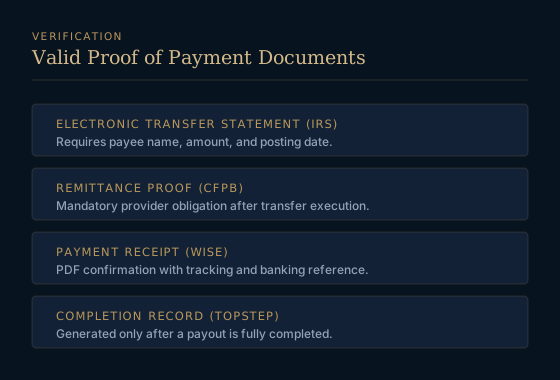
Regulatory bodies define exactly what constitutes proof. IRS Publication 583 says a financial account statement used to prove an electronic funds transfer should show the amount transferred, payee's name, and posting date. Without these fields, the document has no evidentiary value if a dispute arises.
Payment processors also distinguish between disclosures and actual receipts. For covered U.S. remittance transfers, a combined disclosure does not replace the provider's obligation to supply proof of payment after the sender completes the transfer.
Firms that use modern payment rails can generate these documents automatically. Wise makes its PDF transfer confirmation available for completed transfers and describes that document as a payment receipt. This document includes the tracking link and the banking reference required to trace a delayed wire.
Some prop firms have built their own completion records to provide clarity. Topstep's Proof of Payout card is generated only after a payout is completed, making it a completion record rather than a request stage record.
The table below outlines the documents that verify a transfer, based entirely on documented standards.
| Document Type | Regulatory or Provider Standard |
|---|---|
| Electronic Transfer Statement | IRS Publication 583 says a financial account statement used to prove an electronic funds transfer should show the amount transferred, payee's name, and posting date. |
| Remittance Proof | For covered U.S. remittance transfers, a combined disclosure does not replace the provider's obligation to supply proof of payment after the sender completes the transfer. |
| Payment Receipt | Wise makes its PDF transfer confirmation available for completed transfers and describes that document as a payment receipt. |
| Completion Record | Topstep's Proof of Payout card is generated only after a payout is completed, making it a completion record rather than a request stage record. |
When a firm uses crypto rails instead of traditional banking, the proof requirement shifts from bank statements to blockchain explorers. A transaction hash on a public ledger is the ultimate proof of payment, as it cannot be forged or altered by the firm. The hash shows the exact timestamp, the sender address, the recipient address, and the precise amount of tokens transferred.
Ordane embraces this transparency. Payouts are paid in real money from company fee revenue. No client deposits are taken and no client capital is traded. Rulebook v1.0 clause PR-1 commits Ordane to publish the payout reserve on-chain; the live rulebook and homepage publish the TRON address. By utilizing transparent ledger technology, the firm removes the ambiguity of traditional banking delays. You do not need to ask support if the money was sent; you simply check the blockchain.
If a firm refuses to provide a verifiable network receipt and instead offers only an internal invoice, the funds have likely not left their accounts. Objective proof eliminates the need to trust support staff assurances. You must demand the transaction hash or the SWIFT MT103 document. Without them, the payment remains theoretical.
Prop Firm Payout Invoice FAQ
Traders frequently ask how to interpret different payment statuses and what documents are required to confirm a transaction. The answers below clarify the terminology used by prop firms and payment processors, helping you understand the exact stage of your withdrawal and what records you need to keep.
What is a prop firm withdrawal invoice?
A prop firm withdrawal invoice is an internal accounting document generated after the firm's compliance team approves your payout request. It signifies that your trading history has been reviewed, no rules were violated, and the finance department is now authorized to prepare your payment. It is not a receipt of transfer.
What happens after a payout approved invoice?
After a payout invoice is approved, the firm's finance department batches the payment instruction and sends it to their payment processor or bank. The processor conducts mandatory Know Your Customer checks and anti-money laundering screenings. Once cleared, the processor executes the transfer through the banking network.
What are the prop firm payout processing steps?
The standard processing steps include the initial request submission, the compliance audit of your trading history, the generation of the internal invoice, the transfer of instructions to the payment gateway, the processor's security screening, the execution of the wire or crypto transfer, and the final network clearing.
Does a bank invoice mean the payout is complete?
No, a bank invoice or an internal firm invoice does not mean the payout is complete. An invoice only documents the intention or the authorization to pay. A payout is only complete when the funds are accessible in your personal bank account or crypto wallet.
Which payout documents prove the clock started?
The only documents that prove the payment clock has started are external network receipts provided by the banking system or the payment processor. These include SWIFT MT103 documents, blockchain transaction hashes, or formal transfer confirmation PDFs from services like Wise or Deel.
Sources
- FTMO. How do I withdraw my payout from a Sim-Funded Account? Retrieved 3 Sep 2026
- FTMO. How do I withdraw my reward? Retrieved 3 Sep 2026
- FundedNext. What is the timeframe for FundedNext to process Performance Rewards? Retrieved 3 Sep 2026
- MyFundedFutures. Guide to Your First Payout: Quick and Easy Process. Retrieved 3 Sep 2026
- Topstep. Payout Policy. Retrieved 3 Sep 2026
- CFPB. 12 CFR 1005.31 Disclosures. Retrieved 3 Sep 2026
- IRS. Publication 583. Starting a Business and Keeping Records. Retrieved 3 Sep 2026
- Wise. How do I check my transfer's status? Retrieved 3 Sep 2026
- Wise. How do I download a transfer confirmation? Retrieved 3 Sep 2026
- Ordane Rulebook v1.0 Retrieved 5 Sep 2026
This article is for information only and is not investment, financial, or tax advice. Ordane accounts operate on simulated capital. No live funds are traded and no deposits are accepted. Payouts depend on simulated performance under Rulebook v1.0; no level of performance is typical or assured.